


US commandos killed a senior Islamic State group leader in a nighttime raid into Syria, US officials said on Saturday, as the Muslim extremists seized the northern part of Syria’s ancient desert city of Palmyra.
Across the border, the Islamic State battled Iraqi army reinforcements in the strategic western city of Ramadi, while Turkey said its armed forces had shot down a Syrian helicopter that had violated its airspace.
US President Barack Obama approved the special forces raid on al-Omar in east Syria on Friday night to capture senior Islamic State leader Abu Sayyaf and his wife Umm Sayyaf, the US government said.
The bold operation, with elite commandos striking at the Islamic State’s inner circle, was a rare use of “boots on the ground” by the US, which has fought the militants almost entirely from the air.
White House national security spokeswoman Bernadette Meehan said Abu Sayyaf, who played a senior role in the Islamic State’s lucrative oil operations, “was killed when he engaged US forces.” His wife was being held in military detention in Iraq, while a young Yezidi woman, who appears to have been held as a slave by the couple, has been freed.
Al-Omar, one of the largest oilfields in Syria, is in oil-rich Deir Ezzor Governorate, much of which is controlled by extremists.
US Secretary of Defense Ashton Carter called the operation a “significant blow” to the Islamic State, while Adam Schiff, a Democrat on the US House of Representatives intelligence committee, said US attacks “have put increasing pressure on the economics undergirding the terrorist organization.”
Meehan said US forces based out of Iraq conducted the raid “with the full consent” of the Iraqi authorities. They suffered no casualties, officials said, without giving details on the number involved.
Members of the US’ elite Delta special operations unit descended on Sayyaf’s compound in Black Hawk helicopters and Osprey tilt-rotor aircraft, a defense official told reporters.
US troops killed “about a dozen” militants in a gun battle before fighting them “at very close quarters... there was hand-to-hand combat,” the official said, speaking on condition of anonymity.
Damascus, which Washington did not say it consulted, said the Syrian army had killed the Islamic State’s “oil minister” in al-Omar, naming him as Abu al-Taym al-Saudi. A Syrian military source would not confirm if this was a reference to another man or Abu Sayyaf.
News of the raid comes the day after Washington authorized sending weapons to the Iraqi military after the Islamic State made key territorial gains, seizing a government compound in the strategic Iraqi city of Ramadi.
Fighters have also taken over the northern neighborhoods of the Syrian city of Palmyra following an assault on the ancient metropolis that has seen them execute 49 people in two days, a monitoring group said.
“IS advanced and took control of most of northern Palmyra, and there are fierce clashes happening now,” Syrian Observatory for Human Rights director Rami Abdel Rahman said.
The head of Syria’s antiquities department, Mamoum Abdulkarim, voiced extreme concern for the UNESCO world heritage site located to Palmyra’s southwest.
“I am living in a state of terror,” Abdulkarim told reporters, adding that the Islamic State “will blow everything up. They will destroy everything” if they enter the site.
Fearing the destruction of Palmyra, known as the “pearl of the desert,” UNESCO has called on the UN Security Council to act to save one of the Middle East’s historic treasures.
Meanwhile in northwest Syria, at least 48 civilians including nine children were killed on Saturday in regime air raids on Idlib Governorate, the observatory said.
It said the air strikes targeted the rebel-held city of Idlib and the towns of Saraqeb and Kafr Awid.
Separately, Turkey’s defense ministry said its armed forces shot down a Syrian helicopter that violated Turkish airspace on Saturday.
“A Syrian helicopter was downed that violated the border for a period of five minutes within a seven mile [11km] limit,” Turkish Minister of National Defense Ismet Yilmaz said, quoted by the Dogan news agency.
Turkish Prime Minister Ahmet Davutoglu told Turkish television channel Star TV the episode served to show Syrian President Bashar al-Assad that “whoever you are, if you violate our border, you will be punished.” Syrian state television had earlier indicated the aircraft was a drone and vehemently denied it could have been a manned aircraft.
In Iraq, the Islamic State tightened its siege on the last government positions in Ramadi, the capital of the al-Anbar Governorate west of Baghdad, a day after they seized the city’s government headquarters.
Taking the city would be the group’s most important victory this year in Iraq, and would give it control of the capitals of two of its largest regions, along with Mosul in Nineveh Governorate.
Al-Anbar extends from the Syrian, Jordanian and Saudi Arabian borders to the gates of Baghdad.
Military reinforcements have been sent to Ramadi and other parts of al-Anbar, local officials said, and Iraq’s army and the US-led coalition have struck Islamic State positions in the area.

China’s military news agency yesterday warned that Japanese militarism is infiltrating society through series such as Pokemon and Detective Conan, after recent controversies involving events at sensitive sites. In recent days, anime conventions throughout China have reportedly banned participants from dressing as characters from Pokemon or Detective Conan and prohibited sales of related products. China Military Online yesterday posted an article titled “Their schemes — beware the infiltration of Japanese militarism in culture and sports.” The article referenced recent controversies around the popular anime series Pokemon, Detective Conan and My Hero Academia, saying that “the evil influence of Japanese militarism lives on in

DIPLOMATIC THAW: The Canadian prime minister’s China visit and improved Beijing-Ottawa ties raised lawyer Zhang Dongshuo’s hopes for a positive outcome in the retrial China has overturned the death sentence of Canadian Robert Schellenberg, a Canadian official said on Friday, in a possible sign of a diplomatic thaw as Canadian Prime Minister Mark Carney seeks to boost trade ties with Beijing. Schellenberg’s lawyer, Zhang Dongshuo (張東碩), yesterday confirmed China’s Supreme People’s Court struck down the sentence. Schellenberg was detained on drug charges in 2014 before China-Canada ties nosedived following the 2018 arrest in Vancouver of Huawei chief financial officer Meng Wanzhou (孟晚舟). That arrest infuriated Beijing, which detained two Canadians — Michael Spavor and Michael Kovrig — on espionage charges that Ottawa condemned as retaliatory. In January

A sign hanging from a rusty ice-green shipping container installed by Thai forces on what they say is the border with Cambodia reads: “Cambodian citizens are strictly prohibited from entering this area.” On opposite sides of the makeshift barricade, fronted by coils of barbed wire, Cambodians lamented their lost homes and livelihoods as Thailand’s military showed off its gains. Thai forces took control of several patches of disputed land along the border during fighting last year, which could amount to several square kilometers in total. Cambodian Kim Ren said her house in Chouk Chey used to stand on what is now the Thai
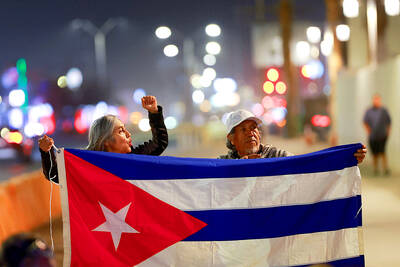
NEW RULES: There would be fewer school days, four-day workweeks, and a reduction in transportation services as the country battles a crisis exacerbated by US pressure The Cuban government on Friday announced emergency measures to address a crippling energy crisis worsened by US sanctions, including the adoption of a four-day work week for state-owned companies and fuel sale restrictions. Cuban Deputy Prime Minister Oscar Perez-Oliva Fraga blamed Washington for the crisis, telling Cuban television the government would “implement a series of decisions, first and foremost to guarantee the vitality of our country and essential services, without giving up on development.” “Fuel will be used to protect essential services for the population and indispensable economic activities,” he said. Among the new measures are the reduction of the working week in


 RSS
RSS