


The Chinese Ministry of Environmental Protection has refused approval for a hydropower dam on an ecologically vulnerable river already damaged by construction, a rare setback for the country’s extensive dam-building program.
While the 1,000-megawatt Xiaonanhai project appears scrapped, experts said China’s overall plan for dams was on course, given pressure to cut smog from coal-fired power plants.
Hydropower capacity is due to rise another 60 gigawatts (GW) in five years as new projects get approved.
The ministry said in a document sent to Three Gorges Project Corp and seen by Reuters that the firm could not plan or build the project on the Jinsha River, the upstream section of the Yangtze, in the southwest.
“In the past 10 years, two investigations have been carried out into construction in precious and unique national protection zones for fish in the lower reaches of the Jinsha River, and the structure and function of the zones have already been heavily impacted,” the ministry said in the document.
“Your company, as well as other units, cannot plan or build the Xiaonanhai hydropower plant,” it said.
Officials at Three Gorges Project Corp were not available for comment and telephone calls went unanswered.
Environmentalists said the blocking of a project once championed by the disgraced former Politburo member Bo Xilai (薄熙來) reflected a tougher stance on protecting rivers.
“We welcome the decision, particularly the recognition that Xiaonanhai dam would have pushed the Yangtze fish reserve past the ecological red line,” Grace Mang of the International Rivers group said.
Final approval for big hydropower plants goes to the State Council, China’s Cabinet, and hydropower advocates questioned the legal basis of the ministry document, an environmental impact assessment of the 10-gigawatt Wudongde plant, also on the Jinsha River.
“The State Council last year approved an overall development plan for the whole of the Yangtze river basin, and that plan cannot be guaranteed without building Xiaonanhai and other projects,” China Hydropower Society deputy secretary-general Zhang Boting (張博庭) said.
“If this company doesn’t build, then another might have to, because this is a state planning requirement,” he said.
China’s dam program slowed after completion of the Three Gorges Project, the world’s biggest hydropower plant, about a decade ago, with leaders concerned about human, financial and environmental costs.
However, with an ambitious nuclear-power program delayed, a greater reliance on hydropower is seen as a good way to cut smog.
In other developments, a city government in southern China has revoked approval of a planned waste incinerator in response to protests, in the latest case of local authorities bowing to a public outcry over health concerns.
The Luoding City Government in Guangdong Province said in a statement on Wednesday that the project fit a national policy to encourage solid waste processing in the cement industry, but that it was canceled “in response to public demands.”
Thousands of residents fearful of pollution rallied on Monday and clashed with police the following day, the Global Times reported.
‘GROSS NEGLIGENCE?’ Despite a spleen typically being significantly smaller than a liver, the surgeon said he believed Bryan’s spleen was ‘double the size of what is normal’ A Florida surgeon who is facing criminal charges after allegedly removing a patient’s liver instead of his spleen has said he is “forever traumatized” by that person’s death. In a deposition from November last year that was recently obtained by NBC, 44-year-old Thomas Shaknovsky described the death of 70-year-old William Bryan as an “incredibly unfortunate event that I regret deeply.” Bryan died after the botched surgery; and last month, a grand jury in Tallahassee indicted Shaknovsky on a charge of manslaughter. “I’m forever traumatized by it and hurt by it,” Shaknovsky added, also saying that wrong-site surgeries can happen “during

Former Chinese ministers of national defense Wei Fenghe(魏鳳和) and Li Shangfu (李尚福) were both sentenced to death with a two-year reprieve over graft charges, state news agency Xinhua reported on Thursday, underscoring the severity of the purge in the military. The armed forces have been one of the main targets of a broad corruption crackdown ordered by Chinese President Xi Jinping (習近平) after coming to power in 2012. The purges reached the elite Rocket Force, which oversees nuclear weapons as well as conventional missiles, in 2023. Earlier this year they escalated further, resulting in the removal of the top general in
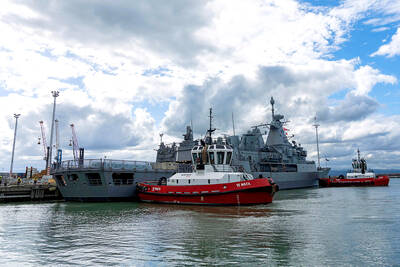
New Zealand is open to expanding its frigate fleet beyond its current two vessels, with New Zealand Minister of Defence Chris Penk saying “no options are off the table” as the government weighs buying new warships from Japan or the UK. The government yesterday said it is looking to replace its two aging Anzac-class frigates, which were both commissioned almost 30 years ago. The UK’s Type 31 and Japan’s Mogami-class warships are the options under consideration. Speaking in an interview, Penk said there is potential to increase the number of frigates the nation purchases. “We need a certain amount of capability as a

The Philippine Coast Guard yesterday said it deployed aircraft to issue radio warnings to a Chinese research ship in a disputed area of the South China Sea “swarming” with vessels from Beijing’s so-called maritime militia. The research vessel Xiang Yang Hong 33 (向陽紅33), which is capable of supporting submersible craft, was operating near a reef in the contested Spratly Islands (Nansha Islands, 南沙群島), which Taiwan also claims, the Philippine Coast Guard said. The Chinese ship was deploying a service boat toward the Spratly’s Iroquois Reef on Wednesday when it was spotted by a coast guard plane, “confirming ongoing unauthorized [marine scientific research]


 RSS
RSS