


Revelations that AirAsia Flight QZ8501 climbed too fast before stalling and plunging into the sea point to “striking” similarities between the Java Sea accident and the 2009 crash of an Air France jet, analysts said yesterday.
Indonesian Transport Minister Ignasius Jonan said the Airbus A320-200 was ascending at a rate of 1,800m a minute before stalling, as it flew in stormy weather last month from Indonesia’s Surabaya to Singapore.
“In the final minutes, the plane climbed at a speed which was beyond normal,” Jonan told reporters on Tuesday.
That ascent is about two to three times the normal climb rate for a commercial jet, according to experts.
Indonesian divers recovered the plane’s black boxes a week ago, after an arduous search for the jet that crashed on Dec. 28 last year with 162 people on board. The cockpit voice recorder and the flight data recorder are now being analyzed, with a preliminary report due next week.
While they stressed the difficulty of drawing conclusions without seeing the full black box data, analysts said the accident had strong echoes of the crash of Air France Flight AF447 into the Atlantic in 2009, with the loss of 228 lives.
“The similarities are pretty striking,” said Daniel Tsang, founder of Hong Kong-based consultancy Aspire Aviation.
In that case, the Airbus A330 en route from Rio de Janeiro to Paris vanished at night during a storm.
The aircraft’s speed sensors were found to have malfunctioned and the plane climbed too steeply, causing it to stall. As with the AirAsia disaster, the accident happened in what is known as the “intertropical convergence zone,” an area around the equator where the north and south trade winds meet, and thunderstorms are common.
The investigation into AF447 found that both technical and human error were to blame. After the speed sensors froze and failed, the pilots failed to react properly, according to the French aviation authority, who said they lacked proper training.
Jonan on Tuesday likened the doomed plane’s ascent to a fighter jet, although experts noted that warplanes can climb considerably faster.
However, Tom Ballantyne, Sydney-based chief correspondent for Orient Aviation magazine, said the rate of climb of the AirAsia jet was “just phenomenal,” adding: “I’m not sure I’ve heard of anything that dramatic before.”
He said it would be unusual for weather alone to cause such a rapid ascent, but added it was possible if the jet hit “some bizarre unprecedented storm cell.”
“It is possible that the aircraft could have got caught in some sort of updraft that lifted it thousands of feet,” he said.
However, while saying the rapid ascent showed that there was “something very wrong,” Gerry Soejatman, a Jakarta-based independent aviation analyst, added it was too early to have a firm read on the cause of the crash.
“Although there are similarities with Air France, and the weather seems to be a factor, we can’t make any conclusions that this is caused by the weather or icing — it’s too early,” Soejatman said.
Nevertheless, Tsang said the probe was unfolding as analysts had predicted, with no explosions or loud bangs registered on the cockpit voice recorder, and therefore no indication terrorism played a role.
The Indonesian National Transportation Safety Committee, which is probing the crash, this week said they are now focusing on human or aircraft error as probable causes, after analyzing the data from the cockpit recorder.
A huge international hunt for the crashed plane, involving ships from several nations, including the US and China, finally located the wreckage at relatively shallow depth in the Java Sea.
Indonesian search and rescue teams have so far recovered just 53 bodies.
All but seven of those on board the flight were Indonesian. The foreign nationals were from South Korea, Singapore, Malaysia, Britain and France.
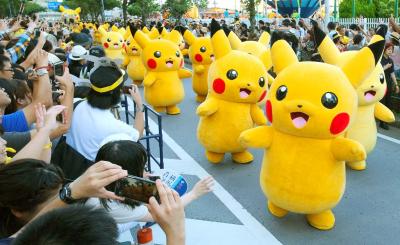
China’s military news agency yesterday warned that Japanese militarism is infiltrating society through series such as Pokemon and Detective Conan, after recent controversies involving events at sensitive sites. In recent days, anime conventions throughout China have reportedly banned participants from dressing as characters from Pokemon or Detective Conan and prohibited sales of related products. China Military Online yesterday posted an article titled “Their schemes — beware the infiltration of Japanese militarism in culture and sports.” The article referenced recent controversies around the popular anime series Pokemon, Detective Conan and My Hero Academia, saying that “the evil influence of Japanese militarism lives on in

DIPLOMATIC THAW: The Canadian prime minister’s China visit and improved Beijing-Ottawa ties raised lawyer Zhang Dongshuo’s hopes for a positive outcome in the retrial China has overturned the death sentence of Canadian Robert Schellenberg, a Canadian official said on Friday, in a possible sign of a diplomatic thaw as Canadian Prime Minister Mark Carney seeks to boost trade ties with Beijing. Schellenberg’s lawyer, Zhang Dongshuo (張東碩), yesterday confirmed China’s Supreme People’s Court struck down the sentence. Schellenberg was detained on drug charges in 2014 before China-Canada ties nosedived following the 2018 arrest in Vancouver of Huawei chief financial officer Meng Wanzhou (孟晚舟). That arrest infuriated Beijing, which detained two Canadians — Michael Spavor and Michael Kovrig — on espionage charges that Ottawa condemned as retaliatory. In January

A sign hanging from a rusty ice-green shipping container installed by Thai forces on what they say is the border with Cambodia reads: “Cambodian citizens are strictly prohibited from entering this area.” On opposite sides of the makeshift barricade, fronted by coils of barbed wire, Cambodians lamented their lost homes and livelihoods as Thailand’s military showed off its gains. Thai forces took control of several patches of disputed land along the border during fighting last year, which could amount to several square kilometers in total. Cambodian Kim Ren said her house in Chouk Chey used to stand on what is now the Thai
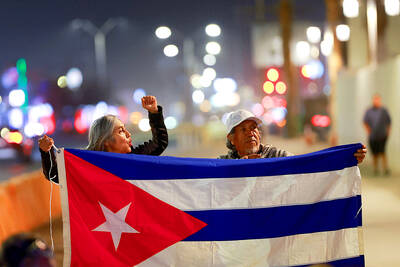
NEW RULES: There would be fewer school days, four-day workweeks, and a reduction in transportation services as the country battles a crisis exacerbated by US pressure The Cuban government on Friday announced emergency measures to address a crippling energy crisis worsened by US sanctions, including the adoption of a four-day work week for state-owned companies and fuel sale restrictions. Cuban Deputy Prime Minister Oscar Perez-Oliva Fraga blamed Washington for the crisis, telling Cuban television the government would “implement a series of decisions, first and foremost to guarantee the vitality of our country and essential services, without giving up on development.” “Fuel will be used to protect essential services for the population and indispensable economic activities,” he said. Among the new measures are the reduction of the working week in


 RSS
RSS