


The toll in the Ebola epidemic has risen to 5,420 deaths out of 15,145 cases in eight countries, the WHO said on Wednesday, with transmission of the deadly virus still “intense and widespread” in Sierra Leone.
The figures, through Sunday, represent a jump of 243 deaths and 732 cases since those issued on Friday last week, and cases continue to be under-reported, the WHO said in its latest update.
Sierra Leone confirmed 533 new cases in the week to Sunday, the WHO said, accounting for much of the increase. It also reported 63 deaths since Friday last week.
“Much of this was driven by intense transmission in the country’s west and north,” the WHO said.
The capital, Freetown, which accounted for 168 new confirmed cases, and nearby Port Loko were particularly hard hit.
A Cuban doctor infected with Ebola in Sierra Leone will be flown to Switzerland for hospitalization in Geneva, Swiss health authorities said on Wednesday. He is the first Cuban known to have contracted the disease.
The outbreaks in Guinea and Liberia currently appear to be driven by intense transmission in several key districts, the WHO said, citing N’Zerekore and Macenta in Guinea and Montserrado in Liberia, which includes the capital, Monrovia.
In the three most affected countries — Guinea, Liberia and Sierra Leone — 1,159 beds are now operational in 18 Ebola treatment centers, or one-quarter percent of beds planned, according to the UN agency. However, only 13 percent of Ebola patients in Sierra Leone are in isolation, its figures show.
“As this number increases, so does the capacity to isolate patients and prevent further transmission of the disease,” it said.
Authorities in Mali have reported six Ebola cases including five deaths, the WHO said. All contacts of its first case, a two-year-old girl who died last month, have survived the 21-day incubation period.
The remaining cases were in Nigeria, Senegal, Spain and the US.
Liberian President Ellen Johnson Sirleaf on Wednesday said that her government has the upper hand in the fight against Ebola, but warned against complacency or any reduction in international support.
WHO said that in Liberia, 80 probable cases were reported in the week to Saturday last week.
“Nationally, on average, between 10 and 20 laboratory-confirmed cases are being reported each day,” the agency said.
NEW YORK TIMES
However, the New York Times yesterday reported that the global response to Ebola in Liberia is being hampered by poor coordination and serious disagreements between Liberian officials and the donors and health agencies fighting the epidemic.
The newspaper, citing minutes of top-level meetings and interviews with participants, said many confirmed cases still go unreported, countries refuse to change plans to erect field hospitals in the wrong places, families cannot find out whether their relatives in treatment are alive or dead, health workers sent to take temperatures sometimes lack thermometers, and bodies have been cremated because a larger cemetery was not yet open.
The detailed accounts of high-level meetings obtained by the Times, the most recent from Monday, lift the veil on the messy and contentious process of running the sprawling response to Liberia’s epidemic, one that now involves more than 100 government agencies, charities and donors from around the world.
Despite the problems, with help from donors, Liberia has seen new cases drop to about 20 a day from about 100 a day two months ago.
Experts attribute that to fearful Liberians touching one another less, more safe burials of bodies and distribution of protective gear to health care workers, but they warn that cases are now holding steady and could explode again.
In an interview with the Times, Hans Rosling, a Swedish epidemiologist and consultant to Liberia’s Health Ministry since last month, cited some of the problems not listed in the minutes.
One Asian and two European donor countries are insisting on building new Ebola field hospitals in Monrovia, where hospitals have empty beds, rather than in remote counties where beds are desperately needed; they insisted because they announced those plans two months ago, he said.
The national case count was not reported for two days recently because the government employee compiling it went unpaid and stopped working, he said.
The minutes make it clear that the accuracy of the national case count is shaky.
Despite problems, the response is going better than he had hoped, Rosling said. He compared it to Dunkirk, the hasty 1940 evacuation of British and French troops from France, which he described as “chaotic, but a success.”
Additional reporting by NY Times News Service

SPEAKING OUT: After Siranudh Scott’s allegations surfaced, celebrities and public figures took to social media to share their own experiences of sexual misconduct and abuse A high-profile alleged sexual abuse case within a wealthy Thai beer brewing family has prompted a wave of painful accounts from survivors of unconnected abuse in the conservative nation. Siranudh Scott, a member of the billionaire Thai family that founded the ubiquitous Singha beer brand, posted an emotional video this month accusing his elder brother Sunit of repeatedly abusing him when he was a teenager. Sunit, who is in his 30s, later denied the allegations in a video posted online, but Singha parent Boonrawd dismissed him from his executive role with the company on Tuesday last week. “I felt I needed to speak

SEEKING ORDER: Rodrigo Paz said that ‘anyone who wants to destroy the nation will have to deal with this president and the full force of the constitution’ Bolivian President Rodrigo Paz on Wednesday said that the nation was at a “breaking point” after nearly a month of protests that have caused shortages of food, fuel and medicine. Paz, who took office six months ago amid the worst economic crisis there in four decades, is battling a groundswell of fury over his policies. The political capital, La Paz, has been besieged by low-income workers and members of the indigenous majority calling for his resignation. “The country needs order and is reaching breaking point,” the 58-year-old said at a public event in La Paz, renewing his appeal for dialogue. On Tuesday, the Bolivian
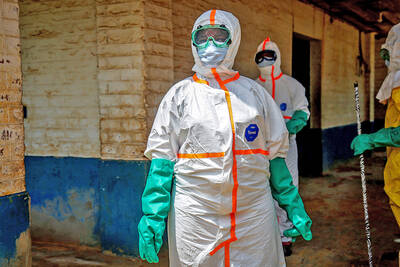
COMMUNITY CONFLICT: Concerns about disease spread from corpses has run up against friends and families’ desire to bury their dead as infection spreads in the area Angry residents of a town at the epicenter of the Ebola outbreak in the Democratic Republic of the Congo (DR Congo) attacked and burned a tent that was part of a health center where people are being treated for the virus, the staff there said Saturday. It was the second such attack in the region in a week. No one was hurt in the attack, according to reports but as patients ran out to escape the fire, 18 people with suspected Ebola infections fled the facility and are unaccounted for, a hospital director said. Angry residents arrived at the clinic in the
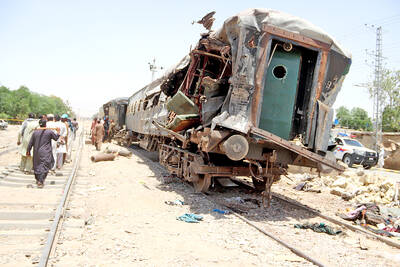
INSURGENT ACTION: A local independence movement in Balochistan, alleged by Pakistan’s government to be backed by India, claimed responsibility for the strike A suicide bomber detonated an vehicle-borne IED near a railway as a passenger train passed through the southwestern Pakistani city of Quetta yesterday, killing at least 23 people and wounding over 70, officials said. The explosion caused two of the train cars to overturn and catch fire, according to footage shared online. The attack happened in an area where security forces are usually stationed, badly damaging several nearby buildings and smashing more than a dozen vehicles parked along the road, according to witnesses and images circulating on social media. Doctors at local hospitals said they had received the wounded, with 20 in critical


 RSS
RSS