


Syrian President Bashar al-Assad made a rare public appearance on Saturday by attending prayers for a key Muslim holiday at a mosque in Damascus, hours after the US-led coalition carried out new airstrikes against the Islamic State (IS) group in Syria.
The airstrikes targeted Islamic State positions on Friday night in the eastern town of Shaddadeh, in the northeastern Syrian province of Hassakeh, a stronghold of the Islamic State, formerly known as the Islamic State of Iraq and the Levant.
The airstrikes caused casualties, activists said, with one group saying up to 30 Islamic State fighters were killed. It was the first time Shaddadeh was struck since the US-led campaign began nearly two weeks ago. There was no immediate confirmation by Washington.
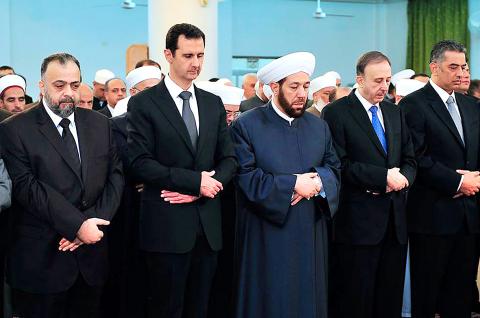
Photo: AFP
The US and five Arab allies launched a bombing campaign against the Islamic State in Syria on Sept. 23 with the aim of rolling back and ultimately crushing the group, which has created a proto-state spanning the border of Syria and Iraq.
The militants have also massacred captured Syrian and Iraqi troops, terrorized minorities in both countries and beheaded two American journalists and two British aid workers.
About 30 explosions were heard in and near Shaddadeh on Friday night, according to an activist in Hassakeh Province, who added that the targets included several buildings occupied by Islamic State fighters.
“There were deaths for sure,” said an activist who goes by the name Salar al-Kurdi. He spoke via Skype.
The UK-based Syrian Observatory for Human Rights, which relies on a network of activists around Syria, said as many as 30 fighters from the Islamic State group were killed in the airstrikes on Shaddadeh. It said all the dead were foreign fighters.
Meanwhile, intense fighting continued on the outskirts of Kobani, on the Syrian and Turkish border, where Islamic State fighters have been trying to capture the town, to open a direct link between their positions in the Syrian province of Aleppo, and their stronghold of Raqqa to the east.
Kobani and its surrounding areas have been under attack since mid-September, with militants capturing dozens of nearby Kurdish villages. The assault, which has forced about 160,000 Syrians to flee their homes, has left the Kurdish militiamen scrambling to repel the Islamic State’s advance into the outskirts of the town, also known in Arabic as Ayn Arab.
The Observatory said fighting on Saturday was focused on the southwestern edge of the town, adding that members of the Islamic State group were shelling Kobani.
From across the border in Turkey, the sound of heavy machine-gun fire could be heard coming from Kobani. It was not immediately clear if the Islamic State had entered the town itself, which is defended by fighters of the Kurdish People’s Protection Units.
Earlier on Friday, the US-led coalition had launched airstrikes near Kobani killing at least five Islamic State militants, according to the Observatory.
Kurdish Democratic Union Party spokesman Nawaf Khalil said the coalition airstrikes near Kobani had a “positive effect” and that the militants had failed to capture a strategic hill overlooking the town after five attacks.
In Turkey, a senior special forces police officer was wounded in the head by stray shrapnel from the fighting in Kobani, reported the private Dogan news agency. There was no immediate official confirmation of the incident. The news agency said the officer was being treated in hospital.
Also on the Turkish side, a group of about 200 activists marched toward the border with Syria on Saturday, chanting slogans in support of the Kurdish fighters in Kobani. Turkish troops stopped the group about 50m from the border, then fired tear gas to push them away from the frontier.
Meanwhile, Syrian state television aired footage of al-Assad praying on Saturday at the al-Numan Bin Bashir mosque in Damascus, along with government officials and the country’s Grand Mufti Ahmad Badreddine Hassoun as most Muslims around the world started celebrating the three-day holiday of Eid al-Adha.
During Syria’s civil war, which is now in its fourth year and which activists say has killed more than 190,000 people, al-Assad has been making rare public appearances.
He previously appeared in public in July, when he attended prayers for the Eid al-Fitr holiday, which marks the end of fasting during the Muslim holy month of Ramadan.
Also on Saturday, a mortar shell struck a park where families were celebrating Eid al-Adha in the northwestern city of Idlib, killing six people, including four children, state news agency SANA reported.
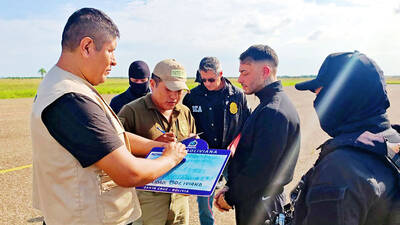
KINGPIN: Marset allegedly laundered the proceeds of his drug enterprise by purchasing and sponsoring professional soccer teams and even put himself in the starting lineups Notorious Latin American narco trafficker Sebastian Marset, who eluded police for years, was handed over to US authorities after his arrest on Friday in Bolivia. Marset, a Uruguayan national who was on the US most-wanted list, was passed to agents of the US Drug Enforcement Administration at Santa Cruz airport in Bolivia, then put on a US airplane, Bolivian state television showed. “The arrest and deportation were carried out pursuant to a court order issued by the US justice system,” Bolivian Minister of Government Marco Antonio Oviedo told reporters. The alleged kingpin was arrested in an upscale neighborhood of Santa
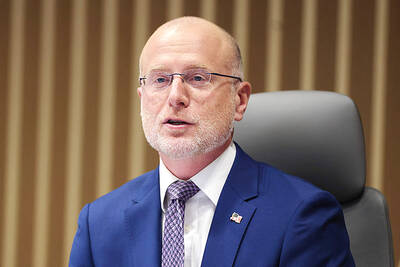
FAKE NEWS? ‘When the government demands the press become a state mouthpiece under the threat of punishment, something has gone very wrong,’ a civic group said The top US broadcast regulator on Saturday threatened media outlets over negative coverage of the Middle East war, after US President Donald Trump slammed critical headlines from the “Fake News Media.” The US president since his first term has derided mainstream media as “fake news” and has sued major outlets over what he sees as unfair coverage. Brendan Carr, head of the US Federal Communications Commission — which oversees the nation’s radio, television and Internet media — said broadcasters risked losing their licenses over news coverage. “The law is clear. Broadcasters must operate in the public interest, and they will
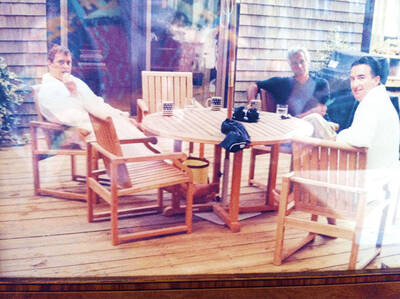
SCANDAL: Other images discovered earlier show Andrew bent over a female and lying across the laps of a number of women, while Mandelson is pictured in his underpants A photograph of former British prince Andrew and veteran politician Peter Mandelson sitting in bathrobes alongside late sex offender Jeffrey Epstein was unearthed on Friday in previously published documents. The image is believed to be the first known photograph of the two men with Epstein. They are currently engulfed in scandal in the UK over their ties to their mutual friend. The undated photograph, first reported by ITV News, shows King Charles III’s disgraced brother and former British ambassador to the US sitting barefoot outside on a wooden deck. They appear to have mugs with a US flag on them
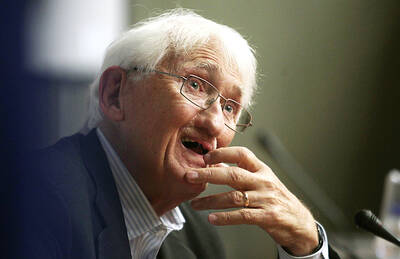
INFLUTENTIAL THEORIST: Habermas was particularly critical of the ‘limited interest’ shown by German politicians in ‘shaping a politically effective Europe Jurgen Habermas, whose work on communication, rationality and sociology made him one of the world’s most influential philosophers and a key intellectual figure in his native Germany, has died. He was 96. Habermas’ publisher, Suhrkamp, said he died on Saturday in Starnberg, near Munich. Habermas frequently weighed in on political matters over several decades. His extensive writing crossed the boundaries of academic and philosophical disciplines, providing a vision of modern society and social interaction. His best-known works included the two-volume Theory of Communicative Action. Habermas, who was 15 at the time of Nazi Germany’s defeat, later recalled the dawn of


 RSS
RSS