


Colorful floats, elaborate costumes, politicians and merrymakers filled Brooklyn’s streets on Monday for the annual West Indian Day Parade, a massive Caribbean celebration that was marred by a fatal shooting nearby before the official festivities got underway.
The annual parade — which draws about 1 million people — features loud music and louder costumes. Many revelers dance their way through much of the 3.2km-long route, which winds through some of the city’s most diverse neighborhoods and draws scores of politicians eager for a big statement just a week before primary election day.
“I love the culture, the dancing, the food and the fun,” said Giovanni Oriol, 35, a Brooklyn resident of Haitian descent. “My culture is very important to me, and this is a celebration of all that is good about all of these people and places.”
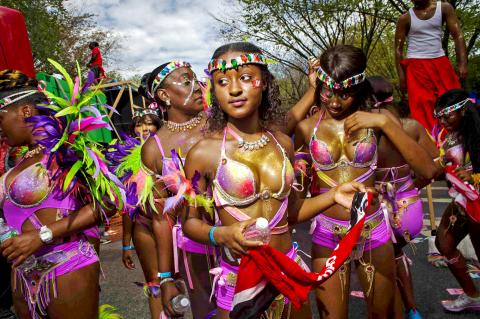
Photo: Reuters
However, the march often kicks off under a shadow of violence and this year’s was no different. Hours before the parade stepped off, a recent parolee opened fire on a crowd partaking in pre-dawn festivities not far from the parade site, police Commissioner William Bratton said.
A 55-year-old man, identified as Michael Sampson, was killed, and a 20-year-old woman and a 22-year-old man were both shot in their left legs. A 26-year-old man was taken into custody and faces charges including murder and assault.
Last year, two people were fatally stabbed at the parade, and a man was shot to death in 2011. Another man was killed in broad daylight on the parade route years earlier, and a photograph of his body on the sidewalk ran in city tabloids.
Bratton said more than 4,000 police officers were deployed along the parade route, including dozens of undercover officers mingling with partygoers, and several police helicopters thundered above the festivities.
New York Mayor Bill de Blasio defended the importance of the parade despite the violence that has all too frequently surrounded it.
“The vast, vast majority have a wonderful time and only a few individuals get out of line,” he said after a breakfast attended by elected officials, parade organizers and local dignitaries before the parade.
“This parade started small, became big and is one of the great events in our city,” he said.
Sporting a colorful tribal shirt, the mayor was joined on the hot, humid day by his wife, Chirlane McCray, who is of Caribbean decent, and their children, Dante and Chiara. They received cheers throughout the march and frequently shook hands with revelers.
This was De Blasio’s first time marching as mayor; a year ago, the raucous reception he received at the parade foreshadowed his blowout win in the Democratic primary.
He and his family marked the occasion last year by debuting a family dance they dubbed “The Smackdown,” which calls for them to pantomime licking their hands, swirling them over the heads, slapping their palms to the concrete and then jumping backward.
The burdens of office did not stop the family from delivering an encore performance on Monday, drawing cheers from the sweaty crowd and a gasp from the parade’s master of ceremonies.
New York Governor Andrew Cuomo also received a warm welcome a week from his bid to reclaim the Democratic nomination for governor. He dismissed chatter that he could replace his choice for lieutenant governor, Kathy Hochul, amid a surge of support for a previously unheralded candidate, Tim Wu.
Cuomo has refused to debate Wu’s running mate, longshot candidate Zephyr Teachout, who has received a wave of favorable press and endorsements from liberal groups in recent weeks.
She spent much of the parade granting interview requests when she was not dancing and waving at flag-toting partiers.
The parade celebrates Caribbean culture and echoes traditional pre-Lenten Carnival festivities, with dancers wearing elaborate costumes, some of which are feathered, others quite revealing.
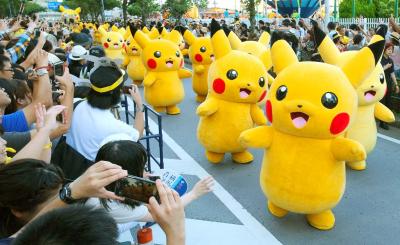
China’s military news agency yesterday warned that Japanese militarism is infiltrating society through series such as Pokemon and Detective Conan, after recent controversies involving events at sensitive sites. In recent days, anime conventions throughout China have reportedly banned participants from dressing as characters from Pokemon or Detective Conan and prohibited sales of related products. China Military Online yesterday posted an article titled “Their schemes — beware the infiltration of Japanese militarism in culture and sports.” The article referenced recent controversies around the popular anime series Pokemon, Detective Conan and My Hero Academia, saying that “the evil influence of Japanese militarism lives on in

DIPLOMATIC THAW: The Canadian prime minister’s China visit and improved Beijing-Ottawa ties raised lawyer Zhang Dongshuo’s hopes for a positive outcome in the retrial China has overturned the death sentence of Canadian Robert Schellenberg, a Canadian official said on Friday, in a possible sign of a diplomatic thaw as Canadian Prime Minister Mark Carney seeks to boost trade ties with Beijing. Schellenberg’s lawyer, Zhang Dongshuo (張東碩), yesterday confirmed China’s Supreme People’s Court struck down the sentence. Schellenberg was detained on drug charges in 2014 before China-Canada ties nosedived following the 2018 arrest in Vancouver of Huawei chief financial officer Meng Wanzhou (孟晚舟). That arrest infuriated Beijing, which detained two Canadians — Michael Spavor and Michael Kovrig — on espionage charges that Ottawa condemned as retaliatory. In January

A sign hanging from a rusty ice-green shipping container installed by Thai forces on what they say is the border with Cambodia reads: “Cambodian citizens are strictly prohibited from entering this area.” On opposite sides of the makeshift barricade, fronted by coils of barbed wire, Cambodians lamented their lost homes and livelihoods as Thailand’s military showed off its gains. Thai forces took control of several patches of disputed land along the border during fighting last year, which could amount to several square kilometers in total. Cambodian Kim Ren said her house in Chouk Chey used to stand on what is now the Thai
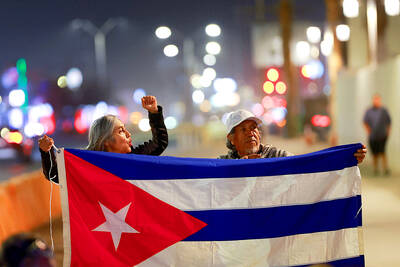
NEW RULES: There would be fewer school days, four-day workweeks, and a reduction in transportation services as the country battles a crisis exacerbated by US pressure The Cuban government on Friday announced emergency measures to address a crippling energy crisis worsened by US sanctions, including the adoption of a four-day work week for state-owned companies and fuel sale restrictions. Cuban Deputy Prime Minister Oscar Perez-Oliva Fraga blamed Washington for the crisis, telling Cuban television the government would “implement a series of decisions, first and foremost to guarantee the vitality of our country and essential services, without giving up on development.” “Fuel will be used to protect essential services for the population and indispensable economic activities,” he said. Among the new measures are the reduction of the working week in


 RSS
RSS