


It has long been known that the practice of mummification of the dead in ancient Egypt was old, but researchers are now uncovering just how long ago it began.
Researchers on Wednesday said a form of mummification was being carried out more than 6,000 years ago, much earlier than previously thought. Embalming substances contained in funerary textiles from the oldest-known Egyptian cemeteries showed mummy-making from as early as about 4300 BC, they said.
The embalming agents were infused into the linen used to wrap the corpse to provide an antibacterial and protective barrier. Their use was not as elaborate as the process used much later, but came more than 1,500 years earlier than Egyptian mummification had been thought to have started.
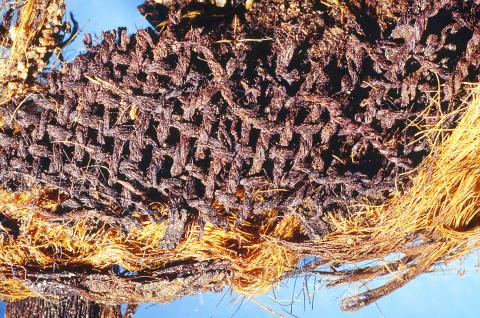
Photo: Reuters
There is evidence of mummification from about 2600 BC and evidence of linen that contained resin being used to wrap bodies around 2800 BC, but researchers were amazed to find that the plant, animal and mineral components used in preparing the mummies at the cemeteries in Mostagedda in central Egypt were essentially the same embalming “recipe” used thousands of years later.
“I was surprised that the prehistoric Egyptians, who lived in a tribal society 1,000 years before the invention of writing, were already in possession of the empirical science that would later become true mummification,” said researcher Jana Jones, an Egyptologist at Macquarie University in Australia.
Biochemical analysis identified the components from funerary textiles retrieved from the cemeteries during excavations in the 1920s and 1930s and held in Britain’s Bolton Museum. The study appears in the scientific journal PLOS ONE.

SPEAKING OUT: After Siranudh Scott’s allegations surfaced, celebrities and public figures took to social media to share their own experiences of sexual misconduct and abuse A high-profile alleged sexual abuse case within a wealthy Thai beer brewing family has prompted a wave of painful accounts from survivors of unconnected abuse in the conservative nation. Siranudh Scott, a member of the billionaire Thai family that founded the ubiquitous Singha beer brand, posted an emotional video this month accusing his elder brother Sunit of repeatedly abusing him when he was a teenager. Sunit, who is in his 30s, later denied the allegations in a video posted online, but Singha parent Boonrawd dismissed him from his executive role with the company on Tuesday last week. “I felt I needed to speak

SEEKING ORDER: Rodrigo Paz said that ‘anyone who wants to destroy the nation will have to deal with this president and the full force of the constitution’ Bolivian President Rodrigo Paz on Wednesday said that the nation was at a “breaking point” after nearly a month of protests that have caused shortages of food, fuel and medicine. Paz, who took office six months ago amid the worst economic crisis there in four decades, is battling a groundswell of fury over his policies. The political capital, La Paz, has been besieged by low-income workers and members of the indigenous majority calling for his resignation. “The country needs order and is reaching breaking point,” the 58-year-old said at a public event in La Paz, renewing his appeal for dialogue. On Tuesday, the Bolivian

A Hong Kong astronaut is to join a Chinese space mission for the first time as part of a three-person crew launching today, as Beijing edges closer to its goal of landing people on the moon. The Tiangong space station — crewed by teams of three astronauts that are typically rotated every six months — is the crown jewel of China’s space program, boosted by billions in state investment in a bid to catch up with the US and Russia. The Shenzhou-23 mission is to blast off at 11:08pm from the Jiuquan Satellite Launch Center in northwestern China, carrying three astronauts to
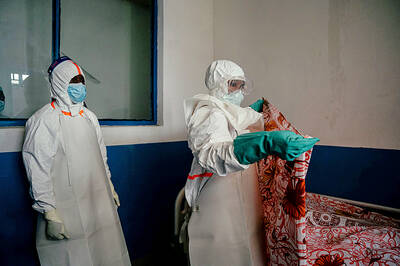
UPGRADED ALERT: The risk inside DR Congo is now considered ‘very high,’ while neighboring countries face a ‘high’ threat as the outbreak continues, the WHO said Ebola is spreading faster than responders can track it in eastern Congo, where health workers managed to follow up with barely one in five identified contacts in a single day. Authorities in the Democratic Republic of the Congo (DR Congo) reported 83 confirmed infections, 746 suspected cases and 1,603 identified contacts as of Thursday, but health workers were able to follow up on only 342 contacts that day — about 21 percent of the total under monitoring — data released by the DR Congo Ministry of Public Health on Friday showed. The figures suggest the response is falling behind the outbreak itself,


 RSS
RSS