


It is not your typical used car lot.
Just steps from the Florida Straits, dozens of vehicles bake in the Caribbean sun. An elderly security guard slumps in a sleepy waiting area and customers are nowhere to be seen.
A price list hanging on the green chain-link fence hints at why: US$85,000 for a six-year-old Peugeot compact; US$46,000 for a tiny 2008 Citroen C3 hatchback that would cost less than a third of that in Europe. Elsewhere, a larger, new Peugeot 508 lists for US$262,000, five times its price in Britain — and more than a millennium worth of paychecks in Cuba, where wages average about US$20 a month.
The euphoria that greeted a January reform that lets Cubans buy vehicles from the government without a special permit for the first time in decades turned to anger when the prices were posted. When authorities announced recently that just 50 cars had rolled off the lots of state-run dealerships in the first half-year, bringing in US$1.3 million in sales, it was tempting to call the policy a failure.
However, analysts say it seems the measure was designed to work that way.
“At those prices, they obviously didn’t want to sell many cars,” said Philip Peters, president of the Virginia-based Cuba Research Center. “And they’re not.”
“The only Cuban consumers who can afford it are probably musicians that have got some terrific royalty earnings on their latest record, or people who cashed out fabulously when they sold their family home and I can’t think of anybody else,” Peters said. “It’s a very, very small sliver of the public that could think of affording such prices, and, as we see, an even smaller sliver that actually decides to do it.”
Some islanders initially hoped authorities would adjust prices downward when they got a sense of what the market would bear. That happened when cellphones first appeared in Cuba more than a decade ago.
However, a recent tour of several dealerships in Havana found the same 400 percent markups as before. Not a single potential client was in sight. Employees refused to speak to reporters, though one confirmed that prices have not budged.
There are no publicly available statistics on how many vehicles circulate in Cuba, but visitors to Havana marvel at how empty the streets are for a city of about 2 million people.
Jorge Pinon, a Latin America energy expert at the University of Texas, said Cuba’s reluctance to sell cars is not out of fear of insufficient fuel. The country gets tens of thousands of barrels of oil a day on preferential terms from Venezuela.
However, Pinon said that a huge infusion of vehicles would test the creaky transportation infrastructure of Cuba, where potholes can go unfilled for years and traffic lights are scarce.
Peters suggested officials simply do not see it as a priority and would rather spend what little hard currency available on things like food and industrial inputs.
“I think there’s only one explanation ... the government does not want to use its foreign exchange reserves to import cars for a retail market,” he said. “So therefore the only way that it’s worth it to them, to import a car for US$20,000 and then sell it retail, is to soak up US$50,000 worth of liquidity.”
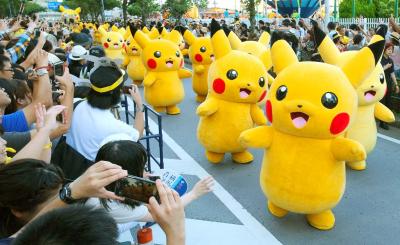
China’s military news agency yesterday warned that Japanese militarism is infiltrating society through series such as Pokemon and Detective Conan, after recent controversies involving events at sensitive sites. In recent days, anime conventions throughout China have reportedly banned participants from dressing as characters from Pokemon or Detective Conan and prohibited sales of related products. China Military Online yesterday posted an article titled “Their schemes — beware the infiltration of Japanese militarism in culture and sports.” The article referenced recent controversies around the popular anime series Pokemon, Detective Conan and My Hero Academia, saying that “the evil influence of Japanese militarism lives on in

DIPLOMATIC THAW: The Canadian prime minister’s China visit and improved Beijing-Ottawa ties raised lawyer Zhang Dongshuo’s hopes for a positive outcome in the retrial China has overturned the death sentence of Canadian Robert Schellenberg, a Canadian official said on Friday, in a possible sign of a diplomatic thaw as Canadian Prime Minister Mark Carney seeks to boost trade ties with Beijing. Schellenberg’s lawyer, Zhang Dongshuo (張東碩), yesterday confirmed China’s Supreme People’s Court struck down the sentence. Schellenberg was detained on drug charges in 2014 before China-Canada ties nosedived following the 2018 arrest in Vancouver of Huawei chief financial officer Meng Wanzhou (孟晚舟). That arrest infuriated Beijing, which detained two Canadians — Michael Spavor and Michael Kovrig — on espionage charges that Ottawa condemned as retaliatory. In January

A sign hanging from a rusty ice-green shipping container installed by Thai forces on what they say is the border with Cambodia reads: “Cambodian citizens are strictly prohibited from entering this area.” On opposite sides of the makeshift barricade, fronted by coils of barbed wire, Cambodians lamented their lost homes and livelihoods as Thailand’s military showed off its gains. Thai forces took control of several patches of disputed land along the border during fighting last year, which could amount to several square kilometers in total. Cambodian Kim Ren said her house in Chouk Chey used to stand on what is now the Thai

NEW RULES: There would be fewer school days, four-day workweeks, and a reduction in transportation services as the country battles a crisis exacerbated by US pressure The Cuban government on Friday announced emergency measures to address a crippling energy crisis worsened by US sanctions, including the adoption of a four-day work week for state-owned companies and fuel sale restrictions. Cuban Deputy Prime Minister Oscar Perez-Oliva Fraga blamed Washington for the crisis, telling Cuban television the government would “implement a series of decisions, first and foremost to guarantee the vitality of our country and essential services, without giving up on development.” “Fuel will be used to protect essential services for the population and indispensable economic activities,” he said. Among the new measures are the reduction of the working week in


 RSS
RSS