


Three years after Mexican drug lord Nazario Moreno was declared dead, doubts abound about his demise, with stories of him indoctrinating recruits every Sunday and hosting a feast last year.
Even though his body was never recovered, the government announced on Dec. 10, 2010, that “El Chayo” was killed after an hours-long gunfight with federal police near the city of Apatzingan, in the western state of Michoacan.
At the time, then-government security spokesman Alejandro Poire cited “several elements and information obtained” in the operation to declare that the head of La Familia Michoacana cartel was dead.
However, the government of Mexican President Enrique Pena Nieto, who took office in December last year, is now checking whether the man also known as “The Craziest One,” who would be 43 years old, is really dead.
La Familia began to crumble after his disappearance, leading to the creation of an offshoot christened as the Knights Templar, whose brutality prompted civilians in Michoacan to form vigilante forces and the government to deploy thousands of troops in May.
Several residents of Michoacan insist that Moreno is now leading the Knights Templar, who were accused of killing a vice admiral in an ambush last Sunday, days after clashes with police that left four officers and 20 gangsters dead.
While the government vows to pacify the state, a federal police officer in the area said official intelligence states that the capo is hiding in the rough mountain terrain of a region known as Tierra Caliente (Hot Land) — the epicenter of clashes between police and the cartel.
The resurrection of Moreno would probably suit the drug kingpin, a self-styled “messiah” who wrote the Gospel of La Familia — a sort of gang bible with rules barring its members from consuming drugs or alcohol.
A leader of a vigilante group said he was among 60 people invited by Moreno to a dinner in a house in the small town of Aguililla in September last year.
“It’s the kind of invitation that you can’t turn down,” the vigilante said.
The guests arrived on time for the food, music and dancing. “El Chayo” showed up three hours later, with armed men providing security at the house while others monitored the only road leading to the town.
The guests were ordered to turn off their cellphones and were forbidden from leaving until after Moreno had left at dawn.
“He didn’t do any proselytism,” the vigilante said.
Instead, he displayed left-wing politics and revealed that he was now known as Ernesto Villa Moreno, in honor of Argentine guerrillero Ernesto “Che” Guevara and Mexican revolution hero Pancho Villa.
Juan Manuel, an 18-year-old who says he was recruited by the cartel to be a hitman at age 13, said that Moreno and other Knights Templar leaders meet to indoctrinate their men every Sunday.
“El Chayo has very large weapons,” said Juan Manuel, who said he recently left the cartel and last saw Moreno two months ago.
Moreno began his criminal career selling marijuana in the US.
He founded La Familia after returning to Michoacan and his cartel, which vowed to impose “divine justice,” made its presence known in 2006, when it rolled five human heads down a bar’s dancefloor.

A humanoid robot that won a half-marathon race for robots in Beijing on Sunday ran faster than the human world record in a show of China’s technological leaps. The winner from Honor, a Chinese smartphone maker, completed the 21km race in 50 minutes and 26 seconds, said a WeChat post by the Beijing Economic-Technological Development Area, also known as Beijing E-Town, where the race began. That was faster than the human world record holder, Ugandan Jacob Kiplimo, who finished the same distance in about 57 minutes in March at the Lisbon road race. The performance by the robot marked a significant step forward
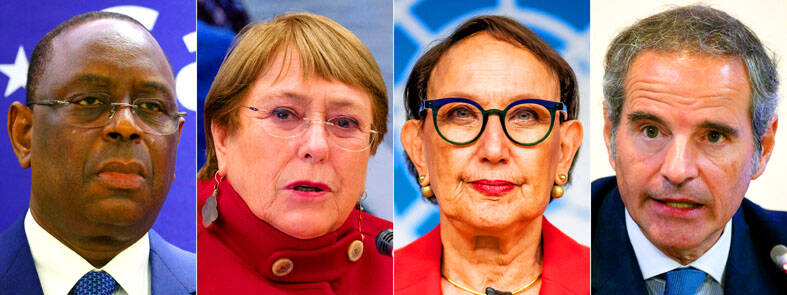
Four contenders are squaring up to succeed Antonio Guterres as secretary-general of the UN, which faces unprecedented global instability, wars and its own crushing budget crisis. Chile’s Michelle Bachelet, Argentina’s Rafael Grossi, Costa Rica’s Rebeca Grynspan and Senegal’s Macky Sall are each to face grillings by 193 member states and non-governmental organizations for three hours today and tomorrow. It is only the second time the UN has held a public question-and-answer, a format created in 2016 to boost transparency. Ultimately the five permanent members of the UN’s top body, the Security Council, hold the power, wielding vetoes over who leads the

An earthquake registering a preliminary magnitude of 7.7 off northern Japan on Monday prompted a short-lived tsunami alert and the advisory of a higher risk of a possible mega-quake for coastal areas there. The Cabinet Office and the Japan Meteorological Agency said there was a 1% chance for a mega-quake, compared to a 0.1% chance during normal times, in the next week or so following the powerful quake near the Chishima and Japan trenches. Officials said the advisory was not a quake prediction but urged residents in 182 towns along the northeastern coasts to raise their preparedness while continuing their daily lives. Prime
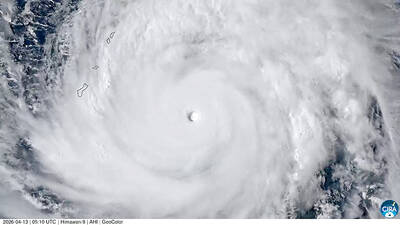
HAZARDOUS CONDITION: The typhoon’s sheer size, with winds extending 443km from its center, slowed down the ability of responders to help communities, an official said The US Coast Guard was searching for six people after losing contact with their disabled boat off the coast of Guam following Typhoon Sinlaku. The crew of the 44m dry cargo vessel, the US-registered Mariana, on Wednesday notified the coast guard that the boat had lost its starboard engine and needed assistance, Petty Officer 3rd Class Avery Tibbets said yesterday. The coast guard set up a one-hour communication schedule with the vessel, but lost contact on Thursday. A Coast Guard HC-130 Hercules aircraft was launched to search for the six people on board, but it had to return to Guam because of


 RSS
RSS