


When Chinese activist Chen Guangcheng (陳光誠) arrived in the US in May last year he was given a fellowship at New York University (NYU), use of a Greenwich Village apartment and a pile of gifts from supporters, including smartphones and an iPad.
However, at least two of the gadgets presented to Chen as gifts may not have been quite what they seemed: They included software intended to spy on the dissident, said Jerome Cohen, an NYU professor who has been Chen’s mentor, and another source familiar with the episode.
Like nearly everything surrounding Chen these days, the existence of the spyware is in dispute, and only adds to the public recriminations there have been between NYU and Chen’s supporters over events surrounding the end of his fellowship.
Last weekend, Chen accused NYU of bowing to pressure from China by ending the fellowship, and his supporters have suggested that the university is wary of displeasing the Chinese authorities because of its plans for a campus in Shanghai.
At issue in the latest escalation in the argument are an iPad and at least one of the smartphones that were given to Chen days after he fled China and arrived in Manhattan. The devices were found by NYU technicians to have been loaded with software that made it possible to track the dissident’s movements and communications, according to Cohen and the second source, who was not authorized to speak on the matter.
The episode suggests that from almost the day that he arrived at the university there was an uneasy atmosphere between Chen, his supporters and NYU.
Among the first visitors in May last year to the New York apartment Chen had moved into with his family after a dramatic escape from house arrest in China was Heidi Cai, the wife of activist Bob Fu (傅希秋). She brought an iPad and iPhone as gifts.
The devices were screened by NYU technicians within a few days and were found to have been loaded with hidden spying software, said Cohen, who arranged the fellowship for Chen at NYU Law School, helping defuse a diplomatic crisis between the US and China after Chen took refuge in the US embassy in Beijing.
The spyware issue was not publicized at the time and has only surfaced because of the recent scrutiny of NYU’s arrangement with Chen.
Asked about the gadgets, Fu said that his wife had given two Apple devices to Chen shortly after the dissident had settled in New York. Fu runs a Christian group called ChinaAid that supports underground churches in China and victims of forced abortions.
Although Cohen and the second source say they were left with no doubt spyware had deliberately been installed on the devices, it could not be established whether there might be a more innocent explanation for what technicians believed they had found. The technicians could not be reached for comment. In examining the iPad and the iPhone, they found software that allowed a third party to secretly connect to an inbuilt global positioning system, essentially turning a device into a tracking device, the second source said.
The technicians also found hidden, password-protected software that backed up the contents to a remote server, the source added.
Fu said he consulted ChinaAid’s computer technician on Thursday and “my staffer is 100 percent sure that the only thing he added on the iPad was a Skype account.”
John Beckman, a spokesman for NYU, declined to discuss specifics about the episode.
Several of Chen’s supporters allege that NYU staff has controlled and withheld access to the activist. NYU rejects these claims and some figures connected with the university, including Cohen, say that some of Chen’s supporters may be trying to manipulate the self-trained lawyer who speaks little English to serve their own political ends. Chen could not be reached for comment.
However, Mark Corallo, a media consultant who has been working with Chen, said that the gifts from Fu were taken away by NYU before the dissident received them.
“The devices were brand-new when ChinaAid gave them to NYU to give to Chen, so there was no need or reason to perform any check,” he said in an e-mail.
Cohen and the second source maintain that Chen was told within days of his arrival in an unfamiliar country that people he believed to be his supporters were very likely spying on him. Chen was “furious” and “very upset” when told, the second source recalled.
Even so, Cohen said Chen still continued to interact with the Fu family.
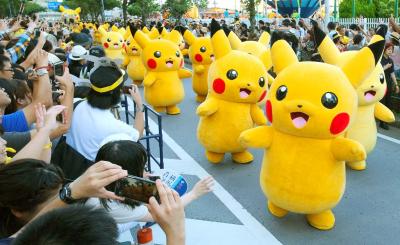
China’s military news agency yesterday warned that Japanese militarism is infiltrating society through series such as Pokemon and Detective Conan, after recent controversies involving events at sensitive sites. In recent days, anime conventions throughout China have reportedly banned participants from dressing as characters from Pokemon or Detective Conan and prohibited sales of related products. China Military Online yesterday posted an article titled “Their schemes — beware the infiltration of Japanese militarism in culture and sports.” The article referenced recent controversies around the popular anime series Pokemon, Detective Conan and My Hero Academia, saying that “the evil influence of Japanese militarism lives on in
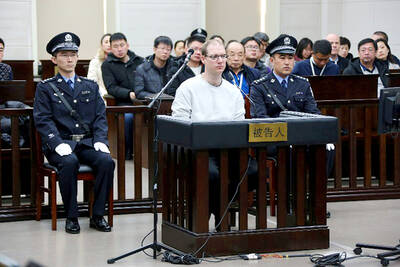
DIPLOMATIC THAW: The Canadian prime minister’s China visit and improved Beijing-Ottawa ties raised lawyer Zhang Dongshuo’s hopes for a positive outcome in the retrial China has overturned the death sentence of Canadian Robert Schellenberg, a Canadian official said on Friday, in a possible sign of a diplomatic thaw as Canadian Prime Minister Mark Carney seeks to boost trade ties with Beijing. Schellenberg’s lawyer, Zhang Dongshuo (張東碩), yesterday confirmed China’s Supreme People’s Court struck down the sentence. Schellenberg was detained on drug charges in 2014 before China-Canada ties nosedived following the 2018 arrest in Vancouver of Huawei chief financial officer Meng Wanzhou (孟晚舟). That arrest infuriated Beijing, which detained two Canadians — Michael Spavor and Michael Kovrig — on espionage charges that Ottawa condemned as retaliatory. In January

A sign hanging from a rusty ice-green shipping container installed by Thai forces on what they say is the border with Cambodia reads: “Cambodian citizens are strictly prohibited from entering this area.” On opposite sides of the makeshift barricade, fronted by coils of barbed wire, Cambodians lamented their lost homes and livelihoods as Thailand’s military showed off its gains. Thai forces took control of several patches of disputed land along the border during fighting last year, which could amount to several square kilometers in total. Cambodian Kim Ren said her house in Chouk Chey used to stand on what is now the Thai
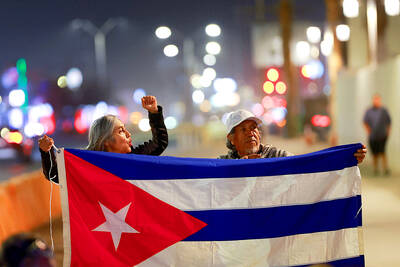
NEW RULES: There would be fewer school days, four-day workweeks, and a reduction in transportation services as the country battles a crisis exacerbated by US pressure The Cuban government on Friday announced emergency measures to address a crippling energy crisis worsened by US sanctions, including the adoption of a four-day work week for state-owned companies and fuel sale restrictions. Cuban Deputy Prime Minister Oscar Perez-Oliva Fraga blamed Washington for the crisis, telling Cuban television the government would “implement a series of decisions, first and foremost to guarantee the vitality of our country and essential services, without giving up on development.” “Fuel will be used to protect essential services for the population and indispensable economic activities,” he said. Among the new measures are the reduction of the working week in


 RSS
RSS