


North Korean farmers knee-deep in muddy paddies across the country have a new incentive during this year’s crucial rice planting season: possible bonuses that are part of an economic shift echoing ally China’s steps three decades ago toward embracing capitalism.
Details about the changes are emerging nearly two months after the North Korean regime unveiled its dual goals of building the economy and developing nuclear weapons in the first concrete economic policy laid out by North Korean leader Kim Jong-un since he assumed power in December 2011.
Farmers say they have begun working under the new policies, which are designed to boost production by giving managers and workers financial incentives.
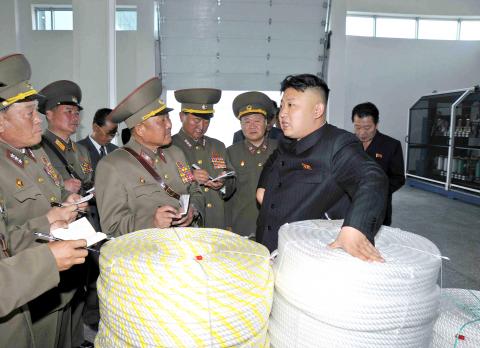
Photo: Reuters
Foreign analysts say the moves to spur North Korea’s moribund economy suggest Pyongyang is taking cues from Beijing on how to incorporate free-market ideas within its rigid socialist system.
The North enshrining its provocative push to build atomic weapons as a national goal has complicated efforts to force Pyongyang to abandon its nuclear program and dominated international discussion about the country. The North’s economic priorities have drawn far less attention, but some experts think important reforms could be unfolding.
Impoverished North Korea suffers chronic food and power shortages and has not released economic data for decades. South Korea’s central bank estimates that the North’s gross national income was US$1,250 per person in 2011, compared with US$23,400 in South Korea.
In the past, the North Korean state set workers’ salaries. Under new measures announced on April 1, the managers of farms, factories and other enterprises have been given leeway to set salaries and offer raises to productive workers.
Providing material incentives and loosening central control over economic decisionmaking are two key elements in transitioning from a command economy to a market-based system, said John Delury, an assistant professor of Chinese studies at Yonsei University in Seoul.
Also announced on April 1 was the reappointment of North Korean Premier Pak Pong-ju after his dismissal from the post in 2007. Pak was central to reform attempts more than a decade ago.
“You just wouldn’t bring back Pak Pong-ju unless you were going to try readjusting economy policy,” Delury said.
North Korea’s policy changes echo the market reforms that transformed China into a manufacturing powerhouse and the world’s second-largest economy, while also lifting millions out of grinding poverty.
Beijing dismantled its centrally planned economy slowly. In the 1970s, it began allowing farmers to keep more of their harvests, incentivizing them to grow more to sell on newly allowed free markets. Food production soared.
In the mid-1980s, Beijing gave state enterprises the authority to link bonuses and salaries to better performance. Those changes were mostly aimed at managers, but they cracked a communist-era preference for egalitarianism.
New rules in the early 1990s gave state firms full flexibility to set wages, widening the use of incentives. In that decade, China truly broke away from its centralized “iron rice bowl” system of guaranteed employment and state-set incomes.
Delury and others say that if the North is intent on economic reform, it is likely to be a fitful process.
“We have to be careful not to say: ‘Aha, it’s all change, it’s finally here,’” he said. “The point is — and we see this from the Chinese case — this is a process that unfolds over time and there are starts and stops, too, but this is a strong signal of a push.”
Foreign media reported in September last year that farmers had been notified of upcoming changes at collective farms that would give decisionmaking and responsibility for crops to local officials and let farmers keep surpluses.
“Last year, we studied reasonable economic management methods in different fields of economic work and introduced it to some units on a trial basis,” Ri Ki-song, an economist from North Korea’s Academy of Social Sciences, said this week.
North Korea announced the policy, and its expansion to include factories and other enterprises, a day after a plenary session of the Central Committee of the Workers’ Party. Rodong Sinmun, the ruling party’s newspaper, called it part of a “new strategic line.”
However, Ri dismissed characterizations of the changes as reform.
He said that what is new is allowing managers to dole out goods and cash as incentives. In addition, after paying back investments provided by the state, managers can set their employees’ salaries and offer raises, he added.
The main goal is to encourage “greater profits” and solve the chronic food shortages, Ri said.
He said North Koreans work hard, but the incentives give them motivation to work even harder.
Political and military expert Ralph Cossa, president of the Pacific Forum CSIS in Hawaii, said that North Korea has rolled back past attempts at economic reform.
Cossa cited international aid groups as saying that the North’s military is pressuring farmers to donate their surplus to the army.
At the Tongbong farm in Hamhung, things are being managed differently this year, said Kim Jong-jin, deputy chairman of the farm’s managing committee.
After the rice is harvested, farmers must “repay” the state for the seeds it has provided. At Tongbong that means giving the state about 193kg of rice for every 140kg of seedlings received. However, this year farmers can keep any surplus to sell, barter or distribute.

South Korea’s air force yesterday apologized for a 2021 midair collision involving two fighter jets, a day after auditors said the pilots were taking selfies and filming during the flight and held them responsible for the accident. “We sincerely apologize to the public for the concern caused by the accident that occurred in 2021,” an air force spokesman told a news conference, adding that one of the pilots involved had been suspended from flying duties, received severe disciplinary action and has since left the military. The apology followed a report released on Wednesday by the South Korean Board of Audit and Inspection,
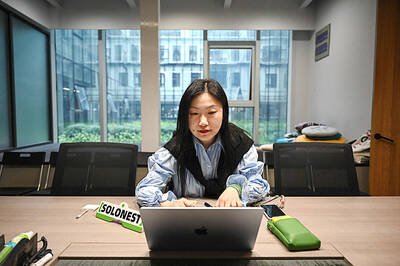
Young Chinese, many who fear age discrimination in their workplace after turning 35, are increasingly starting “one-person companies” that have artificial intelligence (AI) do most of the work. Smaller start-ups are already in vogue in Silicon Valley and elsewhere, with rapidly advancing AI tools seen as a welcome teammate even as they threaten layoffs at existing firms. More young people in China are subscribing to the model, as cities pledge millions of dollars in funding and rent subsidies for such ventures, in alignment with Beijing’s political goal of “technological self-reliance.” “The one-person company is a product of the AI era,” said Karen Dai

About 240 Indians claiming descent from a Biblical tribe landed at Tel Aviv airport on Thursday as part of a government operation to relocate them to Israel. The newcomers passed under a balloon arch in blue and white, the colors of the Israeli flag, as dozens of well-wishers welcomed them with a traditional Jewish song. They were the first “bnei Menashe” (“sons of Manasseh”) to arrive in Israel since the government in November last year announced funding for the immigration of about 6,000 members of the community from the states of Manipur and Mizoram in northeast India. The community claims to descend from

‘TROUBLING’: The firing of Phelan, who was an adviser to a nonprofit that supported the defense of Taiwan, was another example of ‘dysfunction’ under Trump, a US senator said US Secretary of the Navy John Phelan has been fired, a US official and a person familiar with the matter said on Wednesday, in another wartime shakeup at the Pentagon coming just weeks after US Secretary of Defense Pete Hegseth ousted the Army’s top general. The Pentagon announced his departure in a brief statement, saying he was leaving the administration “effective immediately,” but it did not provide a reason or say whether it was his decision to go. The sources, who spoke on condition of anonymity, said Phelan was dismissed in part because he was moving too slowly to implement reforms to


 RSS
RSS