


The fallout from Venezuela’s disputed presidential election continued to spread this week as the government of Venezuelan President Nicolas Maduro threatened to jail the opposition candidate and arrested a US filmmaker accused of working for US intelligence.
While electoral officials prepared a wider audit of the narrow vote on April 14, opposition candidate Henrique Capriles added to the tension on Thursday by demanding scrutiny of registers containing voters’ signatures and fingerprints.
Capriles has refused to accept the declared result, according to which he was defeated by less than 2 percent. Alleging thousands of cases of vote-rigging and other electoral law violations, he called on his supporters to stage peaceful cacerolazo — a popular form of protest where people bang on pots and pans.
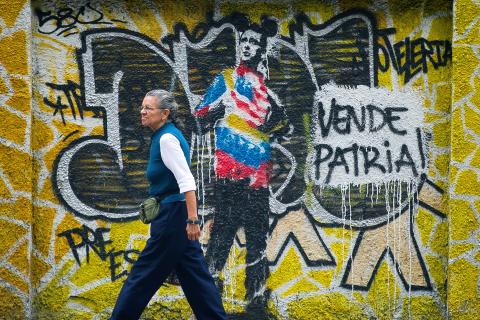
Photo: EPA
The protests have been called off, but the government said the demonstrations last week led to nine deaths, 78 people injured and the burning down of clinics and party headquarters. This too is disputed, but the ruling United Socialist party initiated an investigation in the national assembly this week into whether Capriles should be held responsible.
“The deaths ordered by the fascist murderer Capriles cannot go unpunished,” National Assembly of Venezuela President Diosdado Cabello said on Twitter on Thursday. “The investigations are going forward.”
Venezuelan Minister of the Penitentiary System Iris Valera said she had a cell waiting for the opposition leader.
“Capriles is the intellectual author of these crimes and will not go unpunished,” Varela said on state television. “The only good news for you is that the prison waiting for you, Capriles Radonski, is not like the ones we inherited from the previous governments.”
Capriles said he was ready to go to jail rather than accept what he describes as a “stolen” election, but he denied instigating violence.
“If they want to bring me to trial what’s their reason?” Capriles said on Wednesday. “For asking that the vote boxes be opened? For asking people to bang pots and pans? If that’s the cost, then do it fast. Don’t keep threatening.”
Capriles spent 119 days in prison for his alleged involvement in a violent protest outside the Cuban embassy after a failed coup against late Venezuelan president Hugo Chavez in 2002.
The ruling camp has promised to audit the vote, yet said the result is “irreversible.”
Capriles supporters say the audit will not be valid and will be boycotted by his movement unless it includes detailed information from voting notebooks, as well as checks on whether people voted more than once and whether votes were registered in the names of dead people.
The ruling party and its supporters believe the unrest is the latest attempt by the US to delegitimize a hostile government that is sitting on the world’s biggest oil resources. The US has been reluctant to recognize Maduro as president and called for a recount.
Earlier on Thursday, authorities detained a US citizen, Timothy Hallet Tracy, who they accuse of trying to destabilize the country on behalf of an unnamed US intelligence agency.
“We detected the presence of an American who began developing close relations with these [students],” Venezuelan Minister of the Interior Miguel Rodriguez said in a press conference. “His actions clearly show training as an intelligence agent, there can be no doubt about it. He knows how to work in clandestine operations.”
Rodriguez said Tracy, 35, from Michigan, had received financing from a foreign non-profit organization and had redirected those funds toward student organizations.
The ultimate aim was to provoke “civil war,” he said.
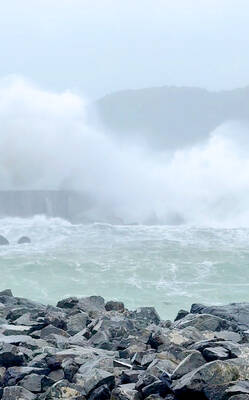
Heavy rain and strong winds yesterday disrupted flights, trains and ferries, forcing the closure of roads across large parts of New Zealand’s North Island, while snapping power links to tens of thousands. Domestic media reported a few flights had resumed operating by afternoon from the airport in Wellington, the capital, although cancelations were still widespread after airport authorities said most morning flights were disrupted. Air New Zealand said it hoped to resume services when conditions ease later yesterday, after it paused operations at Wellington, Napier and Palmerston North airports. Online images showed flooded semi-rural neighborhoods, inundated homes, trees fallen on vehicles and collapsed

‘COST OF DEFECTION’: Duterte’s announcement could be an effort to keep allies in line with the promise of a return to power amid political uncertainty, an analyst said Philippine Vice President Sara Duterte yesterday announced she would run for president of the Southeast Asian nation of 116 million in 2028. Duterte, who is embroiled in a bitter feud with Philippine President Ferdinand Marcos Jr, was impeached last year only to see the country’s Supreme Court throw the case out over procedural issues. Her announcement comes just days before her father, former Philippine president Rodrigo Duterte, begins a pretrial hearing at the International Criminal Court (ICC) in the Netherlands over crimes against humanity allegedly committed as part of a brutal crackdown on drugs. “I offer my life, my strength and my future

FEROCIOUS FISH-EATER Scientists have found a new species of dinosaur from the Cretaceous Period, a ‘hell heron’ that stalked the rivers, deep in the Saharan desert At a remote Sahara desert site in Niger, scientists have unearthed fossils of a new species of Spinosaurus, among the biggest of the meat-eating dinosaurs, notable for its large blade-shaped head crest and jaws bearing interlocking teeth for snaring fish. It prowled a forested inland environment and strode into rivers to catch sizable fish like a modern-day wading bird — a “hell heron,” as one of the researchers put it, considering it was about 12 meters long and weighed 5-7 tons. The dinosaur presented a striking profile on the Cretaceous Period landscape of Africa some 95 million years ago as it hunted

NOT YET THERE: While the show was impressive, it failed to demonstrate their ability to move in unstructured environments, such as a factory floor, an expert said Dancing humanoid robots on Monday took center stage during the annual China Media Group’s Spring Festival Gala, China’s most-watched official television broadcast. They lunged and backflipped (landing on their knees), they spun around and jumped. Not one fell over. The display was impressive, but if robots can now dance and perform martial arts, what else can they do? Experts have mixed opinions, with some saying the robots had limitations and that the display should be viewed through a lens of state propaganda. Developed by several Chinese robotics firms, the robots performed a range of intricate stunts, including martial arts, comedy sketches and choreographed


 RSS
RSS