


Argentine police and soldiers searched house to house, in creeks and culverts and even in trees for bodies on Thursday after floods killed at least 59 people in La Plata and Buenos Aires.
As torrential rains stopped and the waters receded, the crisis shifted to guaranteeing public health and safety in La Plata. Safe drinking water was in short supply, and more than a quarter-million people were without power, although authorities said most would get their lights back on overnight.
Many people barely escaped with their lives after seeing everything they own disappear under water reeking with sewage and fuel that rose more than 2m high inside some homes.
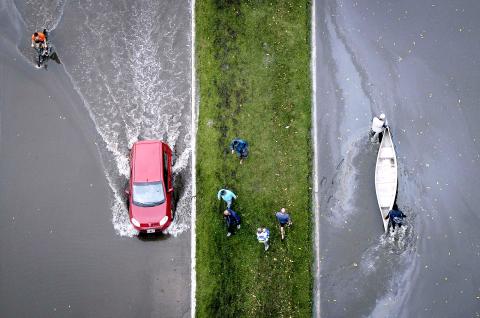
Photo: Reuters
The wreckage was overwhelming: piles of broken furniture, overturned cars, ruined food and other debris.
Their frustration was uncontainable as politicians arrived making promises. Argentine President Cristina Fernandez de Kirchner, Buenos Aires Province Governor Daniel Scioli, Argentine Social Welfare Minister Alicia Kirchner and the mayors of Buenos Aires and La Plata were all booed when they tried to talk with victims.
Many yelled “go away” and “you came too late.”
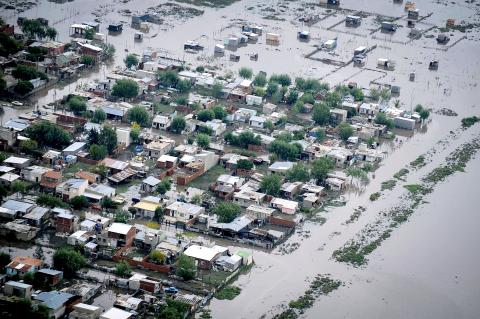
Photo: Reuters
“I understand you, I understand you’re angry,” Alicia Kirchner said before she and the governor fled in their motorcade from an angry crowd.
“There is no water, there is no electricity. We have nothing,” said Nelly Cerrado, who was looking for donated clothing at a local school. “Terrible, terrible what we are going through. And no one comes. No one. Because here, it is neighbors who have to do everything.”
The nearby Ensenada refinery, Argentina’s largest, remained offline after flooding caused a fire that took hours to quench in the middle of the rainstorm, the state-run YPF oil company said. YPF said it would take them 36 more hours just to drain excess water from the damaged refinery, and at least another seven days before the refinery can renew operations.
The company also said it was putting into place an emergency plan to guarantee gasoline supplies, and would invest US$800 million to replace a damaged coking unit where the flood caused a fire with a newer, higher-capacity unit.
Scioli said the death toll had risen to 51 people in and around La Plata, following six deaths in the national capital from flooding two days earlier.
However, he said nearly all of the missing had been accounted for.
The victims included a member of the Grandmothers of the Plaza de Mayo human rights group, Lucila Ahumada de Inama, who was found under 1.7m of water inside her home.
She died without having found her grandson, born in captivity after her pregnant daughter-in-law was kidnapped by Argentina’s dictatorship in 1977.
Several flooded residents were being lauded as heroes. Alejandro Fernandez, a 44-year-old policeman who was off-duty when the rains started, pulled out his rubber boat and shuttled about 100 neighbors to higher ground. His neighbor, Dr Jose Alberto Avelar, turned his home into a clinic, treating dozens for hypothermia.
Fernandez “won’t say it, because he’s too humble, but what he did was incredible,” Avelar said. “His action got everyone else helping as well.”
A store and an elementary school were looted, but police and troops were helping residents guard neighborhoods to prevent more crimes. In addition to 750 provincial police officers, the national government sent in army, coast guard, police and social welfare workers.
Mobile hospitals were activated after two major hospitals were flooded, and government workers were handing out donated water, canned food and clothing. Argentine provincial Health Minister Alejandro Collia said hepatitis shots were being given at 33 evacuation centers, and that spraying would kill mosquitoes that spread dengue fever.
“The humanitarian question comes first. The material questions will be resolved in time,” said Scioli, who promised subsidies, loans and tax exemptions for the victims.
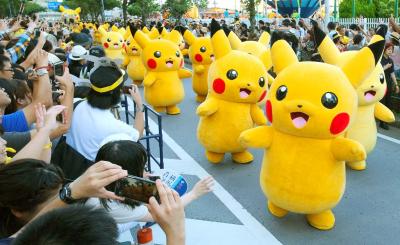
China’s military news agency yesterday warned that Japanese militarism is infiltrating society through series such as Pokemon and Detective Conan, after recent controversies involving events at sensitive sites. In recent days, anime conventions throughout China have reportedly banned participants from dressing as characters from Pokemon or Detective Conan and prohibited sales of related products. China Military Online yesterday posted an article titled “Their schemes — beware the infiltration of Japanese militarism in culture and sports.” The article referenced recent controversies around the popular anime series Pokemon, Detective Conan and My Hero Academia, saying that “the evil influence of Japanese militarism lives on in

DIPLOMATIC THAW: The Canadian prime minister’s China visit and improved Beijing-Ottawa ties raised lawyer Zhang Dongshuo’s hopes for a positive outcome in the retrial China has overturned the death sentence of Canadian Robert Schellenberg, a Canadian official said on Friday, in a possible sign of a diplomatic thaw as Canadian Prime Minister Mark Carney seeks to boost trade ties with Beijing. Schellenberg’s lawyer, Zhang Dongshuo (張東碩), yesterday confirmed China’s Supreme People’s Court struck down the sentence. Schellenberg was detained on drug charges in 2014 before China-Canada ties nosedived following the 2018 arrest in Vancouver of Huawei chief financial officer Meng Wanzhou (孟晚舟). That arrest infuriated Beijing, which detained two Canadians — Michael Spavor and Michael Kovrig — on espionage charges that Ottawa condemned as retaliatory. In January

A sign hanging from a rusty ice-green shipping container installed by Thai forces on what they say is the border with Cambodia reads: “Cambodian citizens are strictly prohibited from entering this area.” On opposite sides of the makeshift barricade, fronted by coils of barbed wire, Cambodians lamented their lost homes and livelihoods as Thailand’s military showed off its gains. Thai forces took control of several patches of disputed land along the border during fighting last year, which could amount to several square kilometers in total. Cambodian Kim Ren said her house in Chouk Chey used to stand on what is now the Thai
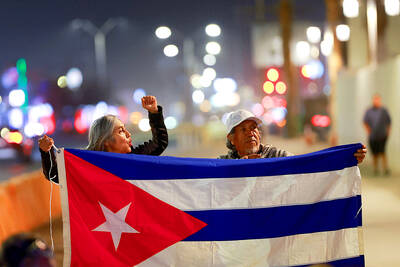
NEW RULES: There would be fewer school days, four-day workweeks, and a reduction in transportation services as the country battles a crisis exacerbated by US pressure The Cuban government on Friday announced emergency measures to address a crippling energy crisis worsened by US sanctions, including the adoption of a four-day work week for state-owned companies and fuel sale restrictions. Cuban Deputy Prime Minister Oscar Perez-Oliva Fraga blamed Washington for the crisis, telling Cuban television the government would “implement a series of decisions, first and foremost to guarantee the vitality of our country and essential services, without giving up on development.” “Fuel will be used to protect essential services for the population and indispensable economic activities,” he said. Among the new measures are the reduction of the working week in


 RSS
RSS