


Man-made chemicals in everyday products are likely to be at least the partial cause of a global surge in birth deformities, hormonal cancers and psychiatric diseases, a UN-sponsored research team reported on Tuesday.
These substances, dubbed EDCs, could also be linked to a decline in the human male sperm count and female fertility, to an increase in once-rare childhood cancers and to the disappearance of some animal species, they said.
“It is clear that some of these chemical pollutants can affect the endocrinal [hormonal] system and … may also interfere with the development processes of humans and wildlife species,” the report declared.

Photo: AFP
The international group, academic experts working under the umbrella of the UN environmental and health agencies UNEP and WHO, issued their findings in a paper updating a 2002 study on the potential dangers of synthetic chemicals.
Declaring “a global threat that needs to be resolved,” the team said humans and animals across the planet were probably exposed to hundreds of these often little-studied or understood compounds at any one time.
“We live in a world in which man-made chemicals have become part of everyday life,” said their 28-page report, State of the Science of Endocrine Disrupting Chemicals, 2012, issued as a policy guide for governments.
EDCs include phthalates long used in making plastics soft and flexible. Products made from them include toys, children’s dummies, perfumes and pharmaceuticals, as well as cosmetics like deodorants that are absorbed into the body.
Another is bisphenol A, or BPA, which is used to harden plastics and is found in food and beverage containers, including some babies’ bottles and the coating of food cans.
A few countries — including the US, Canada and some EU members — have already banned the use of some of them in certain products, especially those destined for the use of children.
However, the report said, “many hundreds of thousands” are in use around the world and only a small fraction had been assessed for their potential to spark disease by upsetting the endocrinal, or hormonal, systems of humans and animals.
Experts believe that in general, such chemicals can be absorbed into drinks and food from the containers they come in.
The team said a key problem was that manufacturers of consumer products did not identify many of their chemical components.
Consequently, the researchers said, they had only been able to look at “the tip of the iceberg.”
Using studies of the effect of the chemicals on humans and animals, the team added, a link to EDCs could be suspected in breast and prostate cancer, diabetes, infertility, asthma, obesity, strokes, and Alzheimer’s and Parkinson’s diseases.
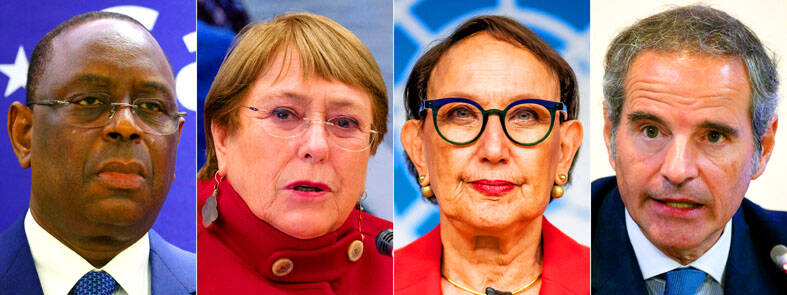
Four contenders are squaring up to succeed Antonio Guterres as secretary-general of the UN, which faces unprecedented global instability, wars and its own crushing budget crisis. Chile’s Michelle Bachelet, Argentina’s Rafael Grossi, Costa Rica’s Rebeca Grynspan and Senegal’s Macky Sall are each to face grillings by 193 member states and non-governmental organizations for three hours today and tomorrow. It is only the second time the UN has held a public question-and-answer, a format created in 2016 to boost transparency. Ultimately the five permanent members of the UN’s top body, the Security Council, hold the power, wielding vetoes over who leads the
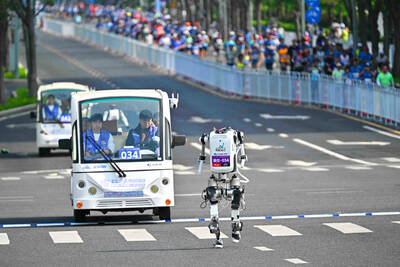
A humanoid robot that won a half-marathon race for robots in Beijing on Sunday ran faster than the human world record in a show of China’s technological leaps. The winner from Honor, a Chinese smartphone maker, completed the 21km race in 50 minutes and 26 seconds, said a WeChat post by the Beijing Economic-Technological Development Area, also known as Beijing E-Town, where the race began. That was faster than the human world record holder, Ugandan Jacob Kiplimo, who finished the same distance in about 57 minutes in March at the Lisbon road race. The performance by the robot marked a significant step forward
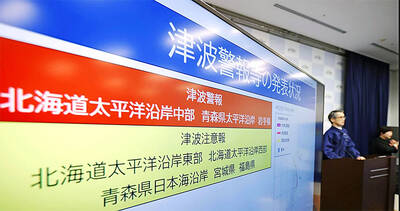
An earthquake registering a preliminary magnitude of 7.7 off northern Japan on Monday prompted a short-lived tsunami alert and the advisory of a higher risk of a possible mega-quake for coastal areas there. The Cabinet Office and the Japan Meteorological Agency said there was a 1% chance for a mega-quake, compared to a 0.1% chance during normal times, in the next week or so following the powerful quake near the Chishima and Japan trenches. Officials said the advisory was not a quake prediction but urged residents in 182 towns along the northeastern coasts to raise their preparedness while continuing their daily lives. Prime
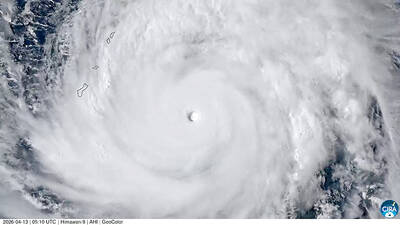
HAZARDOUS CONDITION: The typhoon’s sheer size, with winds extending 443km from its center, slowed down the ability of responders to help communities, an official said The US Coast Guard was searching for six people after losing contact with their disabled boat off the coast of Guam following Typhoon Sinlaku. The crew of the 44m dry cargo vessel, the US-registered Mariana, on Wednesday notified the coast guard that the boat had lost its starboard engine and needed assistance, Petty Officer 3rd Class Avery Tibbets said yesterday. The coast guard set up a one-hour communication schedule with the vessel, but lost contact on Thursday. A Coast Guard HC-130 Hercules aircraft was launched to search for the six people on board, but it had to return to Guam because of


 RSS
RSS