


Russian President Vladimir Putin yesterday vowed to strengthen the nation’s economy and military might, and rejected what he described as foreign lecturing about democracy and aatempts at foreign interference in its internal affairs.
Putin’s speech was his first state-of-the nation address since winning a third term in March’s election despite a wave of massive protests in Moscow. Putin has taken a tough course on dissent since his inauguration with arrests and searches of opposition activists and introduction of laws that impose heavy fines on protesters and rigid rules on civil society groups.
In a speech that focused heavily on social issues, Putin promised to encourage families to have more children, create 25 million new jobs and develop new incentives for teachers, doctors, engineers and others.
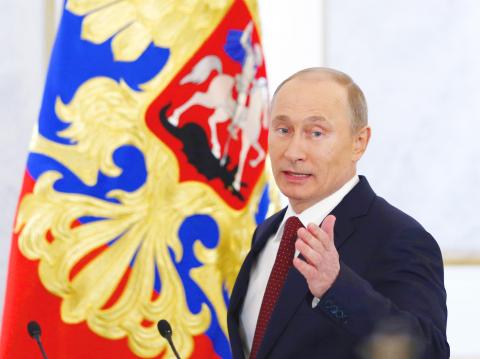
Photo: Reuters
He also pledged to support “institutions that represent traditional spiritual values,” a hint at even more state support for the Russian Orthodox Church.
In August, three members of the punk band Pussy Riot were sentenced to two years in prison for performing a protest song in Moscow’s main cathedral against the church’s backing for Putin. One of them was released on appeal, but two others are serving their sentences despite an international outrage over what was widely seen as the intolerance to dissent in Russia.
Putin said Russia would follow its own view on democracy and shrug off any “standards enforced on us from outside.”
“Direct or indirect foreign interference in our political processes is inadmissible,” he said. “Those who receive money from abroad for their political activities and serve alien interests shouldn’t engage in politics in Russia.”
One of the laws passed by the Kremlin-controlled parliament requires non-governmental organizations that receive foreign funding and engage in vaguely defined political activities to register as “foreign agents,” a move the groups said was aimed to intimidate them and destroy their credibility before the Russians where the term “agent” is synonymous to spy.
Putin said that on the global stage, Russia’s task will be to preserve its “national and spiritual identity,” adding that the strengthening of the nation’s military might should “guarantee its independence and security.”
He said Russia would continue to push for “coordinated collective efforts” in dealing with global issues.
The Kremlin has said that its continuous refusal to support international sanctions against Syrian President Bashar al-Assad is rooted in international law that bars interference in a sovereign country’s affairs.
Putin also made new promises to boost the fight against corruption.
“Corruption is destroying the resources of a national development,” he said.
Russia is considered to be one of the most corrupt countries in the world. A group that tracks global perception of the problem ranks Russia 143rd out of 183 countries.
Putin called for sanctioning officials who own foreign stocks or banks accounts abroad, and said they will have to explain the source of financing for big purchases including real estate abroad.
The statements would play well with the domestic audience, which has relished in the recent ouster of Anatoly Serdyukov as defense minister over a military corruption scandal and investigations against other officials suspected of graft.
Putin repeated pledges to reduce the nation’s reliance on exports of oil and other mineral resources and encourage the development of high-tech industries.
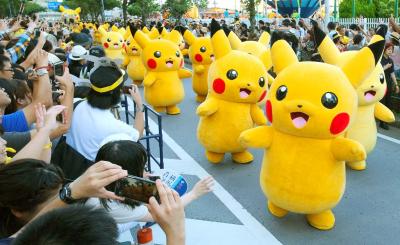
China’s military news agency yesterday warned that Japanese militarism is infiltrating society through series such as Pokemon and Detective Conan, after recent controversies involving events at sensitive sites. In recent days, anime conventions throughout China have reportedly banned participants from dressing as characters from Pokemon or Detective Conan and prohibited sales of related products. China Military Online yesterday posted an article titled “Their schemes — beware the infiltration of Japanese militarism in culture and sports.” The article referenced recent controversies around the popular anime series Pokemon, Detective Conan and My Hero Academia, saying that “the evil influence of Japanese militarism lives on in
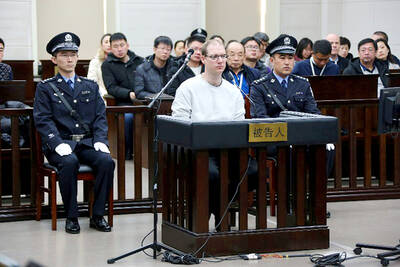
DIPLOMATIC THAW: The Canadian prime minister’s China visit and improved Beijing-Ottawa ties raised lawyer Zhang Dongshuo’s hopes for a positive outcome in the retrial China has overturned the death sentence of Canadian Robert Schellenberg, a Canadian official said on Friday, in a possible sign of a diplomatic thaw as Canadian Prime Minister Mark Carney seeks to boost trade ties with Beijing. Schellenberg’s lawyer, Zhang Dongshuo (張東碩), yesterday confirmed China’s Supreme People’s Court struck down the sentence. Schellenberg was detained on drug charges in 2014 before China-Canada ties nosedived following the 2018 arrest in Vancouver of Huawei chief financial officer Meng Wanzhou (孟晚舟). That arrest infuriated Beijing, which detained two Canadians — Michael Spavor and Michael Kovrig — on espionage charges that Ottawa condemned as retaliatory. In January

A sign hanging from a rusty ice-green shipping container installed by Thai forces on what they say is the border with Cambodia reads: “Cambodian citizens are strictly prohibited from entering this area.” On opposite sides of the makeshift barricade, fronted by coils of barbed wire, Cambodians lamented their lost homes and livelihoods as Thailand’s military showed off its gains. Thai forces took control of several patches of disputed land along the border during fighting last year, which could amount to several square kilometers in total. Cambodian Kim Ren said her house in Chouk Chey used to stand on what is now the Thai
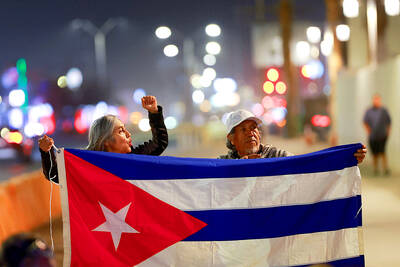
NEW RULES: There would be fewer school days, four-day workweeks, and a reduction in transportation services as the country battles a crisis exacerbated by US pressure The Cuban government on Friday announced emergency measures to address a crippling energy crisis worsened by US sanctions, including the adoption of a four-day work week for state-owned companies and fuel sale restrictions. Cuban Deputy Prime Minister Oscar Perez-Oliva Fraga blamed Washington for the crisis, telling Cuban television the government would “implement a series of decisions, first and foremost to guarantee the vitality of our country and essential services, without giving up on development.” “Fuel will be used to protect essential services for the population and indispensable economic activities,” he said. Among the new measures are the reduction of the working week in


 RSS
RSS