


The main Islamist rebel groups in Aleppo, a key front line in Syria’s civil war, on Monday rejected the newly formed opposition bloc, saying they want an Islamic state, as clashes raged countrywide.
“We, the fighting squads of Aleppo city and province, unanimously reject the conspiratorial project called the National Coalition and announce our consensus to establish an Islamic state” in Syria, a spokesman announced in an Internet video.
“We reject any external coalitions or councils imposed on us at home from any party whatsoever,” he said.
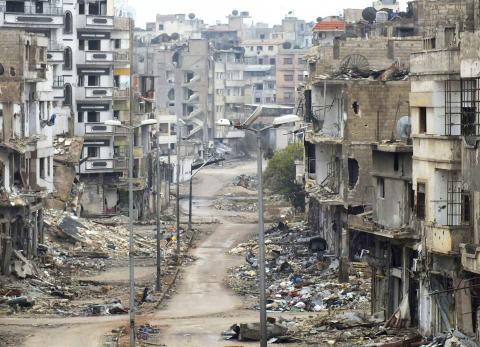
Photo: Reuters
The unidentified speaker sat at the head of a long table with at least 30 other men and a black Islamist flag on the wall.
He listed 14 armed groups as signatories to the statement, including the al-Nusra Front, Ahrar al-Sham and Liwa al-Tawhid.
However, the Ahrar al-Sham group rejected the proclamation on its official Web site, saying that its leadership did not endorse the statement.
The al-Nusra Front, a formidable fighting force, has claimed the majority of suicide bombings in Syria’s deadly 20-month-old conflict.
Abdel Jabbar al-Okaidi, the head of the mainstream rebel Free Syrian Army (FSA) in the embattled northern city of Aleppo, said the statement did not represent the opinion of all rebel groups in the province.
“These groups represent a number of military factions on the ground and reflect their position, but not all military forces in Aleppo agree with this,” the defected former army colonel said by telephone.
“The military council has announced its support for the National Coalition and is collaborating with them,” Okaidi added.
The new National Coalition aims to present a united front to the international community and is lobbying for weapons supplies to help topple Syrian President Bashar al-Assad’s regime.
On the ground, fighting flared along the Turkish border after rebels took control of the large army Base 46 in the northern province of Aleppo that had been besieged for weeks.
Six rebels were killed in clashes with Kurdish fighters and the head of the local Kurdish People’s Assembly was shot dead in the town of Ras al-Ain, the Britain-based Syrian Observatory for Human Rights reported.
The clashes erupted after a Kurdish demonstration demanding that all rebels not from Ras al-Ain leave after they took the town last week.
The Kurdish fighters belonged to the People’s Defense Units, the armed wing of the Democratic Union Party (PYD), which is linked to Turkey’s rebel Kurdistan Workers’ Party.
“The rebels burned a flag of the [Kurdish] Democratic Union Party and the Kurds reacted by burning the FSA flag,” an activist told AFP.
Rebels accuse Kurdish groups of negotiating directly with al-Assad’s regime, while Kurds question why the rebels entered a safe area.
“The Kurdish regions provide safe havens to thousands of refugees from Damascus, Hama and Homs,” PYD leader Saleh Muslim said by telephone.
“We are not looking for a confrontation with the FSA, but its members who provoked the incident today in Ras al-Ain receive their orders from Turkey,” he said.
Elsewhere, the Observatory said a general it named as Abdullah Darawi was killed in a rebel attack on the town of Nabak, north of Damascus, along with four policemen accompanying him.
The official SANA news agency blamed “terrorists” for the killings.
Fighting also erupted at a border post near the town of Kasab in Latakia Province, the Observatory said.
In the mountainous region of Jabal al-Turkman, eight rebels and four soldiers were killed after insurgents attacked an army convoy en route to Kasab.
The Observatory, which relies on a network of activists and medics, said at least 96 people were killed nationwide on Monday — 45 rebels, 26 civilians and 25 soldiers.
It puts the death toll in more than 20 months of conflict at more than 39,000.

An American scientist convicted of lying to US authorities about payments from China while he was at Harvard University has rebuilt his research lab in Shenzhen, China, to pursue technology the Chinese government has identified as a national priority: embedding electronics into the human brain. Charles Lieber, 67, is among the world’s leading researchers in brain-computer interfaces. The technology has shown promise in treating conditions such as amyotrophic lateral sclerosis and restoring movement in paralyzed people. It also has potential military applications: Scientists at the Chinese People’s Liberation Army have investigated brain interfaces as a way to engineer super soldiers by boosting
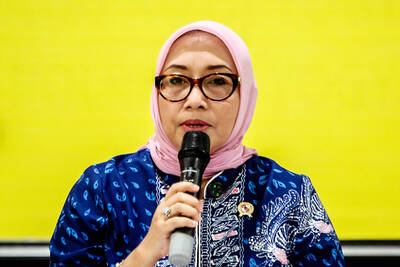
Indonesian police have arrested 13 people after shocking images of alleged abuse against small children at a daycare center went viral, sparking outrage across the nation, officials said on Monday. Police on Friday last week raided Little Aresha, a daycare center in Yogyakarta on Java island, following a report from a former employee. CCTV footage circulating on social media showed children, most younger than two, lying on the floor wearing only diapers, their hands and feet bound with rags. The police have confirmed that the footage is authentic. Police said they also found 20 children crammed into a room just 3m by 3m. “So
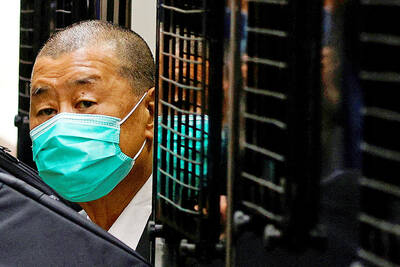
Jailed media entrepreneur Jimmy Lai (黎智英) has been awarded Deutsche Welle’s (DW) freedom of speech award for his contribution to Hong Kong’s pro-democracy movement. The German public broadcaster on Thursday said Lai would be presented in absentia with the 12th iteration of the award on June 23 at the DW Global Media Forum in Bonn. Deutsche Welle director-general Barbara Massing praised the 78-year-old founder of the now-shuttered news outlet Apple Daily for standing “unwaveringly for press freedom in Hong Kong at great personal risk.” “With Apple Daily, he gave journalists a platform for free reporting and a voice to the democracy movement in
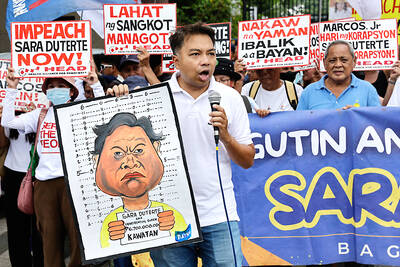
PHILIPPINE COMMITTEE: The head of the committee that made the decision said: ‘If there is nothing to hide, there is no reason to hide, there is no reason to obstruct’ A Philippine congressional committee on Wednesday ruled that there was “probable cause” to impeach Philippine Vice President Sara Duterte after hearing allegations of unexplained wealth, misuse of state funds and threats to have the president assassinated. The unanimous decision of the 53-member committee in the Philippine House of Representatives sends the two impeachment complaints to deliberations and voting by the entire lower chamber, which has more than 300 lawmakers. The complaints centered on Duterte’s alleged illegal use and mishandling of intelligence funds from the vice president’s office, and from her time as education secretary under Philippine President Ferdinand Marcos Jr. Duterte and the


 RSS
RSS