


South Korean President Lee Myung-bak yesterday warned that conflicts over bitter shared history were complicating ties with former colonial master Japan and urged Tokyo to do more to resolve an emotive dispute over Korean women abducted to serve as sex slaves to wartime Japanese soldiers.
Underscoring how history haunts Japan’s ties with neighboring South Korea and China, two Japanese Cabinet ministers paid homage at a controversial Tokyo shrine for war dead on the 67th anniversary of the end of World War II.
Despite close economic ties, memories of Japanese militarism run deep in China and South Korea.
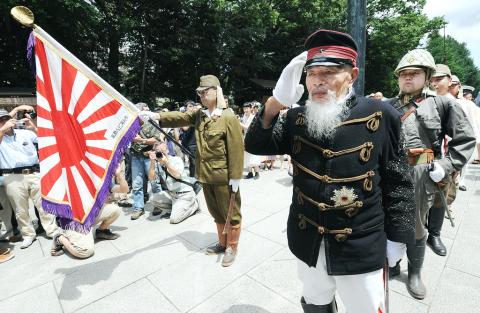
Photo: AFP
Recent feuding over rival claims to rocky islands are the latest sign of how the region has been unable to resolve differences over its past nearly seven decades after Japan’s defeat and the end of the occupation and colonization of its neighbors.
Lee, whose visit on Friday to an island claimed by both Seoul and Tokyo frayed ties between the two US allies, yesterday called Japan an “important partner that we should work with to open the future.”
However, in remarks commemorating Korea’s liberation from Japan’s 1910-1945 rule, Lee also said the countries’ tangled history was “hampering the common march toward a better tomorrow.”
He urged Tokyo to do more to resolve a dispute over compensation for Korean women abducted to serve as sex slaves for wartime Japanese soldiers, known by the euphemism “comfort women” in Japan and long a source of friction.
“It was a breach of women’s rights committed during wartime, as well as a violation of universal human rights and historic justice. We urge the Japanese government to take responsible measures in this regard,” Lee said.
Japan says the matter was closed under a 1965 treaty establishing diplomatic ties. In 1993, Tokyo issued a statement in the name of its then-chief Cabinet secretary and two years later set up a fund to make payments to the women, but South Korea say those moves were not official and so not enough.
The feuds reflect skepticism among Japan’s Asian neighbors over the sincerity of its apologies for wartime and colonial excesses. On Tuesday, Lee told a meeting of teachers that Japanese Emperor Akihito should apologize sincerely if he wants to visit South Korea, saying a repeat of his 1990 expression of “deepest regrets” would not suffice.
Speaking at a ceremony marking the war’s end yesterday, Japanese Prime Minister Yoshiko Noda acknowledged the “enormous damage and suffering” caused by Japan to other countries, especially in Asia.
“We deeply reflect upon [that] and express our deepest condolences to the victims and their families,” he said, vowing that Japan would never go to war again.
Tapping into anti-Japanese sentiment remains a way to seek public support in South Korea and China, which face leadership changes in the coming months, and some experts see a new strain of nationalism surfacing in Japan amid frustration at the country’s stagnant economy and disappointment with Noda’s ruling party three years after it surged to power on hopes for change.
In a sign of the domestic pressures, Japanese National Public Safety Commission Chairman Jin Matsubara and Japanese Transport Minister Yuichiro Hata visited the Yasukuni Shrine for war dead, defying Noda’s urgings to stay away.
Many see the shrine as a symbol of Japan’s past militarism because 14 Japanese wartime leaders convicted as war criminals by an Allied tribunal are honored there, along with Japan’s war dead.
Wednesday’s visit was the first by a cabinet minister since the Democrats swept to power in 2009, promising to forge warmer ties with the rest of Asia.
The China Daily, Beijing’s main English-language newspaper, warned that the shrine visits risked “putting hard-won diplomatic relations with China in jeopardy.”
“Some Japanese politicians are trying to distract the Japanese public from domestic problems by creating conflicts with China, but this is just doubling down on a bad bet,” a commentary said.
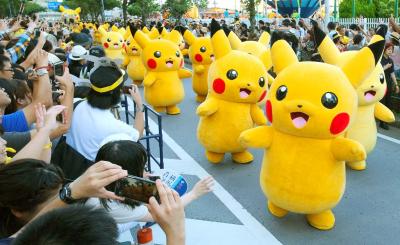
China’s military news agency yesterday warned that Japanese militarism is infiltrating society through series such as Pokemon and Detective Conan, after recent controversies involving events at sensitive sites. In recent days, anime conventions throughout China have reportedly banned participants from dressing as characters from Pokemon or Detective Conan and prohibited sales of related products. China Military Online yesterday posted an article titled “Their schemes — beware the infiltration of Japanese militarism in culture and sports.” The article referenced recent controversies around the popular anime series Pokemon, Detective Conan and My Hero Academia, saying that “the evil influence of Japanese militarism lives on in

DIPLOMATIC THAW: The Canadian prime minister’s China visit and improved Beijing-Ottawa ties raised lawyer Zhang Dongshuo’s hopes for a positive outcome in the retrial China has overturned the death sentence of Canadian Robert Schellenberg, a Canadian official said on Friday, in a possible sign of a diplomatic thaw as Canadian Prime Minister Mark Carney seeks to boost trade ties with Beijing. Schellenberg’s lawyer, Zhang Dongshuo (張東碩), yesterday confirmed China’s Supreme People’s Court struck down the sentence. Schellenberg was detained on drug charges in 2014 before China-Canada ties nosedived following the 2018 arrest in Vancouver of Huawei chief financial officer Meng Wanzhou (孟晚舟). That arrest infuriated Beijing, which detained two Canadians — Michael Spavor and Michael Kovrig — on espionage charges that Ottawa condemned as retaliatory. In January

A sign hanging from a rusty ice-green shipping container installed by Thai forces on what they say is the border with Cambodia reads: “Cambodian citizens are strictly prohibited from entering this area.” On opposite sides of the makeshift barricade, fronted by coils of barbed wire, Cambodians lamented their lost homes and livelihoods as Thailand’s military showed off its gains. Thai forces took control of several patches of disputed land along the border during fighting last year, which could amount to several square kilometers in total. Cambodian Kim Ren said her house in Chouk Chey used to stand on what is now the Thai
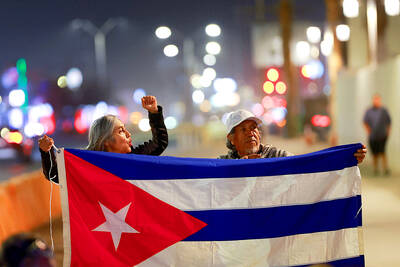
NEW RULES: There would be fewer school days, four-day workweeks, and a reduction in transportation services as the country battles a crisis exacerbated by US pressure The Cuban government on Friday announced emergency measures to address a crippling energy crisis worsened by US sanctions, including the adoption of a four-day work week for state-owned companies and fuel sale restrictions. Cuban Deputy Prime Minister Oscar Perez-Oliva Fraga blamed Washington for the crisis, telling Cuban television the government would “implement a series of decisions, first and foremost to guarantee the vitality of our country and essential services, without giving up on development.” “Fuel will be used to protect essential services for the population and indispensable economic activities,” he said. Among the new measures are the reduction of the working week in


 RSS
RSS