


Rebels fighting to depose Syrian President Bashar al-Assad have for the first time acquired a small supply of surface-to-air missiles, according to a news report that a Western official did not dispute.
NBC News reported on Tuesday night that the rebel Free Syrian Army had obtained nearly two dozen of the weapons, which were delivered to them via Turkey, whose moderate Islamist government has been demanding al-Assad’s departure with increasing vehemence.
The indications are that the US government, which has said it opposes arming the rebels, is not responsible for the delivery of the missiles.
However, some US government sources have been saying for weeks that Arab governments seeking to oust al-Assad, including Saudi Arabia and Qatar, have been pressing for such missiles, also known as man-portable air-defense systems (MANPADs), to be supplied to the rebels.
In recent days, air operations against the rebels by Syrian government forces appear to have been stepped up, particularly around the contested city of Aleppo, making the rebels’ need for MANPADs more urgent.
Precisely what kind of MANPADs have been delivered to the Syrian rebels is unclear and NBC News did not provide details. Such weapons range from the primitive to highly sophisticated.
Some conservative US lawmakers such as Republican Senators John McCain and Lindsey Graham, have criticized the administration of US President Barack Obama for moving too slowly to assist the rebels and have suggested the US government should become directly involved in arming al-Assad’s opponents.
The White House, at least until now, has taken a considerably more cautious approach.
As of last month, US officials warned that if any Middle Eastern nation was “even considering giving arms to the Syrian opposition,” it ought to “take a measured approach and think twice about providing arms that could have unintended consequences.”
Nonetheless, even at that time, US and allied officials acknowledged that officials from Saudi Arabia and Qatar were discussing whether surface-to-air missiles might help Syrian rebels bring down the Russian-made helicopters and other aircraft used by the Syrian army to move troops between trouble spots.
Following the fall of former Libyan leader Muammar Qaddafi, some intelligence experts estimated that as many as 10,000 to 15,000 MANPADs sets were looted from Libyan government stockpiles. The whereabouts of most of these are unknown.
Many US officials have been wary of arming Syrian rebels with MANPADs, saying they could be easily turned on targets other than the Syrian government, including civilian airliners.
After the Soviet Union invaded Afghanistan, the CIA, with Saudi backing, provided sophisticated shoulder-fired Stinger missiles to Islamic militants seeking to oust Soviet troops.
The missiles proved deadly against Soviet helicopter gunships, but subsequently became a major headache for US and western counter-terrorism agencies when anti-Soviet militants morphed into anti-Western militants.
Recent intelligence and news reporting has suggested a growing number of militants, including some affiliated with al-Qaeda, have traveled to Syria to try to join anti-Assad forces. However, US officials have said they do not believe the militants yet play a dominant role in the Syrian opposition.
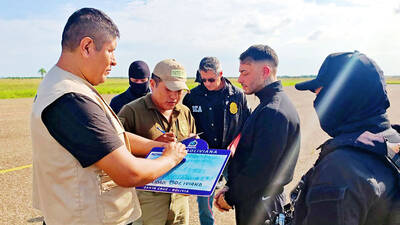
KINGPIN: Marset allegedly laundered the proceeds of his drug enterprise by purchasing and sponsoring professional soccer teams and even put himself in the starting lineups Notorious Latin American narco trafficker Sebastian Marset, who eluded police for years, was handed over to US authorities after his arrest on Friday in Bolivia. Marset, a Uruguayan national who was on the US most-wanted list, was passed to agents of the US Drug Enforcement Administration at Santa Cruz airport in Bolivia, then put on a US airplane, Bolivian state television showed. “The arrest and deportation were carried out pursuant to a court order issued by the US justice system,” Bolivian Minister of Government Marco Antonio Oviedo told reporters. The alleged kingpin was arrested in an upscale neighborhood of Santa
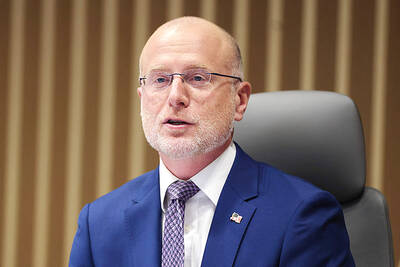
FAKE NEWS? ‘When the government demands the press become a state mouthpiece under the threat of punishment, something has gone very wrong,’ a civic group said The top US broadcast regulator on Saturday threatened media outlets over negative coverage of the Middle East war, after US President Donald Trump slammed critical headlines from the “Fake News Media.” The US president since his first term has derided mainstream media as “fake news” and has sued major outlets over what he sees as unfair coverage. Brendan Carr, head of the US Federal Communications Commission — which oversees the nation’s radio, television and Internet media — said broadcasters risked losing their licenses over news coverage. “The law is clear. Broadcasters must operate in the public interest, and they will
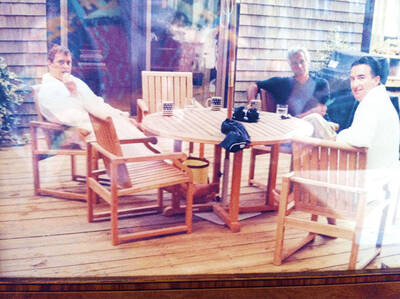
SCANDAL: Other images discovered earlier show Andrew bent over a female and lying across the laps of a number of women, while Mandelson is pictured in his underpants A photograph of former British prince Andrew and veteran politician Peter Mandelson sitting in bathrobes alongside late sex offender Jeffrey Epstein was unearthed on Friday in previously published documents. The image is believed to be the first known photograph of the two men with Epstein. They are currently engulfed in scandal in the UK over their ties to their mutual friend. The undated photograph, first reported by ITV News, shows King Charles III’s disgraced brother and former British ambassador to the US sitting barefoot outside on a wooden deck. They appear to have mugs with a US flag on them
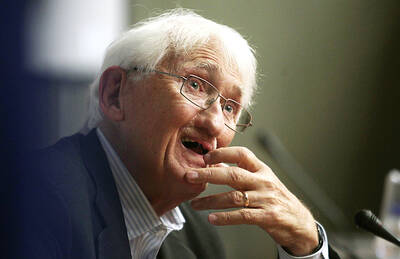
INFLUTENTIAL THEORIST: Habermas was particularly critical of the ‘limited interest’ shown by German politicians in ‘shaping a politically effective Europe Jurgen Habermas, whose work on communication, rationality and sociology made him one of the world’s most influential philosophers and a key intellectual figure in his native Germany, has died. He was 96. Habermas’ publisher, Suhrkamp, said he died on Saturday in Starnberg, near Munich. Habermas frequently weighed in on political matters over several decades. His extensive writing crossed the boundaries of academic and philosophical disciplines, providing a vision of modern society and social interaction. His best-known works included the two-volume Theory of Communicative Action. Habermas, who was 15 at the time of Nazi Germany’s defeat, later recalled the dawn of


 RSS
RSS