


Australian Prime Minister Julia Gillard hit the jackpot yesterday when she was recommended for a 31 percent pay rise to take her salary to A$481,000 (US$476,000) — more than US President Barack Obama.
Gillard, whose support in opinion polls is near rock bottom, was handed the early Christmas present by the independent Remuneration Tribunal, which recommended pay hikes for most politicians and public servants.
Parliament needs to approve the changes before the new scale comes into effect.
Cabinet ministers will see their salary rise from A$224,300 to A$319,125, while federal members of parliament (MP) will also get pay hikes, with the base salary for even the most junior parliamentarian jumping from A$140,000 to A$185,000.
In exchange, politicians will lose some of their perks, such as being able to fly first class for overseas study tours.
Australia’s controversial gold pass scheme, under which former MPs travel for free, will also be phased out.
Tribunal president John Conde said of Gillard’s projected pay rise: “In our view, that is not an unreasonable salary for the prime -minister of Australia, whoever he or she may be.”
It was important to have good pay to attract people to parliament, he said.
Asked whether it was the right time in the economic cycle to be thinking about pay rises, Conde said: “There is never a right time for this.
“It’s been a long time coming. We’ve concluded our work and this is our conclusion,” Conde said.
According to the White House, Obama earns a salary of US$395,188 as president.
While Gillard’s earnings — currently a yearly US$367,000 — are significantly more than the average annual wage of less than A$55,000, her salary pales in comparison with some of the country’s top chief executives.
BHP Billiton chief Marius Kloppers earns more than A$11 million, while the head of Westpac Bank, Gail Kelly, takes home more than A$8 million.
The tribunal’s report found that the pay rises for MPs were justified by the advent of e-mail and social networking.
“E-mail, Facebook, Twitter and the like have increased community expectations on members as regards their availability to their constituents,” it said. “As some members at interview noted, this means that they are now never off duty.”
However, Australian Minister of Resources and Energy Martin Ferguson told reporters he did not need a pay rise, but accepted the tribunal’s decision.
“I actually think my ministerial salary is pretty good,” he said.
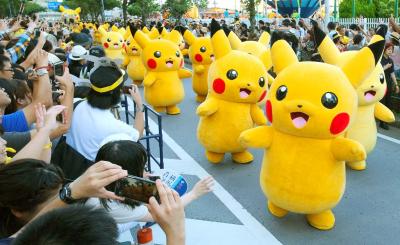
China’s military news agency yesterday warned that Japanese militarism is infiltrating society through series such as Pokemon and Detective Conan, after recent controversies involving events at sensitive sites. In recent days, anime conventions throughout China have reportedly banned participants from dressing as characters from Pokemon or Detective Conan and prohibited sales of related products. China Military Online yesterday posted an article titled “Their schemes — beware the infiltration of Japanese militarism in culture and sports.” The article referenced recent controversies around the popular anime series Pokemon, Detective Conan and My Hero Academia, saying that “the evil influence of Japanese militarism lives on in

DIPLOMATIC THAW: The Canadian prime minister’s China visit and improved Beijing-Ottawa ties raised lawyer Zhang Dongshuo’s hopes for a positive outcome in the retrial China has overturned the death sentence of Canadian Robert Schellenberg, a Canadian official said on Friday, in a possible sign of a diplomatic thaw as Canadian Prime Minister Mark Carney seeks to boost trade ties with Beijing. Schellenberg’s lawyer, Zhang Dongshuo (張東碩), yesterday confirmed China’s Supreme People’s Court struck down the sentence. Schellenberg was detained on drug charges in 2014 before China-Canada ties nosedived following the 2018 arrest in Vancouver of Huawei chief financial officer Meng Wanzhou (孟晚舟). That arrest infuriated Beijing, which detained two Canadians — Michael Spavor and Michael Kovrig — on espionage charges that Ottawa condemned as retaliatory. In January

A sign hanging from a rusty ice-green shipping container installed by Thai forces on what they say is the border with Cambodia reads: “Cambodian citizens are strictly prohibited from entering this area.” On opposite sides of the makeshift barricade, fronted by coils of barbed wire, Cambodians lamented their lost homes and livelihoods as Thailand’s military showed off its gains. Thai forces took control of several patches of disputed land along the border during fighting last year, which could amount to several square kilometers in total. Cambodian Kim Ren said her house in Chouk Chey used to stand on what is now the Thai
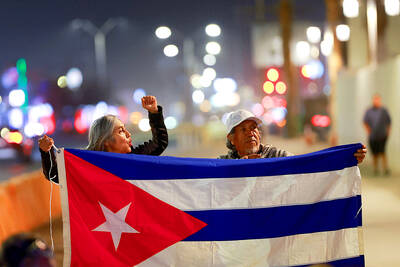
NEW RULES: There would be fewer school days, four-day workweeks, and a reduction in transportation services as the country battles a crisis exacerbated by US pressure The Cuban government on Friday announced emergency measures to address a crippling energy crisis worsened by US sanctions, including the adoption of a four-day work week for state-owned companies and fuel sale restrictions. Cuban Deputy Prime Minister Oscar Perez-Oliva Fraga blamed Washington for the crisis, telling Cuban television the government would “implement a series of decisions, first and foremost to guarantee the vitality of our country and essential services, without giving up on development.” “Fuel will be used to protect essential services for the population and indispensable economic activities,” he said. Among the new measures are the reduction of the working week in


 RSS
RSS