


A gunman shot by police at the University of California, Berkeley, was a student and has died of his wounds, officials said on Wednesday, downplaying links with anti-Wall Street protests.
The 32-year-old died late on Tuesday after the shooting, which occurred as hundreds of protesters descended on the elite college — although there was no link between the protests and the incident.
The police officers involved have been placed on administrative leave while an investigation into the shooting continues.
“He passed away yesterday evening. He was involved as an undergraduate student at our Haas School of Business,” Berkeley spokeswoman Claire Holmes said, adding: “He died in surgery.”
“This is one of the most difficult times we have had as a community,” University chancellor Robert Birgeneau told staff and students at the grief-stricken Haas School of Business community.
The student — named as Christopher Nathen Elliot Travis — was shot by police in a computer lab at the business school, after refusing to surrender his weapon when asked to by officers, police said on Tuesday.
Giving an update on Wednesday, 24 hours after the shooting, UC Berkeley Police Captain Margo Bennett said Travis was carrying a loaded, semiautomatic 9mm Ruger handgun when he was shot multiple times at about 2:25pm on Tuesday.
No motive had yet been found, Bennett said, adding that 20 witnesses had so far been questioned.
She described how four officers entered the school’s computer lab, where Travis had gone, and where there were nine people.
“Upon noticing the officers, Travis pulled out his gun. The police repeatedly asked him to ‘put down the gun, put down the gun, put down the weapon,’” she said.
Instead, “Travis pointed his gun at the officers. One of the officers shot at Travis,” a Berkeley statement said, adding that officers applied first aid until paramedics arrived to take him to hospital, where he died.
Holmes added there was still no indication that the shooting, the first such incident on the campus since the 1980s, was linked with the protesters.
“As far as we know, there is no link with the protesters at this time that we can determine,” she said.
The officer who shot the suspect was put on administrative leave immediately after the shooting, along with two other officers, as was normal policy in such circumstances, UC Berkeley Police Chief Mitchell Celaya said.
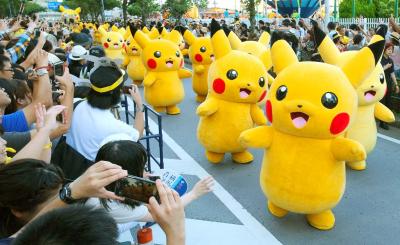
China’s military news agency yesterday warned that Japanese militarism is infiltrating society through series such as Pokemon and Detective Conan, after recent controversies involving events at sensitive sites. In recent days, anime conventions throughout China have reportedly banned participants from dressing as characters from Pokemon or Detective Conan and prohibited sales of related products. China Military Online yesterday posted an article titled “Their schemes — beware the infiltration of Japanese militarism in culture and sports.” The article referenced recent controversies around the popular anime series Pokemon, Detective Conan and My Hero Academia, saying that “the evil influence of Japanese militarism lives on in
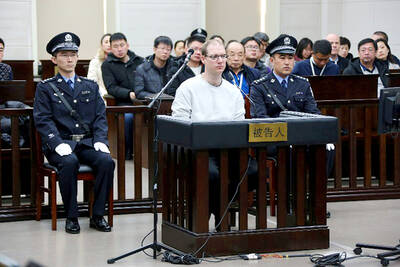
DIPLOMATIC THAW: The Canadian prime minister’s China visit and improved Beijing-Ottawa ties raised lawyer Zhang Dongshuo’s hopes for a positive outcome in the retrial China has overturned the death sentence of Canadian Robert Schellenberg, a Canadian official said on Friday, in a possible sign of a diplomatic thaw as Canadian Prime Minister Mark Carney seeks to boost trade ties with Beijing. Schellenberg’s lawyer, Zhang Dongshuo (張東碩), yesterday confirmed China’s Supreme People’s Court struck down the sentence. Schellenberg was detained on drug charges in 2014 before China-Canada ties nosedived following the 2018 arrest in Vancouver of Huawei chief financial officer Meng Wanzhou (孟晚舟). That arrest infuriated Beijing, which detained two Canadians — Michael Spavor and Michael Kovrig — on espionage charges that Ottawa condemned as retaliatory. In January

A sign hanging from a rusty ice-green shipping container installed by Thai forces on what they say is the border with Cambodia reads: “Cambodian citizens are strictly prohibited from entering this area.” On opposite sides of the makeshift barricade, fronted by coils of barbed wire, Cambodians lamented their lost homes and livelihoods as Thailand’s military showed off its gains. Thai forces took control of several patches of disputed land along the border during fighting last year, which could amount to several square kilometers in total. Cambodian Kim Ren said her house in Chouk Chey used to stand on what is now the Thai
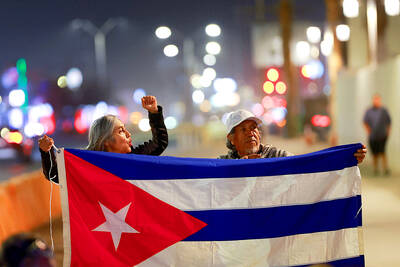
NEW RULES: There would be fewer school days, four-day workweeks, and a reduction in transportation services as the country battles a crisis exacerbated by US pressure The Cuban government on Friday announced emergency measures to address a crippling energy crisis worsened by US sanctions, including the adoption of a four-day work week for state-owned companies and fuel sale restrictions. Cuban Deputy Prime Minister Oscar Perez-Oliva Fraga blamed Washington for the crisis, telling Cuban television the government would “implement a series of decisions, first and foremost to guarantee the vitality of our country and essential services, without giving up on development.” “Fuel will be used to protect essential services for the population and indispensable economic activities,” he said. Among the new measures are the reduction of the working week in


 RSS
RSS