


The UK and the US rejected calls from China and Russia for greater Internet controls on Tuesday at the opening of a major cyberspace conference, but Western states faced accusations of double standards.
Ministers, tech executives and Internet activists are meeting over two days in London to discuss how to tackle security threats and crime on the Internet without stifling economic opportunities or freedom of speech.
While Western states worry about intellectual property theft and hacking, authoritarian governments are alarmed at the role the Internet and social media played in the protests that swept the Arab world this year.
“Too many states around the world are seeking to go beyond legitimate interference or disagree with us about what constitutes ‘legitimate’ behavior,” UK Foreign Secretary William Hague told the meeting. “We saw in Tunisia, Egypt and Libya that cutting off the Internet, blocking Facebook, jamming al-Jazeera, intimidating journalists and imprisoning bloggers does not create stability or make grievances go away ... The idea of freedom cannot be contained behind bars, no matter how strong the lock.”
In September, China, Russia, Tajikistan and Uzbekistan proposed to the UN a global code of conduct, including the principle that “policy authority for Internet-related public issues is the sovereign right of states.”
Cybersecurity experts say Western states hope to fend off Russian, Chinese and other calls for a “cybertreaty” and to prompt those states to rein in hackers.
On the eve of the conference, the head of the UK’s communications spy agency said UK government and industry computer systems faced a “disturbing” number of cyberattacks, including a serious assault on the UK Foreign Office’s network.
Speaking by videoconference after US Secretary of State Hillary Rodham Clinton pulled out citing her mother’s health problems, US Vice President Joe Biden said states and others needed to make sure they followed existing laws when it came to cyberspace.
“The Internet represents and presents new challenges, but to resolve them we don’t need to start from scratch,” Biden said. “International law principles are not suspended in cyberspace. They apply there ... with equal force and equal urgency.”
He said a desire for greater security did not mean that civil liberties should simply be ignored.
“The tactic of invoking security as a justification for harsh crackdowns on freedom is not new in the digital age, but it has new resonance as the Internet has given governments new capacities for tracking and punishing human rights advocates and political dissidents,” Biden said.
Cybersecurity experts and Western intelligence officers say they believe many recent cyberattacks emanate from China, although there seemed little appetite for such direct talk in public sessions at the London conference.
It was unclear whether Western states took a different approach at a closed session on international security. European states, in particular, are seen as being wary of offending Beijing at a time when they sorely need its financial aid.
About 60 countries — including China, Russia and India — are represented at the conference, as well as tech industry figures such as Jimmy Wales, founder of Wikipedia, and senior executives from Facebook and Google.
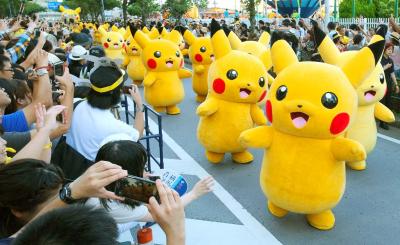
China’s military news agency yesterday warned that Japanese militarism is infiltrating society through series such as Pokemon and Detective Conan, after recent controversies involving events at sensitive sites. In recent days, anime conventions throughout China have reportedly banned participants from dressing as characters from Pokemon or Detective Conan and prohibited sales of related products. China Military Online yesterday posted an article titled “Their schemes — beware the infiltration of Japanese militarism in culture and sports.” The article referenced recent controversies around the popular anime series Pokemon, Detective Conan and My Hero Academia, saying that “the evil influence of Japanese militarism lives on in
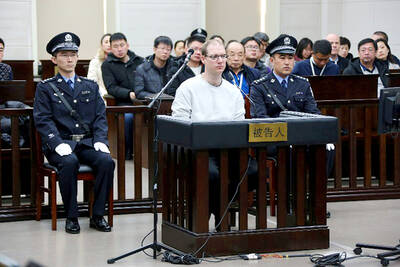
DIPLOMATIC THAW: The Canadian prime minister’s China visit and improved Beijing-Ottawa ties raised lawyer Zhang Dongshuo’s hopes for a positive outcome in the retrial China has overturned the death sentence of Canadian Robert Schellenberg, a Canadian official said on Friday, in a possible sign of a diplomatic thaw as Canadian Prime Minister Mark Carney seeks to boost trade ties with Beijing. Schellenberg’s lawyer, Zhang Dongshuo (張東碩), yesterday confirmed China’s Supreme People’s Court struck down the sentence. Schellenberg was detained on drug charges in 2014 before China-Canada ties nosedived following the 2018 arrest in Vancouver of Huawei chief financial officer Meng Wanzhou (孟晚舟). That arrest infuriated Beijing, which detained two Canadians — Michael Spavor and Michael Kovrig — on espionage charges that Ottawa condemned as retaliatory. In January

A sign hanging from a rusty ice-green shipping container installed by Thai forces on what they say is the border with Cambodia reads: “Cambodian citizens are strictly prohibited from entering this area.” On opposite sides of the makeshift barricade, fronted by coils of barbed wire, Cambodians lamented their lost homes and livelihoods as Thailand’s military showed off its gains. Thai forces took control of several patches of disputed land along the border during fighting last year, which could amount to several square kilometers in total. Cambodian Kim Ren said her house in Chouk Chey used to stand on what is now the Thai

NEW RULES: There would be fewer school days, four-day workweeks, and a reduction in transportation services as the country battles a crisis exacerbated by US pressure The Cuban government on Friday announced emergency measures to address a crippling energy crisis worsened by US sanctions, including the adoption of a four-day work week for state-owned companies and fuel sale restrictions. Cuban Deputy Prime Minister Oscar Perez-Oliva Fraga blamed Washington for the crisis, telling Cuban television the government would “implement a series of decisions, first and foremost to guarantee the vitality of our country and essential services, without giving up on development.” “Fuel will be used to protect essential services for the population and indispensable economic activities,” he said. Among the new measures are the reduction of the working week in


 RSS
RSS