


British Prime Minister David Cameron and French President Nicolas Sarkozy gave Libya’s new rulers strong support during a landmark visit to Tripoli yesterday, vowing to release billions of dollars more in frozen assets and to push ahead with NATO strikes against former Libyan leader Muammar Qaddafi’s last strongholds.
Cameron told the fugitive Libyan leader and his backers, “It is over. Give up.”
The two were the first world leaders to travel to Tripoli since revolutionary forces, backed by NATO airstrikes, swept into the capital and forced Qaddafi into hiding. The visit aimed to give a significant boost to the National Transitional Council (NTC), the body of former rebels that is widely recognized as the new leadership, but faces a major struggle in establishing its authority.
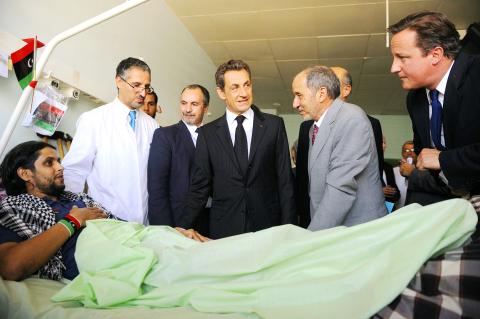
Photo: AFP
At a press conference alongside NTC chief Mustafa Abdul-Jalil and Prime Minister Mahmoud Jibril, Cameron and Sarkozy both expressed their backing for the council.
Cameron said he would push for the release to the council of billions of dollars in Libyan assets that had been frozen to punish Qaddafi’s regime. To that end, he announced Britain would introduce a draft resolution to the UN Security Council today authorizing the release of all Libyan assets.
Cameron also pledged the NATO mission would continue since Qaddafi loyalists are still battling revolutionary forces on three fronts in central and southern Libya.
“There are still parts of Libya under Qaddafi’s control, Qaddafi is still at large, and we must make sure this work is completed,” he said.
He called on all the holdouts to stop fighting.
“The message I think to Qaddafi and all those holding arms on his behalf is: It is over. Give up. The mercenaries should go home,” he said. “It is time for him to give himself up and time for Libyan people get the justice they deserve by seeing him face justice.”
Britain and France led international support for the rebellion and their countries were major contributors to NATO airstrikes that helped turn the tide in favor of the opposition.
Sarkozy said Qaddafi and others who “committed crimes” will be brought to justice, but urged Libyans to avoid “vengeance” and seek unity and reconciliation.
The NTC and an executive committee it created are largely made up of technocrats — some of whom were once would-be reformers in Qaddafi’s regime who grew disillusioned and left — and representatives from town and cities around the country. It not only faces the task of winning control over the last Qaddafi strongholds, it also must rein in the numerous armed groups and factions under the former rebel umbrella.
The flow of more of the frozen funds from abroad could boost its hand.
A Cameron spokeswoman, who spoke on condition of anonymity in line with policy, said a new Security Council resolution authorizing the release of all frozen Libyan assets has support of all five permanent members.
Britain has also won approval from the UN sanctions committee on Libya to release a further US$950 million immediately to fund public sector salaries, she said.
Britain will also offer funds for weapons decommissioning, mine clearance, medical assistance for those with grave combat injuries and specialist help in locating and secure chemical weapons.
NATO forces continued to go after the holdout loyalist forces. Airstrikes hit targets 24 targets on Wednesday, including several radar systems and surface-to-air missile systems near the three main strongholds of Qaddafi’s supporters — his hometown of Sirte, Bani Walid and Sabha — as well as smaller holdouts Waddan and Zillah, the alliance said.
Cameron and Sarkozy were greeted at Tripoli’s airport by NTC leaders. Security was tight in the coastal capital, with Apache helicopters buzzing over the Mediterranean Sea.
Several Libyans clapped and reached out to touch the British and French leaders as they walked toward a hospital, where they met with amputees and other patients who were injured in the fight against Qaddafi. Doctors, nurses and other staff also offered a round of applause and chanted Libyan freedom slogans.
French Finance Minister Francois Baroin said the visit was not about landing economic deals, but about showing support for the former rebels who ousted Qaddafi.
Baroin, speaking on France-Info radio, said the visit “is a strong gesture, it is a historic moment to go today to Libya.”
Asked whether there were economic arguments for the visit, Baroin said: “We are not at that stage.”
France’s focus is not yet on reconstruction contracts, but on supporting the interim leadership and pursuing “the last pro-Qaddafi pockets,” he said.

When a hiker fell from a 55m waterfall in wild New Zealand bush, rescuers were forced to evacuate the badly hurt woman without her dog, which could not be found. After strangers raised thousands of dollars for a search, border collie Molly was flown to safety by a helicopter pilot who was determined to reunite the pet and the owner. A week earlier, an emergency rescue helicopter found the woman with bruises and lacerations after a fall at a rocky spot at the waterfall on the South Island’s West Coast. She was airlifted on March 24, but they were forced to

CONFIDENCE BOOSTER: ’After parkour ... you dare to do a lot of things that you think only young people can do,’ a 67-year-old parkour enthusiast said In a corner of suburban Singapore, Betty Boon vaults a guardrail, crawls underneath a slide, executes forward shoulder rolls and scales a steep slope, finishing the course to applause. “Good job,” the 69-year-old’s coach cheers. This is “geriatric parkour,” where about 20 retirees learned to tackle a series of relatively demanding exercises, building their agility and enjoying a sense of camaraderie. Boon, an upbeat grandmother, said learning parkour has aided her confidence and independence as she ages. “When you’re weak, you will be dependent on someone,” she said after sweating it out with her parkour classmates in suburban Toa Payoh,
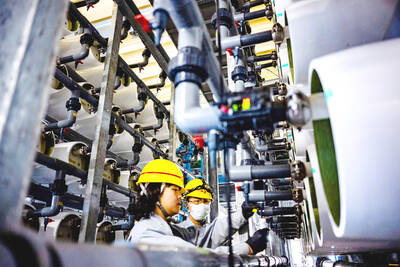
HIGH HOPES: The power source is expected to have a future, as it is not dependent on the weather or light, and could be useful for places with large desalination facilities A Japanese water plant is harnessing the natural process of osmosis to generate renewable energy that could one day become a common power source. The possibility of generating power from osmosis — when water molecules pass from a less salty solution to a more salty one — has long been known. However, actually generating energy from that has proved more complicated, in part due the difficulty of designing the membrane through which the molecules pass. Engineers in Fukuoka, Japan, and their private partners think they might have cracked it, and have opened what is only the world’s second osmotic power plant. It generates

Chinese dissident artist Gao Zhen (高兟), famous for making provocative satirical sculptures of former Chinese leader Mao Zedong (毛澤東), was tried on Monday over accusations of “defaming national heroes and martyrs,” his wife and a rights group said. Gao, 69, who was detained in 2024 during a visit from the US, faces a maximum three-year prison sentence, said his wife, Zhao Yaliang (趙雅良), and Shane Yi, a researcher at the Chinese Human Rights Defenders group which operates outside the nation. The closed-door, one-day trial took place at Sanhe City People’s Court in Hebei Province neighboring the capital, Beijing, and ended without a


 RSS
RSS