


A dramatic Taliban assault on the heart of Kabul inflicted relatively little damage, but scored an important strategic victory for insurgents who showed again they can strike at will, analysts said.
The US ambassador to Afghanistan dismissed the raid, which left 15 dead and six foreign troops wounded, as “not a very big deal” in a 10-year war launched to dislodge the Taliban.
However, Joshua Foust, a fellow at the American Society Project, described the coordinated attacks as a psychological “disaster” for NATO and Afghan forces.
“Its scale, length and audacity, whatever the actual damage it caused, makes it significant,” he wrote.
Writing on the Web site Registan.net, Foust said the audacious 20-hour raid was the latest sign of the foreign and national militaries’ “inability to counter an insurgency hell bent on disrupting the capital.”
For the insurgents “it is an operational failure, but a media and therefore strategic success,” a Western military source said on condition of anonymity. “Their aim is to show that they have the edge ... and that no part of Afghan territory is out of their range.”
This year has seen a number of high-profile insurgent attacks, including a suicide bombing on the British Council cultural body last month and the storming of the luxury Intercontinental Hotel in June.
However, the “intensity and scope” of the latest raid “was unexpected,” Afghanistan Analysts Network researcher Fabrizio Foschini said.
Foust said that since the start of this year, “the attacks in Kabul have become more intense, lasted longer, demonstrated better intelligence and tactics on the part of the insurgency, and struck ever more supposedly secure targets.”
The Taliban’s tactics amount to “propaganda of the deed, of using their assaults to send a very deliberate message to the Afghan people: You are not safe, you are not secure and the West cannot protect you,” Foust said.
The attacks have sown further doubt among Afghans over the ability of their own security forces to protect the nation after 2014, when the last of the foreign combat troops are due to leave under a phased drawdown.
The insurgents have “put their effort into the areas where the transition process has already started and in Kabul, the place where there is the most powerful media impact,” the Western military source said.
Suspicions of complicity between the Taliban and elements within the Afghan security services have been heightened by the rampage in Kabul, with signs that information leaks and infiltration in security services are increasing.
That the Taliban could move men and weapons — including rockets, an 82mm mortar and a machine-gun, according to the interior ministry — so close to the city’s most sensitive locations indicates “possible collusion,” a Western diplomat said.
Foschini said the chaos in the city could further poison the atmosphere surrounding the presence of US-led foreign forces.
“The possible perception among Afghan residents that the presence of foreigners is a catalyst for attacks may lead to a growing conclusion that the problems related to their presence far outweigh the benefits,” he said.
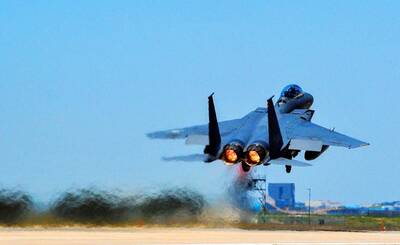
South Korea’s air force yesterday apologized for a 2021 midair collision involving two fighter jets, a day after auditors said the pilots were taking selfies and filming during the flight and held them responsible for the accident. “We sincerely apologize to the public for the concern caused by the accident that occurred in 2021,” an air force spokesman told a news conference, adding that one of the pilots involved had been suspended from flying duties, received severe disciplinary action and has since left the military. The apology followed a report released on Wednesday by the South Korean Board of Audit and Inspection,

About 240 Indians claiming descent from a Biblical tribe landed at Tel Aviv airport on Thursday as part of a government operation to relocate them to Israel. The newcomers passed under a balloon arch in blue and white, the colors of the Israeli flag, as dozens of well-wishers welcomed them with a traditional Jewish song. They were the first “bnei Menashe” (“sons of Manasseh”) to arrive in Israel since the government in November last year announced funding for the immigration of about 6,000 members of the community from the states of Manipur and Mizoram in northeast India. The community claims to descend from

Indonesian police have arrested 13 people after shocking images of alleged abuse against small children at a daycare center went viral, sparking outrage across the nation, officials said on Monday. Police on Friday last week raided Little Aresha, a daycare center in Yogyakarta on Java island, following a report from a former employee. CCTV footage circulating on social media showed children, most younger than two, lying on the floor wearing only diapers, their hands and feet bound with rags. The police have confirmed that the footage is authentic. Police said they also found 20 children crammed into a room just 3m by 3m. “So

‘TROUBLING’: The firing of Phelan, who was an adviser to a nonprofit that supported the defense of Taiwan, was another example of ‘dysfunction’ under Trump, a US senator said US Secretary of the Navy John Phelan has been fired, a US official and a person familiar with the matter said on Wednesday, in another wartime shakeup at the Pentagon coming just weeks after US Secretary of Defense Pete Hegseth ousted the Army’s top general. The Pentagon announced his departure in a brief statement, saying he was leaving the administration “effective immediately,” but it did not provide a reason or say whether it was his decision to go. The sources, who spoke on condition of anonymity, said Phelan was dismissed in part because he was moving too slowly to implement reforms to


 RSS
RSS