


Rioters throwing gasoline bombs battled police in north London overnight, setting patrol cars, buildings and a double-decker bus on fire in some of the worst disorder seen in the British capital in recent years.
About 200 people rained missiles and bottles on riot officers near Tottenham police station after a protest at the fatal shooting of a man by armed officers last week turned violent.
Mounted police and riot officers on foot in turn charged the crowd to push them back.
Twenty-six officers were injured, one with head injuries, as rioters smashed windows and looted buildings including banks, shops and a supermarket and torched three police cars in the main road near the local police station.
The trouble broke out on Saturday night following a peaceful demonstration over the shooting of Mark Duggan, 29, who was killed after an exchange of gunfire with police on Thursday.
Duggan had been in a taxi when it was stopped by armed officers as part of a pre-planned operation. One policeman escaped unhurt after a bullet struck his radio. Duggan’s death is being investigated by the independent police watchdog.
Although there have been riots in other European countries linked to austerity measures to tackle large national debts, London police and local community leaders said anger at Duggan’s shooting was the cause of the riot.
Tottenham has a large number of ethnic minorities and includes areas with the highest unemployment rates in London. It also has a history of racial tension with local young people, especially blacks, resenting police behavior including the use of stop and search powers.
The disorder was very close to where one of Britain’s most notorious race riots occurred just over 25 years ago.
In 1985, police officer Keith Blakelock was hacked to death on the deprived Broadwater Farm housing estate during rioting in which around 500 mainly black youths rampaged through the streets, assaulting police, looting and setting fires.
Classford Stirling, a youth worker from Broadwater Farm, said there had been growing anger recently over stop and search practices by police.
“It wasn’t just black kids. It was the youth in general who are frustrated at the way the police are treating them,” he told BBC TV. “Everybody’s now thinking of the way Mr Duggan was shot and they want answers. It’s very difficult to turn round and say to them this is the wrong way because they believe this is the only way that they’re going to get attention.”
Television pictures showed a blazing bus surrounded by rioters and hooded youths pelting an abandoned police car with rocks and missiles. Media reported some locals had to flee their homes to escape the violence.
The disturbance was finally brought under control yesterday, after hours of sporadic clashes. Buildings were smouldering with plumes of smoke billowing across the skyline.
“The rioting in Tottenham last night was utterly unacceptable,” a spokesman for British Prime Minister David Cameron said. “There is no justification for the aggression the police and the public faced, or for the damage to property.”
Police Commander Stephen Watson said the scenes were “very distressing” for Londoners and perpetrators would be brought to justice.
“Our intention ... is to bring things to as swift a conclusion as we can. Our absolute aim is to restore normality,” he said.
Local Member of Parliament David Lammy said: “The Tottenham community and Mark Duggan’s family and friends need to understand what happened on Thursday evening when Mark lost his life. To understand those facts, we must have calm.”
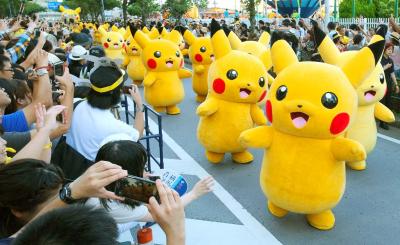
China’s military news agency yesterday warned that Japanese militarism is infiltrating society through series such as Pokemon and Detective Conan, after recent controversies involving events at sensitive sites. In recent days, anime conventions throughout China have reportedly banned participants from dressing as characters from Pokemon or Detective Conan and prohibited sales of related products. China Military Online yesterday posted an article titled “Their schemes — beware the infiltration of Japanese militarism in culture and sports.” The article referenced recent controversies around the popular anime series Pokemon, Detective Conan and My Hero Academia, saying that “the evil influence of Japanese militarism lives on in
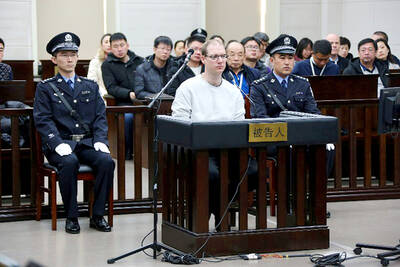
DIPLOMATIC THAW: The Canadian prime minister’s China visit and improved Beijing-Ottawa ties raised lawyer Zhang Dongshuo’s hopes for a positive outcome in the retrial China has overturned the death sentence of Canadian Robert Schellenberg, a Canadian official said on Friday, in a possible sign of a diplomatic thaw as Canadian Prime Minister Mark Carney seeks to boost trade ties with Beijing. Schellenberg’s lawyer, Zhang Dongshuo (張東碩), yesterday confirmed China’s Supreme People’s Court struck down the sentence. Schellenberg was detained on drug charges in 2014 before China-Canada ties nosedived following the 2018 arrest in Vancouver of Huawei chief financial officer Meng Wanzhou (孟晚舟). That arrest infuriated Beijing, which detained two Canadians — Michael Spavor and Michael Kovrig — on espionage charges that Ottawa condemned as retaliatory. In January

A sign hanging from a rusty ice-green shipping container installed by Thai forces on what they say is the border with Cambodia reads: “Cambodian citizens are strictly prohibited from entering this area.” On opposite sides of the makeshift barricade, fronted by coils of barbed wire, Cambodians lamented their lost homes and livelihoods as Thailand’s military showed off its gains. Thai forces took control of several patches of disputed land along the border during fighting last year, which could amount to several square kilometers in total. Cambodian Kim Ren said her house in Chouk Chey used to stand on what is now the Thai
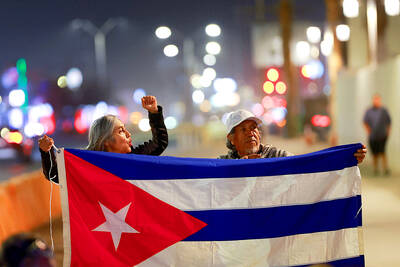
NEW RULES: There would be fewer school days, four-day workweeks, and a reduction in transportation services as the country battles a crisis exacerbated by US pressure The Cuban government on Friday announced emergency measures to address a crippling energy crisis worsened by US sanctions, including the adoption of a four-day work week for state-owned companies and fuel sale restrictions. Cuban Deputy Prime Minister Oscar Perez-Oliva Fraga blamed Washington for the crisis, telling Cuban television the government would “implement a series of decisions, first and foremost to guarantee the vitality of our country and essential services, without giving up on development.” “Fuel will be used to protect essential services for the population and indispensable economic activities,” he said. Among the new measures are the reduction of the working week in


 RSS
RSS