


It was 35 years ago, but my mother still remembers the day she arrived in the UK from Pakistan. My dad, like many men from the subcontinent, was already living and working here, a doctor in the National Health Service (NHS). Immigration rules meant my mom had been forced to wait a year before she was allowed to join him.
She stood in the immigration line at London Heathrow Airport, impatient to get through and finally join her husband. Then, right there in the airport, at the order of British immigration officials, she was subjected to a virginity test. Why? She has no idea.
“I went through immigration and then I was sent aside for a medical,” she said. “They took me to a room. They asked me to undress and made me lie down, and then they did it.”
My mom can’t recall now whether the doctor was male or female, but she still remembers the deep embarrassment.
“I was young. I went along with it. All I wanted was to get outside and join my husband. We were newlyweds and I couldn’t wait to see him,” she said.
She never told my dad about it; she thought, or was given the impression, that it was normal procedure.
“You forget about things when you start a new life, but when I think about it now, it was a violation of my rights,” she said.
A few other young Pakistani women, who had also been on her flight, were similarly taken aside for tests.
“They were only asking the women who were traveling on their own to go to one side,” she said. “It was embarrassing, and also it felt a little shameful.”
Being forced to prove whether or not you are a virgin is degrading, humiliating and belittling. It happens in other parts of the world to some women on their wedding nights, when in-laws demand to see a blood-stained sheet the morning after; it happens in some Zulu tribes; and it happened two months ago during the Tahrir Square protests, when the Egyptian army rounded up 18 women, strip-searched them and then checked whether they had yet had sex.
So why were virginity tests happening at Heathrow airport, of all places, to young Asian women traveling on their own?
This week, a study by two legal academics in Australia, Marinella Marmo and Evan Smith, revealed that in the late 1970s, more than 80 south Asian women were ordered to have a virginity test. My mom was one of them.
At that time, immigration rules stipulated that an engaged woman coming to Britain to marry her fiance within three months did not need a visa, whereas a bride required a visa in order to join her husband. If immigration officers suspected a woman was married, but was pretending to be engaged to avoid the wait for a visa, she would be taken away for an examination.
Although it was known before this week’s report that Indian and Pakistani women arriving in the UK had been subject to virginity tests, it was not thought to be so widespread. In 1979, the Home Office admitted to just three tests (after initially denying the practice). Its admission came only after the Guardian reported the story of a 35-year-old Indian woman who was examined by a male doctor at Heathrow. Virginity testing was subsequently banned.
But while researching for a paper on immigration practices for an academic journal, Marmo and Smith, of Flinders University in Adelaide, found evidence of at least 81 cases of virginity testing in confidential Home Office files. Marmo said there could be many more.
“We suspect that the documents extracted may well be the tip of the iceberg,” she said. “We fear that many cases occurred.”
The official documents never included the names of those tested.
“This is quite distressing as it corroborates our argument that women were just seen as ‘bodies’ to be checked for sociopolitical purposes,” Marmo said.
Marmo and Smith said the immigration officers justified the tests on the stereotype of south Asian women as “submissive, meek and tradition-bound” and on the “absurd generalization” that Asian women were always virgins before they married.
“Even if this generalization had some factual element to it, the practice of ‘testing’ virginity through an invasive medical procedure was still a major violation of the migrant woman’s rights,” their report said.
My mom didn’t meet the stereotype of a “submissive” or “meek” south Asian woman back then, any more than she does now. She arrived in the UK with a master’s degree in politics and strong-minded views, fluent in three languages, confident and excited about what the future here would hold. My parents had already proved their marriage to British officials, submitting the marriage certificate and my mom also already had a visa, allowing her entry into the UK.
So why, then, considering she had all the correct legal documentation required to enter the country, did she still have to go through this degrading test?
“I don’t know,” she said. “Maybe it was the color of my skin and where I came from. They didn’t do it to the women coming from Europe or Australia or America, did they? I suppose it was just to prove that they had power in their hands.”
Marmo said she was shocked that a married woman, with a visa already in place, was subjected to a virginity test: “It opens up a new can of worms. There was no limit here, and it’s even worse than expected.”
The UK government is now under pressure to issue an apology to the Asian women subjected to these tests, although there is no way of knowing just how many there were, unless they come forward.
Like Marmo, my mom also suspects that many more than 81 Asian women of her generation went through these apparently routine virginity tests. She hopes that by sharing her story, it will encourage other women to do the same, and expose the way in which the Home Office allowed migrant women to be treated.
Does she want an apology from the government?
“Yes. I’d forgotten about it, because I thought it was normal, but it makes me angry remembering it. I was naive then, I went along with it. But I came here lawfully, to join my husband who was contributing to the economy. We didn’t deserve that sort of humiliation,” she said.

FEROCIOUS FISH-EATER Scientists have found a new species of dinosaur from the Cretaceous Period, a ‘hell heron’ that stalked the rivers, deep in the Saharan desert At a remote Sahara desert site in Niger, scientists have unearthed fossils of a new species of Spinosaurus, among the biggest of the meat-eating dinosaurs, notable for its large blade-shaped head crest and jaws bearing interlocking teeth for snaring fish. It prowled a forested inland environment and strode into rivers to catch sizable fish like a modern-day wading bird — a “hell heron,” as one of the researchers put it, considering it was about 12 meters long and weighed 5-7 tons. The dinosaur presented a striking profile on the Cretaceous Period landscape of Africa some 95 million years ago as it hunted
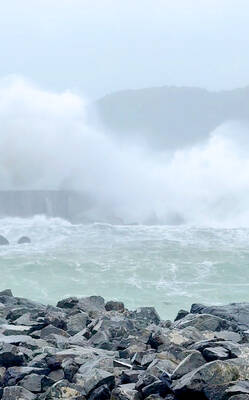
Heavy rain and strong winds yesterday disrupted flights, trains and ferries, forcing the closure of roads across large parts of New Zealand’s North Island, while snapping power links to tens of thousands. Domestic media reported a few flights had resumed operating by afternoon from the airport in Wellington, the capital, although cancelations were still widespread after airport authorities said most morning flights were disrupted. Air New Zealand said it hoped to resume services when conditions ease later yesterday, after it paused operations at Wellington, Napier and Palmerston North airports. Online images showed flooded semi-rural neighborhoods, inundated homes, trees fallen on vehicles and collapsed
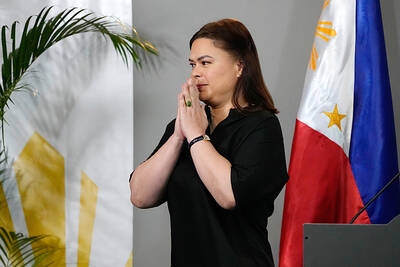
‘COST OF DEFECTION’: Duterte’s announcement could be an effort to keep allies in line with the promise of a return to power amid political uncertainty, an analyst said Philippine Vice President Sara Duterte yesterday announced she would run for president of the Southeast Asian nation of 116 million in 2028. Duterte, who is embroiled in a bitter feud with Philippine President Ferdinand Marcos Jr, was impeached last year only to see the country’s Supreme Court throw the case out over procedural issues. Her announcement comes just days before her father, former Philippine president Rodrigo Duterte, begins a pretrial hearing at the International Criminal Court (ICC) in the Netherlands over crimes against humanity allegedly committed as part of a brutal crackdown on drugs. “I offer my life, my strength and my future

NOT YET THERE: While the show was impressive, it failed to demonstrate their ability to move in unstructured environments, such as a factory floor, an expert said Dancing humanoid robots on Monday took center stage during the annual China Media Group’s Spring Festival Gala, China’s most-watched official television broadcast. They lunged and backflipped (landing on their knees), they spun around and jumped. Not one fell over. The display was impressive, but if robots can now dance and perform martial arts, what else can they do? Experts have mixed opinions, with some saying the robots had limitations and that the display should be viewed through a lens of state propaganda. Developed by several Chinese robotics firms, the robots performed a range of intricate stunts, including martial arts, comedy sketches and choreographed


 RSS
RSS