


When separatist rebels in the remote Indian state of Manipur banned Hindi movies a decade ago, they had little idea it would trigger a cultural invasion from a country more than 3,200km away.
However, when Bollywood was forced out, the Koreans moved in.
In the markets of the state capital Imphal, shops are packed with DVDs of South Korean films and TV soap operas, as well as CDs of Korean pop stars, with a particular focus on preening boy bands.
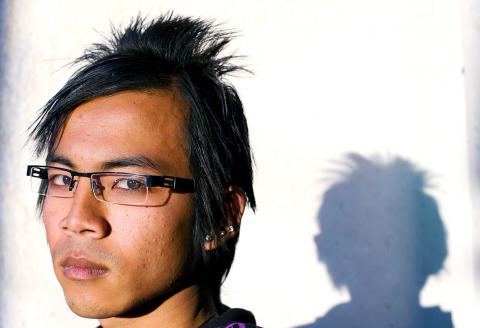
Photo: AFP
Hairdressing salons are covered with headshots of Korean celebrities and offer a wide range of spiky, “Korean-style” cuts, which are hugely popular with young Manipuris of both sexes.
Teenagers also trawl through Gambhir Market, a three-story warren of tiny boutiques, for skinny jeans and other clothing trends inspired by Korean TV shows.
Even the language has made inroads, with Korean phrases like annyeong-haseyo (“hello”), kamsahamnida (“thank you”) and sarang-haeyo (“I love you”) peppering conversations in schoolyards and market places.
Photo: AFP
“When we’re back at boarding school, my friends and I practice our few phrases of Korean and often talk about what it would be like growing up in Korea,” female student Akshaya Longjam, 14, said.
“It just seems so much fun and everybody is good looking; the girls are pretty and the boys are so cute,” said Longjam, a dedicated fan of the Korean boy band Big Bang and its star singer G-Dragon.
At first glance, Manipur would seem the unlikeliest of takers for the so-called “Korean Wave” of pop culture that swept over China, Japan and much of Southeast Asia at the beginning of the last decade.
Tiny, landlocked and with a population of less than 3 million, Manipur borders Myanmar and is one of India’s “Seven Sisters” — seven northeastern states connected to the rest of India by a sliver of land that arches over Bangladesh.
In the 1970s, 1980s and 1990s, entertainment for Manipuris was largely supplied by India’s dominant cultural force, Bollywood.
However, in 2000, a number of the multiple armed secessionist groups that have been active in Manipur since the 1960s ordered a ban on Hindi movies and Hindi satellite TV channels, in a professed bid to “protect” Manipuri culture.
Backed by threats to bomb recalcitrant cinemas and cable operators, the ban was extremely effective and remains in force today.
Desperate to fill the vacuum, cable operators experimented with whatever came to hand, including Arirang TV, a 24-hour, English-language network based in Seoul that began beaming in a diet of dramas and cultural features.
South Korea’s KBS World followed with its own stable of subtitled soap operas and, within a few months, Manipur was hooked.
“Watching Korean soaps and films takes me away from the realities of daily life in Manipur,” said Soma Lhishram, a 19-year-old college student. “We have a problem with water, electricity, roads ... you name it, but everything looks so perfect in Korea. It’s like a fantasy world.”
The attraction is partly a cultural one. The Mongol roots of ethnic Manipuris mean their physical features are far closer to those of Koreans than other Indians.
The family-oriented soap operas resonate strongly in what is a socially conservative state, while teen romance dramas have a mass following among the young.
Lhishram, a part-time actress, is a particular fan of the high school drama Boys Over Flowers and one of its heartthrob stars, Lee Min-hoo.
“It’s a big dream of mine to travel to Korea and to work on a film there,” she said during a break in shooting for a Manipuri language music video in the grounds of a local college.
Endless repeat viewings of all shows are also available thanks to thousands of English-subtitled DVDs — many of them pirated — which are smuggled in from Myanmar and retail in Imphal markets for less than US$1.
Otojit Kshetrimayum, a research academic in sociology at New Delhi’s Jawaharlal Nehru University, has written an academic paper on the phenomenal popularity of all things Korean in Manipur.
“The key factor is cultural proximity, both in appearance and values,” Kshetrimayum said. “The themes and characters that the Korean movies and dramas depict strike a chord with both the younger and older generations in Manipur.”
China’s military news agency yesterday warned that Japanese militarism is infiltrating society through series such as Pokemon and Detective Conan, after recent controversies involving events at sensitive sites. In recent days, anime conventions throughout China have reportedly banned participants from dressing as characters from Pokemon or Detective Conan and prohibited sales of related products. China Military Online yesterday posted an article titled “Their schemes — beware the infiltration of Japanese militarism in culture and sports.” The article referenced recent controversies around the popular anime series Pokemon, Detective Conan and My Hero Academia, saying that “the evil influence of Japanese militarism lives on in

DIPLOMATIC THAW: The Canadian prime minister’s China visit and improved Beijing-Ottawa ties raised lawyer Zhang Dongshuo’s hopes for a positive outcome in the retrial China has overturned the death sentence of Canadian Robert Schellenberg, a Canadian official said on Friday, in a possible sign of a diplomatic thaw as Canadian Prime Minister Mark Carney seeks to boost trade ties with Beijing. Schellenberg’s lawyer, Zhang Dongshuo (張東碩), yesterday confirmed China’s Supreme People’s Court struck down the sentence. Schellenberg was detained on drug charges in 2014 before China-Canada ties nosedived following the 2018 arrest in Vancouver of Huawei chief financial officer Meng Wanzhou (孟晚舟). That arrest infuriated Beijing, which detained two Canadians — Michael Spavor and Michael Kovrig — on espionage charges that Ottawa condemned as retaliatory. In January

A sign hanging from a rusty ice-green shipping container installed by Thai forces on what they say is the border with Cambodia reads: “Cambodian citizens are strictly prohibited from entering this area.” On opposite sides of the makeshift barricade, fronted by coils of barbed wire, Cambodians lamented their lost homes and livelihoods as Thailand’s military showed off its gains. Thai forces took control of several patches of disputed land along the border during fighting last year, which could amount to several square kilometers in total. Cambodian Kim Ren said her house in Chouk Chey used to stand on what is now the Thai

NEW RULES: There would be fewer school days, four-day workweeks, and a reduction in transportation services as the country battles a crisis exacerbated by US pressure The Cuban government on Friday announced emergency measures to address a crippling energy crisis worsened by US sanctions, including the adoption of a four-day work week for state-owned companies and fuel sale restrictions. Cuban Deputy Prime Minister Oscar Perez-Oliva Fraga blamed Washington for the crisis, telling Cuban television the government would “implement a series of decisions, first and foremost to guarantee the vitality of our country and essential services, without giving up on development.” “Fuel will be used to protect essential services for the population and indispensable economic activities,” he said. Among the new measures are the reduction of the working week in


 RSS
RSS