


An unprecedented power struggle at the heart of the Iranian regime intensified on Friday when it emerged that the supreme leader, Ali Khamenei, had given an ultimatum to Iranian President Mahmoud Ahmadinejad to accept his intervention in a Cabinet appointment or resign.
A member of the Iranian parliament, Morteza Agha-Tehrani — who is described as “Ahmadinejad’s moral adviser” — told a gathering of his supporters that a meeting between Ahmadinejad and Khamenei had recently taken place, in which the president was given a deadline to resign or to accept the decision of the ayatollah.
The extraordinary confrontation came to light after Ahmadinejad declined officially to support Khamenei’s reinstatement of a minister whom the president had initially asked to resign.
The rift between the two men grew when the president staged an 11-day walkout in an apparent protest at Khamenei’s decision. In the first Cabinet meeting since ending his protest, the intelligence minister at the center of the row, Heydar Moslehi, was absent and in the second one on Wednesday, he was reportedly asked by Ahmadinejad to leave.
In a video released on Iranian Web sites, Agha-Tehrani quotes Ahmadinejad as saying: “[Khamenei] gave me a deadline to make up my mind. I would either accept [the reinstatement] or resign.”
Although Khamenei is not constitutionally allowed to intervene in Cabinet appointments, an -unwritten law requires all -officials to always abide by the supreme leader without showing any opposition.
Clerics close to Khamenei have launched a campaign to highlight his role in Iranian politics, saying that to disobey him is equal to apostasy, as he is “God’s representative on earth.”
Meanwhile, the president was reportedly absent from religious ceremonies this week at Khamenei’s house, where he was publicly criticized by close allies of the ayatollah. Iranian officials are traditionally required to participate in such ceremonies in order to cover up any political rift that might compromise Khamenei’s power.
Iran’s semi-official Mehr news agency reported on Thursday that several members of parliament had revived a bid to summon Ahmadinejad for questioning over “the recent events.” It said 90 MPs had signed the petition, up from only 12 last week.
Under Iranian law, at least 85 more signatures are required for a possible impeachment of the president.
Supporters of Khamenei say that Ahmadinejad is surrounded by “deviants” in his inner circle, including his controversial chief of staff, Esfandiar Rahim Mashaei, who wants to undermine the involvement of clerics in Iran’s politics. Mashaei and his allies have recently been accused of using supernatural powers and invoking djinns (spirits) in pursuing the government’s policies.
Iran’s elite revolutionary guards, who played an important role in securing Ahmadinejad a second term in Iran’s 2009 disputed elections, have distanced themselves from Ahmadinejad in recent months as Mashaei’s “secular” views have become more pronounced.
In the face of the recent confrontation with Khamenei, Ahmadinejad has been left isolated, with only a handful of serious supporters.
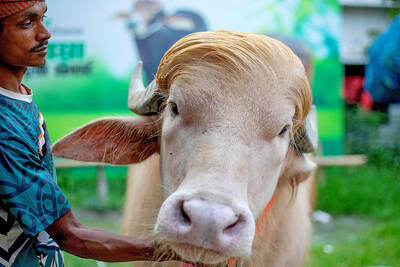
Crowds in Bangladesh are flocking to snap photographs with an unlikely social media star — an albino buffalo with flowing blond hair nicknamed “Donald Trump” that is due to be sacrificed within days. Owner Zia Uddin Mridha, 38, said his brother named the 700kg bull over its flowing helmet of hair resembling the signature look of the US president. “My younger brother picked this name because of the buffalo’s extraordinary hair,” he said at his farm in Narayanganj, just outside the capital, Dhaka. Mridha said that a constant stream of curious visitors — social media fans, onlookers and children — have come throughout

It began as a satirical online project. Now millions of young people in India are flocking to it as an outlet for their frustration. A parody political party called the Cockroach Janta Party, with the insect as its symbol, has exploded across India’s social media by turning absurdist humor into protest. Memes and short videos mocking corruption, joblessness and political dysfunction have flooded social media sites, where millions of users are embracing the cockroach — known for its ability to survive harsh conditions — as a tongue-in-cheek symbol of endurance. The online movement’s rise has been unusually rapid. The Cockroach Janta Party (CJP)
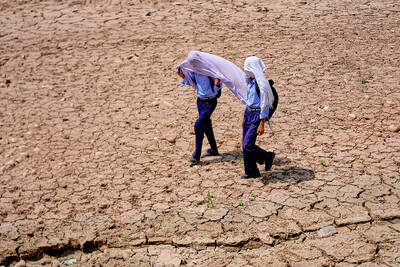
HOTTER: While Indians are accustomed to summer heat, climate change has caused northwestern India to warm faster than other parts of the country, an academic said Roads and markets have emptied during afternoons and some farmers have switched to nighttime work to avoid scorching temperatures as a heat wave grips large parts of India. The India Meteorological Department forecast maximum temperatures for yesterday of about 45°C in the capital, New Delhi, where authorities have opened temporary “cooling zones” to help people cope. The weather department warned that conditions would likely persist across several northern regions in the coming days, with temperatures staying well above seasonal averages. Authorities urged people to stay indoors during the hottest hours and take precautions against heat-related illnesses. India declares a heat wave whenever maximum temperatures
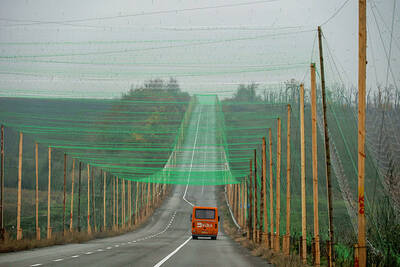
BIGGER ROLE: Beijing has said it maintains an impartial stance on the war in Ukraine, but by training Russian troops, China is far more involved than previously known China’s armed forces secretly trained about 200 Russian military personnel in China late last year, and some have since returned to fight in Ukraine, according to three European intelligence agencies and documents seen by Reuters. While China and Russia have held a number of joint military exercises since Moscow’s full-scale invasion of Ukraine in 2022, Beijing has repeatedly said that it is neutral in the conflict and presents itself as a peace mediator. The covert training sessions, which predominantly focused on the use of drones, were outlined in a dual-language Russian-Chinese agreement signed by senior Russian and Chinese officers in Beijing on


 RSS
RSS