


The US and Britain have inserted covert intelligence agents into Libya to make contact with rebels and to gather data to guide coalition air strikes, a report said on Wednesday.
The White House refused to comment on the apparent shadow war in Libya, and also declined to discuss another report that US President Barack Obama had signed a secret order allowing CIA operations in the country.
A senior US official did, however, warmly welcome the defection to Britain of Libyan Foreign Minister Mussa Kussa, interpreting his flight as a sign that Libyan leader Muammar Qaddafi’s inner circle was beginning to crumble under massive pressure.
The New York Times said the CIA had inserted clandestine agents into Libya to gather data for airstrikes and establish links with rebels, who on Wednesday lost a swathe of captured territory to Qaddafi loyalists.
Obama has insisted no US ground troops will be deployed in the bid to shield civilians in Libya. However, the Times said small groups of covert US agents had been conducting missions inside Libya for several weeks.
It also cited current and former British officials as saying dozens of British special forces and MI6 secret intelligence service agents were also on the ground in Libya collecting data on government forces and weaponry.
ABC News, meanwhile, reported that Obama’s presidential order, or “finding,” authorized covert CIA operations to “aid the effort” in Libya.
Such presidential orders set down a legal framework for conducting covert actions and would generally be required before the launch of clandestine missions. White House spokesman Jay Carney declined to confirm or deny the reports, citing “common practice” not to comment on intelligence matters.
“I will reiterate what the president said yesterday — no decision has been made about providing arms to the opposition or to any group in Libya. We’re not ruling it out or ruling it in,” Carney said. “We’re assessing and reviewing -options for all types of assistance that we could provide to the Libyan people and have consulted directly with the opposition and our international partners about these matters.”
Experts and former US military officers say bombing raids almost always require clandestine “eyes on the ground,” with forward air controllers from special forces or intelligence agencies pointing out targets for warplanes. This was the case in Afghanistan, Iraq, Kosovo, Bosnia and other conflicts, they said.
Intense debate is taking place within the administration, in -Congress and between the US and its coalition partners over the idea of arming rebels in Libya.
Some opponents worry about the leanings of some fighters, especially since NATO’s top commander Admiral James Stavridis said on Tuesday that while most rebels were “responsible,” some showed “flickers” of al-Qaeda or Hezbollah sympathies.
Senior Obama administration officials have said for several days that senior Qaddafi cohorts knew Qaddafi was on borrowed time and were beginning to consider their positions, but there had been little evidence to support their claims.
However, their hopes that Qaddafi’s regime could fall got a huge boost late on Wednesday with the dramatic flight to Britain by Kussa, a former Libyan intelligence chief, who said he was resigning.
“This is a very significant defection and an indication that people around Qaddafi think the writing’s on the wall,” a senior US administration official said on condition of anonymity.
The Obama administration, meanwhile, pressed on with its effort to justify and explain its tactics in the Libyan mission.
US Secretary of State Hillary Clinton, US Secretary of Defense Robert Gates, Director of National Intelligence James Clapper, and the top uniformed US officer, Admiral Mike Mullen, conducted classified briefings on Capitol Hill.
Many lawmakers, especially Republicans, have complained they were not sufficiently consulted about the Libya operation before Obama launched it two weeks ago and have raised sharp questions about US strategy.
Senator Carl Levin, chairman of the Senate Armed Services committee, said the question of possibly arming Libyan rebels needed deep thought.
“It needs cautious consideration and this administration has proceeded with caution generally and I’m sure they will on this one as well,” he said.
Influential Democratic Senator John Kerry said that it was clear that the hard-pressed rebels needed “need some kind of assistance.”
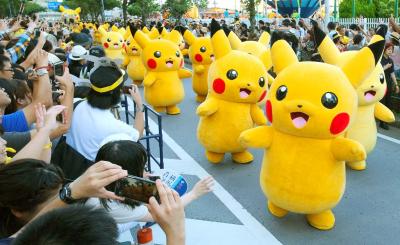
China’s military news agency yesterday warned that Japanese militarism is infiltrating society through series such as Pokemon and Detective Conan, after recent controversies involving events at sensitive sites. In recent days, anime conventions throughout China have reportedly banned participants from dressing as characters from Pokemon or Detective Conan and prohibited sales of related products. China Military Online yesterday posted an article titled “Their schemes — beware the infiltration of Japanese militarism in culture and sports.” The article referenced recent controversies around the popular anime series Pokemon, Detective Conan and My Hero Academia, saying that “the evil influence of Japanese militarism lives on in
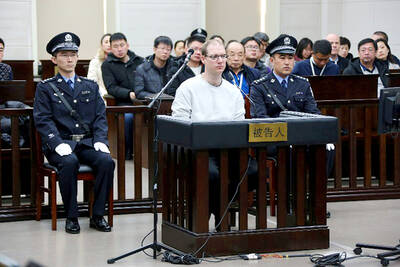
DIPLOMATIC THAW: The Canadian prime minister’s China visit and improved Beijing-Ottawa ties raised lawyer Zhang Dongshuo’s hopes for a positive outcome in the retrial China has overturned the death sentence of Canadian Robert Schellenberg, a Canadian official said on Friday, in a possible sign of a diplomatic thaw as Canadian Prime Minister Mark Carney seeks to boost trade ties with Beijing. Schellenberg’s lawyer, Zhang Dongshuo (張東碩), yesterday confirmed China’s Supreme People’s Court struck down the sentence. Schellenberg was detained on drug charges in 2014 before China-Canada ties nosedived following the 2018 arrest in Vancouver of Huawei chief financial officer Meng Wanzhou (孟晚舟). That arrest infuriated Beijing, which detained two Canadians — Michael Spavor and Michael Kovrig — on espionage charges that Ottawa condemned as retaliatory. In January

A sign hanging from a rusty ice-green shipping container installed by Thai forces on what they say is the border with Cambodia reads: “Cambodian citizens are strictly prohibited from entering this area.” On opposite sides of the makeshift barricade, fronted by coils of barbed wire, Cambodians lamented their lost homes and livelihoods as Thailand’s military showed off its gains. Thai forces took control of several patches of disputed land along the border during fighting last year, which could amount to several square kilometers in total. Cambodian Kim Ren said her house in Chouk Chey used to stand on what is now the Thai
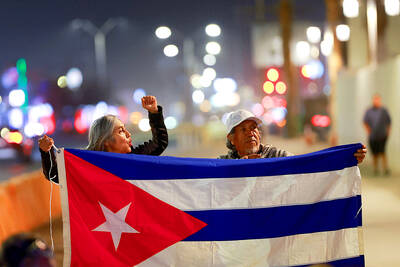
NEW RULES: There would be fewer school days, four-day workweeks, and a reduction in transportation services as the country battles a crisis exacerbated by US pressure The Cuban government on Friday announced emergency measures to address a crippling energy crisis worsened by US sanctions, including the adoption of a four-day work week for state-owned companies and fuel sale restrictions. Cuban Deputy Prime Minister Oscar Perez-Oliva Fraga blamed Washington for the crisis, telling Cuban television the government would “implement a series of decisions, first and foremost to guarantee the vitality of our country and essential services, without giving up on development.” “Fuel will be used to protect essential services for the population and indispensable economic activities,” he said. Among the new measures are the reduction of the working week in


 RSS
RSS