


Khmer Rouge torture chief Duch once taught math to schoolchildren, but put his cold, calculating mind to far more devastating use as head of a jail from which few inmates ever came out alive.
The 68-year-old — real name is Kaing Guek Eav — oversaw the extermination of about 15,000 men, women and children at the Tuol Sleng prison in Phnom Penh during the communist regime’s brutal 1975-1979 rule.
Those who worked under him at the detention center testified that Duch was universally feared. Most of the staff were uneducated teenage boys and Duch said they could be easily indoctrinated because they were “like a blank piece of paper.”
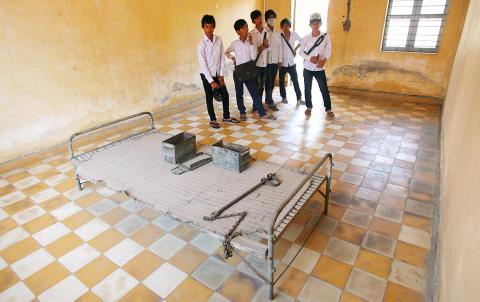
Photo: EPA
Duch begged for forgiveness at Cambodia’s UN-backed war crimes court for crimes committed under his command at the jail, where prisoners were tortured into denouncing themselves and others as foreign spies.
However, victims questioned whether his remorse was genuine after he asked to be acquitted in his closing remarks.
He was sentenced to 30 years in prison in July last year for war crimes and crimes against humanity, but could walk free in less than 19 years.
Duch’s lawyers will appeal against the verdict this coming week, arguing their client should be released because he falls outside the court’s jurisdiction, while the prosecution is seeking a longer jail term.
Anne Heindel, a legal adviser to the Documentation Center of Cambodia, which collects evidence of Khmer Rouge atrocities, said Duch did not accept full responsibility for his crimes.
“He believes he was a cog in the Communist Party wheel, that because he was not fully autonomous in his decision-making, his guilt is lessened,” she said.
Born in 1942 in central Cambodia, Duch is remembered as a sincere teacher devoted to helping the poor before he became a Khmer Rouge cadre in 1970.
“I joined the revolution in order to transform society, to oppose the government, to oppose torture,” Duch said during his trial. “I sacrificed everything for the revolution, sincerely and absolutely.”
Inside the rebel-controlled zones, he chose Duch as his revolutionary name because it was used by a model student in a schoolbook from his youth.
He oversaw a series of jungle prisons before being made head of Tuol Sleng after the regime seized Phnom Penh in 1975.
What began as only a few dozen prisoners turned into a daily torrent of condemned coming through Tuol Sleng, or S-21, as the regime purged itself of its “enemies.”
Ever meticulous, Duch built up a huge archive of photos, confessions and other documents with which prosecutors traced the final horrible months of thousands of inmates’ lives.
Following the Khmer Rouge’s fall from power, he maintained posts within the communist movement as it battled Vietnam-backed troops.
He reportedly worked for Radio China in the 1980s and later taught in at least one refugee camp. After his wife was murdered in 1995, Duch turned to Christianity.
He was arrested after Irish photojournalist Nic Dunlop uncovered him working for a Christian aid agency in western Cambodia under a false name.
Before that, many had long assumed he was dead following his disappearance after Vietnamese troops ousted the Khmer Rouge in 1979.
“I told Nic Dunlop, ‘Christ brought you to meet me,’” Duch told his trial. “I said: ‘Before I used to serve human beings, but now I serve God.’”
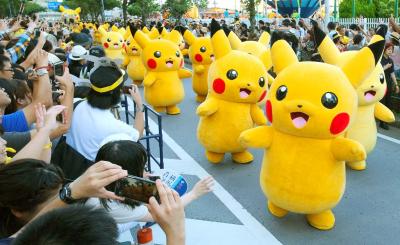
China’s military news agency yesterday warned that Japanese militarism is infiltrating society through series such as Pokemon and Detective Conan, after recent controversies involving events at sensitive sites. In recent days, anime conventions throughout China have reportedly banned participants from dressing as characters from Pokemon or Detective Conan and prohibited sales of related products. China Military Online yesterday posted an article titled “Their schemes — beware the infiltration of Japanese militarism in culture and sports.” The article referenced recent controversies around the popular anime series Pokemon, Detective Conan and My Hero Academia, saying that “the evil influence of Japanese militarism lives on in

DIPLOMATIC THAW: The Canadian prime minister’s China visit and improved Beijing-Ottawa ties raised lawyer Zhang Dongshuo’s hopes for a positive outcome in the retrial China has overturned the death sentence of Canadian Robert Schellenberg, a Canadian official said on Friday, in a possible sign of a diplomatic thaw as Canadian Prime Minister Mark Carney seeks to boost trade ties with Beijing. Schellenberg’s lawyer, Zhang Dongshuo (張東碩), yesterday confirmed China’s Supreme People’s Court struck down the sentence. Schellenberg was detained on drug charges in 2014 before China-Canada ties nosedived following the 2018 arrest in Vancouver of Huawei chief financial officer Meng Wanzhou (孟晚舟). That arrest infuriated Beijing, which detained two Canadians — Michael Spavor and Michael Kovrig — on espionage charges that Ottawa condemned as retaliatory. In January

A sign hanging from a rusty ice-green shipping container installed by Thai forces on what they say is the border with Cambodia reads: “Cambodian citizens are strictly prohibited from entering this area.” On opposite sides of the makeshift barricade, fronted by coils of barbed wire, Cambodians lamented their lost homes and livelihoods as Thailand’s military showed off its gains. Thai forces took control of several patches of disputed land along the border during fighting last year, which could amount to several square kilometers in total. Cambodian Kim Ren said her house in Chouk Chey used to stand on what is now the Thai
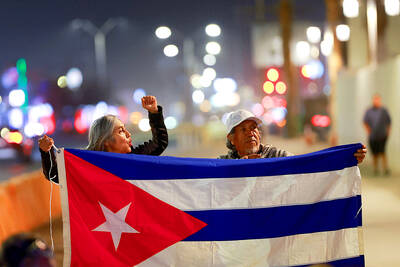
NEW RULES: There would be fewer school days, four-day workweeks, and a reduction in transportation services as the country battles a crisis exacerbated by US pressure The Cuban government on Friday announced emergency measures to address a crippling energy crisis worsened by US sanctions, including the adoption of a four-day work week for state-owned companies and fuel sale restrictions. Cuban Deputy Prime Minister Oscar Perez-Oliva Fraga blamed Washington for the crisis, telling Cuban television the government would “implement a series of decisions, first and foremost to guarantee the vitality of our country and essential services, without giving up on development.” “Fuel will be used to protect essential services for the population and indispensable economic activities,” he said. Among the new measures are the reduction of the working week in


 RSS
RSS