


China has responded to popular uprisings against governments in Tunisia, Egypt and Libya by cracking down on its Uighur ethnic minority, an exiled Uighur activist said yesterday.
World Uyghur Congress president Rebiya Kadeer spoke in an Australian Parliament House committee room at the invitation of two government lawmakers despite objections from China, which denounces her as a separatist.
The 65-year-old US-based businesswoman said through an interpreter that the recent overthrow of Middle Eastern governments “sent shock waves through the Chinese leadership that people’s patience could run out — people will one day rise up and challenge the authority of the regime.”
She said China had responded to the protests with a security crackdown that made the western cities of Kashgar and Urumqi resemble war zones as soldiers searched homes and rounded up members of her Turkic-speaking Muslim Uighur minority and found excuses to detain them.
“What happened in Tunisia and Egypt has strong effects on Uighur people and the Chinese people because it gives the oppressed peoples hope for a better world and the hope for change,” Kadeer told lawmakers, reporters and political staffers.
The Chinese Foreign Ministry in Beijing did not respond to requests for comment.
Human rights groups say China’s massive security apparatus is using anxiety over possible Middle East-inspired protests as a pretext for a wide crackdown on anyone the government considers a threat to its authoritarian rule, including political activists.
Beijing blamed Kadeer for inciting riots in the Xinjiang region of western China in July 2009 between the Uighur minority and Han Chinese that left almost 200 dead. She denies the accusation.
China urged Australia to prevent her from visiting the country later that year. China then punished Australia for giving her a visa by canceling a senior Chinese minister’s scheduled visit.
The Chinese embassy also unsuccessfully pressured the National Press Club to drop her as a guest speaker during her visit to Australia, and was unable to get an international film festival to cancel a screening of a documentary about her life.
Kadeer described China’s response to her current visit to Australia — her first since 2009 — as “mild.”
“Although China has changed its tactics, China has not changed its assaults upon Uighur people’s religious beliefs, cultural identities, freedom of speech and economic life, which are central to the Chinese government’s project of speedy assimilation of our people in China,” she said.
She said Chinese authorities had sentenced 36 people to death — including four Uighurs last month — for their involvement in the 2009 riots and protests.
The Chinese Embassy in -Canberra did not respond to requests for comment.
Chinese Foreign Ministry spokeswoman Jiang Yu (姜瑜) said last week that China was firmly opposed to any country providing a stage for Kadeer’s activities and that Beijing believed Australia understood that position.
The Australian Department of Foreign Affairs and Trade said yesterday that China had not asked Australia to block Kadeer’s visit, but had sought assurances that it would be “handled carefully.”
No Chinese official attended Kadeer’s address yesterday, but Xinhua news agency made a video recording.
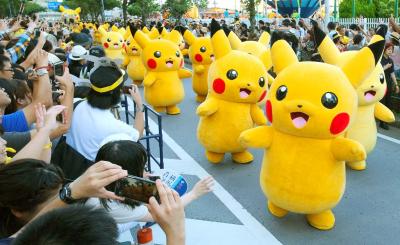
China’s military news agency yesterday warned that Japanese militarism is infiltrating society through series such as Pokemon and Detective Conan, after recent controversies involving events at sensitive sites. In recent days, anime conventions throughout China have reportedly banned participants from dressing as characters from Pokemon or Detective Conan and prohibited sales of related products. China Military Online yesterday posted an article titled “Their schemes — beware the infiltration of Japanese militarism in culture and sports.” The article referenced recent controversies around the popular anime series Pokemon, Detective Conan and My Hero Academia, saying that “the evil influence of Japanese militarism lives on in

DIPLOMATIC THAW: The Canadian prime minister’s China visit and improved Beijing-Ottawa ties raised lawyer Zhang Dongshuo’s hopes for a positive outcome in the retrial China has overturned the death sentence of Canadian Robert Schellenberg, a Canadian official said on Friday, in a possible sign of a diplomatic thaw as Canadian Prime Minister Mark Carney seeks to boost trade ties with Beijing. Schellenberg’s lawyer, Zhang Dongshuo (張東碩), yesterday confirmed China’s Supreme People’s Court struck down the sentence. Schellenberg was detained on drug charges in 2014 before China-Canada ties nosedived following the 2018 arrest in Vancouver of Huawei chief financial officer Meng Wanzhou (孟晚舟). That arrest infuriated Beijing, which detained two Canadians — Michael Spavor and Michael Kovrig — on espionage charges that Ottawa condemned as retaliatory. In January

A sign hanging from a rusty ice-green shipping container installed by Thai forces on what they say is the border with Cambodia reads: “Cambodian citizens are strictly prohibited from entering this area.” On opposite sides of the makeshift barricade, fronted by coils of barbed wire, Cambodians lamented their lost homes and livelihoods as Thailand’s military showed off its gains. Thai forces took control of several patches of disputed land along the border during fighting last year, which could amount to several square kilometers in total. Cambodian Kim Ren said her house in Chouk Chey used to stand on what is now the Thai

NEW RULES: There would be fewer school days, four-day workweeks, and a reduction in transportation services as the country battles a crisis exacerbated by US pressure The Cuban government on Friday announced emergency measures to address a crippling energy crisis worsened by US sanctions, including the adoption of a four-day work week for state-owned companies and fuel sale restrictions. Cuban Deputy Prime Minister Oscar Perez-Oliva Fraga blamed Washington for the crisis, telling Cuban television the government would “implement a series of decisions, first and foremost to guarantee the vitality of our country and essential services, without giving up on development.” “Fuel will be used to protect essential services for the population and indispensable economic activities,” he said. Among the new measures are the reduction of the working week in


 RSS
RSS