


The women charged with thwarting Iraq’s female suicide bombers spend their days in cramped metal sheds at police checkpoints and lobbies of government offices, running their hands over the black-robed bodies of other women.
Iraqi authorities say the searches have helped to curb female suicide attacks, once a scourge of this still dangerous city. And they say the teams of women, known as the Daughters of Iraq, play a crucial role in a country where rigid divisions between the sexes make it awkward, sometimes unthinkable, for male police officers to frisk women and girls in search of the telltale lump of a gun or explosive belt.
However, the women say that they have not been paid in nearly a year, since the Iraqi government took control of the program from the US military, which helped establish and finance the Daughters in 2008.
“They keep promising they’ll pay us next month, then next month,” said Hind Jasim, who joined the Daughters after her husband lost his job. “What keeps us here are their promises.”
The women’s struggles reflect broader concerns about how the Iraqi government will maintain projects financed by the US as the remaining 50,000 US troops depart over the next 10 months.
Some of the 300 women in the Daughters quit after their US$250 monthly pay dried up. Those who stayed on, the vast majority, are sliding deeper into the poverty the program was intended to ameliorate. Many are war widows or their family’s only breadwinners.
In northeastern Diyala Province, once the country’s epicenter of female suicide attacks, the group’s leaders are straining to find money to pay electric bills and rent on its drafty headquarters. The women said that the local government and police forces had advocated on behalf of the group, but had provided little material support.
Wijdan Adil, who helped found the Daughters, said Iraqi officials had encouraged the women to keep working as a matter of duty to Iraq and their slain husbands, even as some sank into debt and became disillusioned with the government.
“If you give up on the Daughters of Iraq, there will be a security vacuum in Diyala,” Adil said. “They’ll be an easy target for al-Qaeda. They know so much about how the security system works.”
A spokesman for Iraqi Prime Minister Nouri al-Maliki blamed “technical reasons” for the lapse in payments, but said the government was committed to financing the Daughters and integrating them into a branch of the security services.
“They are doing a job that cannot be done by their brothers in security,” said the spokesman, Ali al-Moussawi. “Their work is respected and appreciated by all.”
Iraq has also been slow to pay the Awakening Movement, US-backed teams of former Sunni insurgents who switched sides to fight alongside U.S. forces.
Iraqi officials promised to weave the Awakening members into security forces and other government ministries, but a recent report by US officials overseeing Iraq reconstruction found that only 41 percent of 95,000 Awakening members had been given jobs.
The Daughters of Iraq were modeled after the Awakening, though on a smaller scale. In late 2008, trained in self-defense and small-arms use, they fanned out to traffic checkpoints and other security posts in Diyala, Baghdad and towns south of the capital.
Some Iraqis were angered by the sight of women wearing gray military-style shirts at checkpoints or marching in formation during parades. A few of the women received threatening phone calls, said Adil, the group’s director.
Iraqi officials said the searches played a role in curbing female bombers. There were 36 such attacks in 2008; the number plunged to four in 2009 and to only one last year — actually a man dressed as a woman, the US military said.
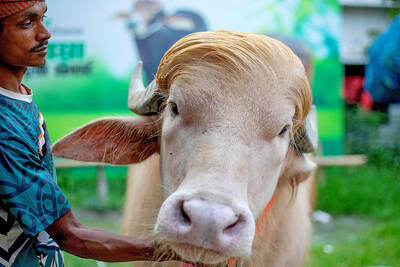
Crowds in Bangladesh are flocking to snap photographs with an unlikely social media star — an albino buffalo with flowing blond hair nicknamed “Donald Trump” that is due to be sacrificed within days. Owner Zia Uddin Mridha, 38, said his brother named the 700kg bull over its flowing helmet of hair resembling the signature look of the US president. “My younger brother picked this name because of the buffalo’s extraordinary hair,” he said at his farm in Narayanganj, just outside the capital, Dhaka. Mridha said that a constant stream of curious visitors — social media fans, onlookers and children — have come throughout

It began as a satirical online project. Now millions of young people in India are flocking to it as an outlet for their frustration. A parody political party called the Cockroach Janta Party, with the insect as its symbol, has exploded across India’s social media by turning absurdist humor into protest. Memes and short videos mocking corruption, joblessness and political dysfunction have flooded social media sites, where millions of users are embracing the cockroach — known for its ability to survive harsh conditions — as a tongue-in-cheek symbol of endurance. The online movement’s rise has been unusually rapid. The Cockroach Janta Party (CJP)
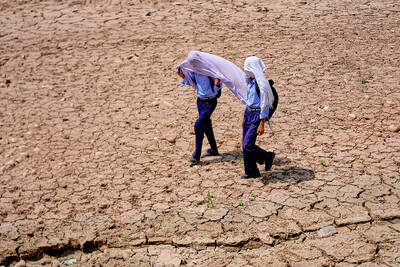
HOTTER: While Indians are accustomed to summer heat, climate change has caused northwestern India to warm faster than other parts of the country, an academic said Roads and markets have emptied during afternoons and some farmers have switched to nighttime work to avoid scorching temperatures as a heat wave grips large parts of India. The India Meteorological Department forecast maximum temperatures for yesterday of about 45°C in the capital, New Delhi, where authorities have opened temporary “cooling zones” to help people cope. The weather department warned that conditions would likely persist across several northern regions in the coming days, with temperatures staying well above seasonal averages. Authorities urged people to stay indoors during the hottest hours and take precautions against heat-related illnesses. India declares a heat wave whenever maximum temperatures
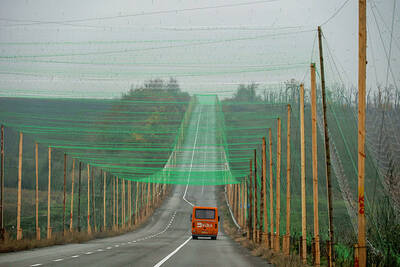
BIGGER ROLE: Beijing has said it maintains an impartial stance on the war in Ukraine, but by training Russian troops, China is far more involved than previously known China’s armed forces secretly trained about 200 Russian military personnel in China late last year, and some have since returned to fight in Ukraine, according to three European intelligence agencies and documents seen by Reuters. While China and Russia have held a number of joint military exercises since Moscow’s full-scale invasion of Ukraine in 2022, Beijing has repeatedly said that it is neutral in the conflict and presents itself as a peace mediator. The covert training sessions, which predominantly focused on the use of drones, were outlined in a dual-language Russian-Chinese agreement signed by senior Russian and Chinese officers in Beijing on


 RSS
RSS