


Egypt’s military has secretly detained hundreds and possibly thousands of suspected government opponents since mass protests against Egyptian President Hosni Mubarak began, and at least some of these detainees have been tortured, according to testimony gathered by the Guardian.
The military has claimed to be neutral, merely keeping anti-Mubarak protesters and loyalists apart. However, human rights campaigners say this is clearly no longer the case, accusing the army of involvement in both disappearances and torture — abuses Egyptians have for years associated with the notorious state security intelligence, but not the army.
The Guardian has spoken to detainees, who say they have suffered extensive beatings and other abuses at the hands of the military in what appears to be an organized campaign of intimidation. Human rights groups have documented the use of electric shocks on some of those held by the army.
Egyptian human rights groups say families are desperately searching for missing relatives who have disappeared into army custody. Some of the detainees have been held inside the renowned Museum of Egyptian Antiquities on the edge of Tahrir Square. Those released have given graphic accounts of physical abuse by soldiers, who accused them of acting for foreign powers, including Hamas and Israel.
Among those detained have been human rights activists, lawyers and journalists, but most have been released. However, Hossam Bahgat, director of the Egyptian Initiative for Personal Rights in Cairo, said hundreds, and possibly thousands, of ordinary people had “disappeared” into military custody across the country for no more than carrying a political flyer, attending the demonstrations or even the way they look. Many were still missing.
“Their range is very wide, from people who were at the protests or detained for breaking curfew to those who talked back at an army officer or were handed over to the army for looking suspicious or for looking like foreigners even if they were not,” he said. “It’s unusual and to the best of our knowledge, it’s also unprecedented for the army to be doing this.”
One of those detained by the army was a 23-year-old man who would only give his first name, Ashraf. He was detained on Friday on the edge of Tahrir Square carrying a box of medical supplies intended for one of the makeshift clinics treating protesters attacked by pro-Mubarak forces.
“I was on a sidestreet and a soldier stopped me and asked me where I was going. I told him and he accused me of working for foreign enemies and other soldiers rushed over and they all started hitting me with their guns,” he said.
Ashraf was hauled off to a makeshift army post where his hands were bound behind his back and he was beaten some more before being moved to an area under military control at the back of the museum.
“They put me in a room. An officer came and asked me who was paying me to be against the government. When I said I wanted a better government he hit me across the head and I fell to the floor. Then soldiers started kicking me. One of them kept kicking me between my legs,” he said.
“They got a bayonet and threatened to rape me with it. Then they waved it between my legs. They said I could die there or I could disappear into prison and no one would ever know. The torture was painful, but the idea of disappearing in a military prison was really frightening,” he said.
Ashraf said the beatings continued on and off for several hours until he was put in a room with about a dozen other men, all of whom had been severely tortured. He was let go after about 18 hours with a warning not to return to Tahrir Square.
Others have not been so lucky.
“A lot of families are calling us and saying: ‘I can’t find my son, he’s disappeared,’” said Heba Morayef, a Human Rights Watch researcher in Cairo. “I think what’s happening is that they’re being arrested by the military.”
Among those missing is Kareem Amer, a prominent government critic and blogger only recently released after serving a four-year prison sentence for criticizing the regime. He was picked up on Monday evening at a military checkpoint late at night as he was leaving Tahrir Square.
Bahgat said the pattern of accounts from those released showed the military had been conducting a campaign to break the protests.
“Some people, especially the activists, say they were interrogated about any possible links to political organizations or any outside forces. For the ordinary protesters, they get slapped around and asked: ‘Why are you in Tahrir?’ It seems to serve as an interrogation operation and an intimidation and deterrence,” Bahgat said.
Human Rights Watch says it has documented 119 arrests of civilians by the military, but believes there are many more.
Bahgat said it was impossible to know how many people had been detained because the army is not acknowledging the arrests. But he believes that the pattern of disappearances seen in Cairo is replicated across the country.

SPEAKING OUT: After Siranudh Scott’s allegations surfaced, celebrities and public figures took to social media to share their own experiences of sexual misconduct and abuse A high-profile alleged sexual abuse case within a wealthy Thai beer brewing family has prompted a wave of painful accounts from survivors of unconnected abuse in the conservative nation. Siranudh Scott, a member of the billionaire Thai family that founded the ubiquitous Singha beer brand, posted an emotional video this month accusing his elder brother Sunit of repeatedly abusing him when he was a teenager. Sunit, who is in his 30s, later denied the allegations in a video posted online, but Singha parent Boonrawd dismissed him from his executive role with the company on Tuesday last week. “I felt I needed to speak

SEEKING ORDER: Rodrigo Paz said that ‘anyone who wants to destroy the nation will have to deal with this president and the full force of the constitution’ Bolivian President Rodrigo Paz on Wednesday said that the nation was at a “breaking point” after nearly a month of protests that have caused shortages of food, fuel and medicine. Paz, who took office six months ago amid the worst economic crisis there in four decades, is battling a groundswell of fury over his policies. The political capital, La Paz, has been besieged by low-income workers and members of the indigenous majority calling for his resignation. “The country needs order and is reaching breaking point,” the 58-year-old said at a public event in La Paz, renewing his appeal for dialogue. On Tuesday, the Bolivian

A Hong Kong astronaut is to join a Chinese space mission for the first time as part of a three-person crew launching today, as Beijing edges closer to its goal of landing people on the moon. The Tiangong space station — crewed by teams of three astronauts that are typically rotated every six months — is the crown jewel of China’s space program, boosted by billions in state investment in a bid to catch up with the US and Russia. The Shenzhou-23 mission is to blast off at 11:08pm from the Jiuquan Satellite Launch Center in northwestern China, carrying three astronauts to
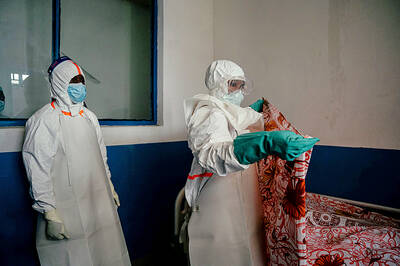
UPGRADED ALERT: The risk inside DR Congo is now considered ‘very high,’ while neighboring countries face a ‘high’ threat as the outbreak continues, the WHO said Ebola is spreading faster than responders can track it in eastern Congo, where health workers managed to follow up with barely one in five identified contacts in a single day. Authorities in the Democratic Republic of the Congo (DR Congo) reported 83 confirmed infections, 746 suspected cases and 1,603 identified contacts as of Thursday, but health workers were able to follow up on only 342 contacts that day — about 21 percent of the total under monitoring — data released by the DR Congo Ministry of Public Health on Friday showed. The figures suggest the response is falling behind the outbreak itself,


 RSS
RSS