


It was meant to be the document that put a lid on the clerical sex abuse scandals that have swept the Roman Catholic world.
However, instead of quelling fury from within and without the church, the Vatican stoked the anger of liberal Catholics and women’s groups by including a provision in its revised decree that made the “attempted ordination” of women one of the gravest crimes in ecclesiastical law.
The change put the “offense” on a par with the sex abuse of minors.
Terry Sanderson, president of the UK’s National Secular Society, called the document “one of the most insulting and misogynistic pronouncements that the Vatican has made for a very long time. Why any self-respecting woman would want to remain part of an organization that regards their full and equal participation as a ‘grave sin’ is a mystery to me.”
Vivienne Hayes, the chief executive of the London-based Women’s Resource Center, said the decision to raise women’s ordination to the level of a serious crime was “appalling.”
“This declaration is doubly disempowering for women as it also closes the door on dialogue around women’s access to power and decision making, when they are still under-represented in all areas of political, religious and civic life,” she said. “We would urge the Catholic Church to acknowledge that women’s rights are not incompatible with religious faith.”
Ceri Goddard, chief executive of the Fawcett Society, which lobbies for gender equality in the UK, said: “We are sure that the vast majority of the general public will share in our abject horror at the Vatican’s decision to categorise the ordination of women as an ‘offense’ in the same category as pedophilia — deemed to be one of the ‘gravest offenses a priest can commit.’”
“This statement follows a series where the Vatican, an institution which yields great influence and power not only in the Catholic community but also wider society, has pitched itself in direct opposition not only to women’s rights but to our equal worth and value. We hope this is an issue that the [UK] government takes the opportunity to raise if it still feels the impending papal visit is appropriate,” Goddard said.
The revision of a decree first issued nine years ago was intended to address the issue of clerical sex abuse.
The Vatican on Friday denied accusations that it viewed the ordination of women as priests and the sexual abuse of minors by clerics as equally criminal.
Monsignor Charles Scicluna, an official in the Vatican’s doctrinal department, said there was no attempt to make women’s ordination and pedophilia comparable crimes under canon law.
“This is not putting everything into one basket,” Scicluna, the Vatican’s internal prosecutor for handling sexual abuse cases, told Reuters in a telephone interview.
“They are in the same document but this does not put them on the same level or assign them the same gravity,” said Scicluna, who helped formulate the revisions.
The document was an attempt to update norms concerning “three sets of canonical crimes that are distinct,” and whose jurisdiction is reserved to the Congregation for the Doctrine of the Faith, the Vatican’s doctrinal department, he said.
While sexual abuse was a “crime against morality,” the attempt to ordain a woman was a “crime against a sacrament,” he said, referring to Holy Orders (the priesthood). The revisions also updated crimes against the faith such as heresy.
“This should not be interpreted as considering all these crimes to be equal,” he said. “They are crimes of a different nature.”
The Catholic Church teaches that it cannot ordain women as priests because Christ chose only men as his apostles. Proponents of a female priesthood reject this, saying he was only acting according to the norms of his times.
Some dissenters saw the placing of the two in one document as an attempt by the Vatican to respond to criticism by those who say the cause of at least some sexual abuse can be found in the Church’s insistence on a male, celibate priesthood.
“Sexuality is so denied in our Church,” said Christian Weisner, a spokesman for the “We Are Church” liberal Catholic reform movement. “The Roman Catholic Church has to revise its sexual teachings because I think that this is the root of pedophile crime,” Weisner said.
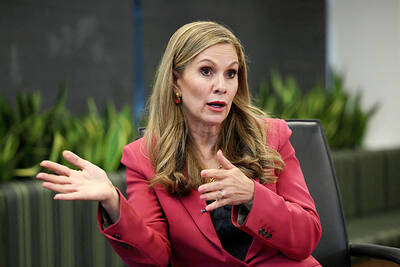
Australians were downloading virtual private networks (VPNs) in droves, while one of the world’s largest porn distributors said it was blocking users from its platforms as the country yesterday rolled out sweeping online age restriction. Australia in December became the first country to impose a nationwide ban on teenagers using social media. A separate law now requires artificial intelligence (AI)-powered chatbot services to keep certain content — including pornography, extreme violence and self-harm and eating disorder material — from minors or face fines of up to A$49.5 million (US$34.6 million). The country also joined Britain, France and dozens of US states requiring
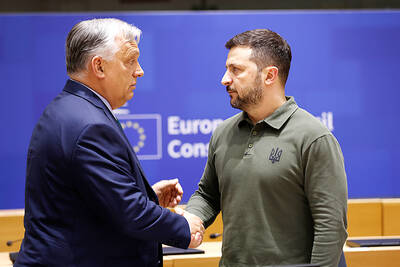
Hungarian authorities temporarily detained seven Ukrainian citizens and seized two armored cars carrying tens of millions of euros in cash across Hungary on suspicion of money laundering, officials said on Friday. The Ukrainians were released on Friday, following their detention on Thursday, but Hungarian officials held onto the cash, prompting Ukraine to accuse Hungary’s Russia-friendly government of illegally seizing the money. “We will not tolerate this state banditism,” Ukrainian Minister of Foreign Affairs Andrii Sybiha said. The seven detained Ukrainians were employees of the Ukrainian state-owned Oschadbank, who were traveling in the two armored cars that were carrying the money between Austria and
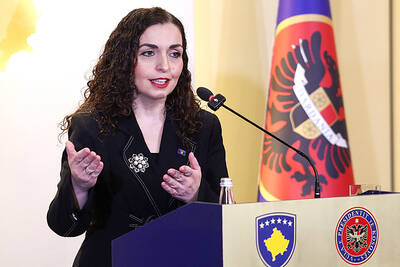
Kosovar President Vjosa Osmani on Friday after dissolving the Kosovar parliament said a snap election should be held as soon as possible to avoid another prolonged political crisis in the Balkan country at a time of global turmoil. Osmani said it is important for Kosovo to wrap up the upcoming election process and form functional institutions for political stability as the war rages in the Middle East. “Precisely because the geopolitical situation is that complex, it is important to finish this electoral process which is coming up,” she said. “It is very hard now to imagine what will happen next.” Kosovo, which declared

MORE BANS: Australia last year required sites to remove accounts held by under-16s, with a few countries pushing for similar action at an EU level and India considering its own ban Indonesia on Friday said it would ban social media access for children under 16, citing threats from online pornography, cyberbullying, online fraud and Internet addiction. “Accounts belonging to children under 16 on high-risk platforms will start to be deactivated, beginning with YouTube, TikTok, Facebook, Instagram, Threads, X, Bigo Live and Roblox,” Indonesian Minister of Communications and Digital Meutya Hafid said. “The government is stepping in so that parents no longer have to fight alone against the giants of the algorithm. Implementation will begin on March 28, 2026,” she said. The social media ban would be introduced in stages “until all platforms fulfill their


 RSS
RSS