


Before the earthquake ripped through Haiti in January, Anne Luze Denestant had never really thought about what life would be like as a disabled person in the impoverished Caribbean nation.
Then on Jan. 12, the earth convulsed, bringing a wave of destruction to the capital Port-au-Prince, killing some 200,000 people, and trapping Denestant under the rubble of her home for three days.
When rescuers finally pulled her out, she had to confront the knowledge that doctors were unable to save her left arm.
“I knew that before they told me,” Denestant said.
The 26-year-old asked doctors to amputate her arm in the hope her pain would stop.
“I just decided to let it go,” she said.
Now she’s joined the swelling ranks of Haiti’s disabled, who are finding a new power and new voice in a country where they were once hidden behind closed doors.
An estimated 2,000 to 6,000 people were left with some kind of disability by the quake, which struck across all classes and social strata.
They join the 800,000 disabled people who already lived in the country before, according to figures from Handicap International.
Denestant met Beatrice Leveille, 30, who has walked with crutches since contracting polio when she was 3, at a recent workshop to empower Haiti’s disabled, organized by international charity Christian Blind Mission.
“For me, being disabled used to mean being someone who can’t do anything,” said Leveille, who now represents the Association of the Handicapped in Carrefour.
“We have made some progress but it’s going to be a long fight,” said Odnel Eleazard, a project manager for the Christian Blind Mission.
Haiti is a signatory to the 2009 UN Convention on the Rights of Persons with Disabilities and recently passed a bill for the integration of people with handicaps.
However, calling for integrated education and greater mobility, Eleazard sees the scores of new disabilities caused by the earthquake as an opportunity for Haitians to move beyond past prejudices.
The earthquake is also an opportunity for Haitians to move beyond the culture of stigmatization that has long surrounded disability, the workshop participants said.
“In a country where 10 percent of the population is disabled, you could spend a week here and never see any,” said Josue Joseph, a spokesperson at the Secretariat for Integration. “Parents would lock up their handicapped kids at home.”
People also tended to associate disability with poverty, Joseph added, suggesting the earthquake is likely to revolutionize Haitians’ perceptions.
“Now there are amputees at all levels, in the upper class, the middle class and the working class,” he said. “January 12 proved that we are all potential handicapped.”
Eleazard’s organization has visited buildings to evaluate accessibility and is providing guidelines on how to reconstruct the leveled city, with the needs of the handicapped also being considered.
The campaign, for the moment, is limited to Port-au-Prince, because of lack of greater resources, but Eleazard said there is an enormous need to deal with the question of disability outside the capital as well.
Four months on, Denestant is adjusting to her new life, living in a crowded refugee camp.
“I can do the same things as before except for combing and washing hair,” said the woman, who used to braid hair for a living.
She hopes to continue her studies at some point.
“I’m strong, I don’t think about my arm,” Denestant said. “But living in that camp is not a life.”
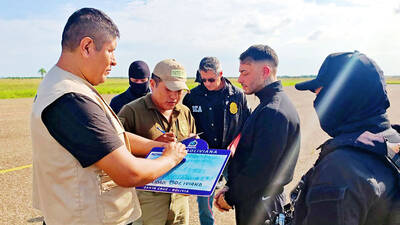
KINGPIN: Marset allegedly laundered the proceeds of his drug enterprise by purchasing and sponsoring professional soccer teams and even put himself in the starting lineups Notorious Latin American narco trafficker Sebastian Marset, who eluded police for years, was handed over to US authorities after his arrest on Friday in Bolivia. Marset, a Uruguayan national who was on the US most-wanted list, was passed to agents of the US Drug Enforcement Administration at Santa Cruz airport in Bolivia, then put on a US airplane, Bolivian state television showed. “The arrest and deportation were carried out pursuant to a court order issued by the US justice system,” Bolivian Minister of Government Marco Antonio Oviedo told reporters. The alleged kingpin was arrested in an upscale neighborhood of Santa

ACTIONABLE ADVICE: The majority of chatbots tested provided guidance on weapons, tactics and target selections, with Perplexity and Meta AI deemed to be the least safe From school shootings to synagogue bombings, leading artificial intelligence (AI) chatbots helped researchers plot violent attacks, according to a study published on Wednesday that highlighted the technology’s potential for real-world harm. Researchers from the nonprofit watchdog Center for Countering Digital Hate and CNN posed as 13-year-old boys in the US and Ireland to test 10 chatbots, including ChatGPT, Google Gemini, Perplexity, Deepseek and Meta AI. Eight of the chatbots assisted the make-believe attackers in more than half the responses, providing advice on “locations to target” and “weapons to use” in an attack, the study said. The chatbots had become a “powerful accelerant for
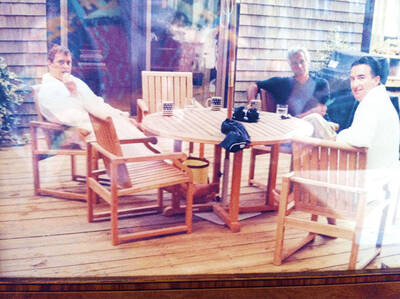
SCANDAL: Other images discovered earlier show Andrew bent over a female and lying across the laps of a number of women, while Mandelson is pictured in his underpants A photograph of former British prince Andrew and veteran politician Peter Mandelson sitting in bathrobes alongside late sex offender Jeffrey Epstein was unearthed on Friday in previously published documents. The image is believed to be the first known photograph of the two men with Epstein. They are currently engulfed in scandal in the UK over their ties to their mutual friend. The undated photograph, first reported by ITV News, shows King Charles III’s disgraced brother and former British ambassador to the US sitting barefoot outside on a wooden deck. They appear to have mugs with a US flag on them
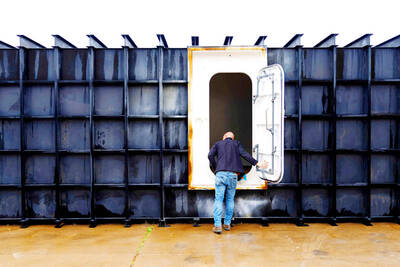
Since the war in the Middle East began nearly two weeks ago, the telephone at Ron Hubbard’s bomb shelter company in Texas has not stopped ringing. Foreign and US clients are rushing to buy his bunkers, seeking refuge in case of air raids, nuclear fallout or apocalypse. With the US and Israel pounding Iran, and Tehran retaliating with strikes across the region, Hubbard has seen demand for his product soar, mostly from Gulf nation customers in Bahrain, Qatar, Kuwait and the United Arab Emirates. “You can imagine how many people are thinking: ‘I wish I had a bomb shelter,’” Hubbard, 63, said in


 RSS
RSS