


Iran’s foreign minister held a rare meeting with the US and other UN Security Council members on Thursday as Tehran faces the possibility of new UN sanctions over its nuclear program.
UN ambassadors of the US, the UK, France and Russia did not attend the dinner meeting with Iranian Foreign Minister Manouchehr Mottaki organized by Iran’s UN mission, but sent lower level diplomats. Washington was represented by Deputy Ambassador Alejandro Wolff.
Most other council members sent ambassadors to the dinner at the Iranian ambassador’s residence in Manhattan. They included Chinese Ambassador Li Baodong (李保東), the only chief of mission from the five permanent council members to attend.
Japanese Ambassador Yukio Takasu indicated there had been no concrete outcome.
“We are not here to negotiate, we are here to exchange frank general ideas,” he told reporters through an interpreter. “There was no talk about sanctions. What is important is that most Security Council members are here.”
He said that Mottaki reiterated Iran’s position “that it has the right to peaceful uses of nuclear energy.”
Wolff declined to comment, except to say that “the dinner was very good.”
Other envoys left without speaking to journalists.
Washington does not have formal diplomatic relations with Iran and rarely participates in meetings with Iranian officials outside of the UN.
It was not immediately clear when a US diplomat last attended a dinner or reception hosted by Iran.
“We see this as an opportunity for Iran to show the council that they’re prepared to play by the rules and meet their obligations,” a US official said before Thursday’s dinner to explain why Washington was taking part. “Iran has been offered many opportunities to prove the peaceful nature of its nuclear program.”
“This meeting is another indication of the lengths the Iranians are going to to make their case,” he said. “They clearly recognize that the ongoing efforts in the Security Council and elsewhere are isolating them and doing them harm.”
Another Western diplomat on the council said the meeting proved the council was continuing to pursue a “dual-track approach” with Iran — negotiations combined with the threat of sanctions.
“We want to keep talking,” the diplomat said.
Washington and its Western allies suspect Iran of developing nuclear weapons under cover of a civilian atomic energy program. Tehran says that its nuclear ambitions are limited to the peaceful generation of electricity, but has refused to halt sensitive activities that could enable it to develop weapons.
The five permanent members of the Security Council — the US, the UK, France, Russia and China — and Germany have been negotiating for weeks on a draft resolution that would impose a fourth round of sanctions on Iran for refusing to halt its uranium enrichment program.
The proposal, drafted by the US, calls for new curbs on Iranian banking, a full arms embargo, tougher steps against Iranian shipping, moves against members of Iran’s Islamic Revolutionary Guard Corps and firms they control, and a ban on new investments in Iran’s energy sector.
Diplomats say that both Russia and China have problems with the proposed arms embargo, energy investment ban and other punitive measures.
Washington and its allies had hoped the Security Council could vote on a new UN sanctions resolution by the end of last month, but diplomats said negotiations could drag on at least until next month.
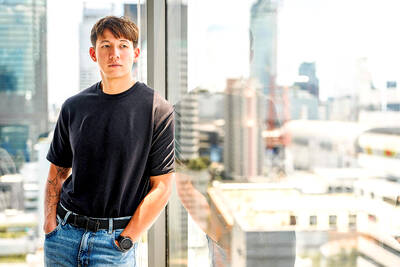
SPEAKING OUT: After Siranudh Scott’s allegations surfaced, celebrities and public figures took to social media to share their own experiences of sexual misconduct and abuse A high-profile alleged sexual abuse case within a wealthy Thai beer brewing family has prompted a wave of painful accounts from survivors of unconnected abuse in the conservative nation. Siranudh Scott, a member of the billionaire Thai family that founded the ubiquitous Singha beer brand, posted an emotional video this month accusing his elder brother Sunit of repeatedly abusing him when he was a teenager. Sunit, who is in his 30s, later denied the allegations in a video posted online, but Singha parent Boonrawd dismissed him from his executive role with the company on Tuesday last week. “I felt I needed to speak

SEEKING ORDER: Rodrigo Paz said that ‘anyone who wants to destroy the nation will have to deal with this president and the full force of the constitution’ Bolivian President Rodrigo Paz on Wednesday said that the nation was at a “breaking point” after nearly a month of protests that have caused shortages of food, fuel and medicine. Paz, who took office six months ago amid the worst economic crisis there in four decades, is battling a groundswell of fury over his policies. The political capital, La Paz, has been besieged by low-income workers and members of the indigenous majority calling for his resignation. “The country needs order and is reaching breaking point,” the 58-year-old said at a public event in La Paz, renewing his appeal for dialogue. On Tuesday, the Bolivian
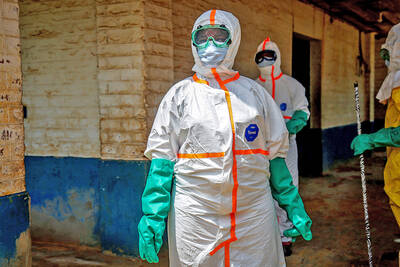
COMMUNITY CONFLICT: Concerns about disease spread from corpses has run up against friends and families’ desire to bury their dead as infection spreads in the area Angry residents of a town at the epicenter of the Ebola outbreak in the Democratic Republic of the Congo (DR Congo) attacked and burned a tent that was part of a health center where people are being treated for the virus, the staff there said Saturday. It was the second such attack in the region in a week. No one was hurt in the attack, according to reports but as patients ran out to escape the fire, 18 people with suspected Ebola infections fled the facility and are unaccounted for, a hospital director said. Angry residents arrived at the clinic in the

Forecasters in Europe yesterday warned of exceptional heat as record temperatures driven by a “heat dome” push temperatures well above seasonal norms across the continent. The surge follows a record-breaking Monday, with France logging its hottest day in the month of May on record, its weather agency said, and the UK also posting unprecedented highs. A so-called “heat dome” of warm air from northern Africa trapped under a high-pressure system over western Europe is behind the high temperatures not usually seen until high summer. Restrictions on outdoor work were imposed in parts of Italy, beaches in southwest France filled earlier than usual and


 RSS
RSS