


A giant oil slick closed in on the fragile Louisiana coast yesterday after attempts to stop it faltered, threatening an environmental and economic disaster as US President Barack Obama arrives to visit.
With Obama expected in the area yesterday morning, windy weather earlier hurt efforts to corral the slick and the US admiral in charge of the response to the spill said it was inevitable oil would reach the coastline.
Louisiana Governor Bobby Jindal warned that the growing oil slick, already one of the largest spills in US history, threatened his state’s “way of life.”
He said British Petroleum and the Coast Guard still had not provided him with detailed plans on how to protect the coast even though the explosion that prompted the leak at an oil rig in the Gulf of Mexico occurred April 20.
Heavier oil from the leak was expected to hit the coast yesterday, he said.
The chain of events has led to a nightmare scenario for Louisiana only months ahead of the five-year anniversary of Hurricane Katrina.
Fishermen and coastal communities finally back on their feet after the 2005 disaster braced for more pain.
“I guess we’re probably going to end up out of business,” Al Sunseri said of his 134-year-old processing company, P&J Oyster in New Orleans’ historic French Quarter, as he considered the potential impact.
Louisiana accounts for an estimated one-third of the country’s total oyster output, and the Gulf of Mexico is prime spawning ground for fish, shrimp and crabs, as well as a major stop for migratory birds.
Cleaning the intricate marshland along Louisiana’s coast, a buffer zone for hurricanes that is already quickly eroding, is likely to be a daunting task.
Environmentalists said it could take decades for the maze of marshes — more than 40 percent of the US’ ecologically fragile wetlands — to recover if waves simply wash the oil over kilometers of boom, floating barriers set up to protect the coast.
“There probably isn’t enough boom in the world to protect what needs to be protected,” said Mark Floegel, a researcher with Greenpeace.
Engineers are racing against time to shut off the flow of oil from a ruptured well some 80km off the coast but are getting nowhere fast as more than 757,000 liters of crude spews into the sea each day.
Commandant Admiral Thad Allen of the US Coast Guard, newly appointed by Obama to spearhead the government response to the burgeoning disaster, admitted the weather conditions meant a major shore impact was inevitable.
The White House said Obama planned to travel to the Gulf yesterday to survey efforts to contain the spill.
Miami University researcher Hans Gruber said satellite images of the slick on Friday showed it was three times bigger than estimated, covering an area of 9,000km², similar in size to Puerto Rico.
At the current estimated rate of leakage, it would take less than eight weeks for the spill to surpass the 41.6 million liters of oil that poured from the grounded Exxon Valdez tanker in Alaska in 1989.
Safety fears over the oil slick led operators of two natural gas platforms to halt production and evacuate workers from one of their sites in the Gulf of Mexico.
So far, the disaster has prompted Louisiana, Florida, Alabama and Mississippi to declare states of emergency.
Also See: Oysters are the world for Louisiana’s threatened coast
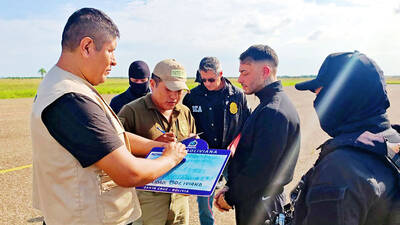
KINGPIN: Marset allegedly laundered the proceeds of his drug enterprise by purchasing and sponsoring professional soccer teams and even put himself in the starting lineups Notorious Latin American narco trafficker Sebastian Marset, who eluded police for years, was handed over to US authorities after his arrest on Friday in Bolivia. Marset, a Uruguayan national who was on the US most-wanted list, was passed to agents of the US Drug Enforcement Administration at Santa Cruz airport in Bolivia, then put on a US airplane, Bolivian state television showed. “The arrest and deportation were carried out pursuant to a court order issued by the US justice system,” Bolivian Minister of Government Marco Antonio Oviedo told reporters. The alleged kingpin was arrested in an upscale neighborhood of Santa
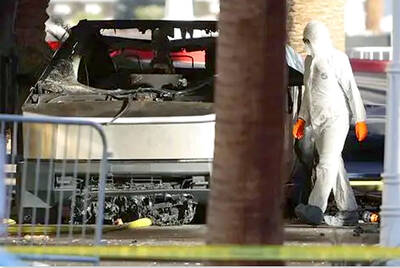
ACTIONABLE ADVICE: The majority of chatbots tested provided guidance on weapons, tactics and target selections, with Perplexity and Meta AI deemed to be the least safe From school shootings to synagogue bombings, leading artificial intelligence (AI) chatbots helped researchers plot violent attacks, according to a study published on Wednesday that highlighted the technology’s potential for real-world harm. Researchers from the nonprofit watchdog Center for Countering Digital Hate and CNN posed as 13-year-old boys in the US and Ireland to test 10 chatbots, including ChatGPT, Google Gemini, Perplexity, Deepseek and Meta AI. Eight of the chatbots assisted the make-believe attackers in more than half the responses, providing advice on “locations to target” and “weapons to use” in an attack, the study said. The chatbots had become a “powerful accelerant for
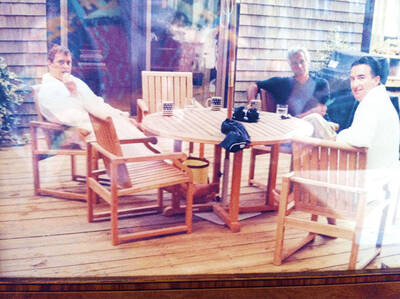
SCANDAL: Other images discovered earlier show Andrew bent over a female and lying across the laps of a number of women, while Mandelson is pictured in his underpants A photograph of former British prince Andrew and veteran politician Peter Mandelson sitting in bathrobes alongside late sex offender Jeffrey Epstein was unearthed on Friday in previously published documents. The image is believed to be the first known photograph of the two men with Epstein. They are currently engulfed in scandal in the UK over their ties to their mutual friend. The undated photograph, first reported by ITV News, shows King Charles III’s disgraced brother and former British ambassador to the US sitting barefoot outside on a wooden deck. They appear to have mugs with a US flag on them
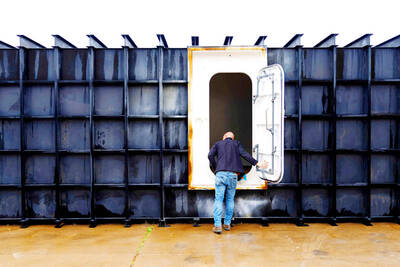
Since the war in the Middle East began nearly two weeks ago, the telephone at Ron Hubbard’s bomb shelter company in Texas has not stopped ringing. Foreign and US clients are rushing to buy his bunkers, seeking refuge in case of air raids, nuclear fallout or apocalypse. With the US and Israel pounding Iran, and Tehran retaliating with strikes across the region, Hubbard has seen demand for his product soar, mostly from Gulf nation customers in Bahrain, Qatar, Kuwait and the United Arab Emirates. “You can imagine how many people are thinking: ‘I wish I had a bomb shelter,’” Hubbard, 63, said in


 RSS
RSS