


It is not even dawn and Al Sunseri is hustling to load sacks of oysters in a truck as the potentially catastrophic oil leak in the Gulf of Mexico forces him to ponder the unthinkable.
“I guess we’re probably going to end up out of business,” he says of his 134-year-old processing company, P&J Oyster, as he considers what could happen if the state’s shellfish beds are shut down for a long period of time.
The oil spill, already one of the worst in US history as it reaches the state’s coastline, has threatened to cut off supplies of Louisiana oysters, a vital economic resource and a beloved symbol of local culture.

PHOTO: AFP
Louisiana’s shellfish industry provides about a third of the nation’s supply each year and a complete shutdown would badly hit the pocketbooks of many.
However, it would also be a cruel moral blow to an area still struggling to recover from Hurricane Katrina, with oysters on the menu seemingly everywhere in New Orleans, from hole-in-the-wall saloons to the finest restaurants.
Oysters aren’t a delicacy here — they’re practically a necessity.
“That’s why I came here today,” Russell Henderson, a 62-year-old slurping down a dozen raw oysters at Casamento’s in uptown New Orleans, said on Saturday.
“I’m out running errands and I said, ‘I better get some oysters while I can,’” he said.
Oyster gathering areas have already been closed along Louisiana’s coastline east of the Mississippi River, and fishermen and processors fear the worst is yet to come.
Officials say, however, that the oysters that are still being brought to market are safe.
The oil also poses major risks to other seafood products, including crabs, shrimp and a wide range of fish, but an oyster shutdown may hit closest to home.
Louisiana produces about 113.4 million kilograms of oysters each year, amounting to about a third of the US total, said Mike Voisin, who serves on an industry board that advocates for oystermen.
“Oysters are culturally a part of who we are,” he said. “I’m seventh generation in the oyster business. Oyster liquor runs in our blood.”
They’re eaten any number of ways here: fried, on sandwiches called po-boys or raw. There are recipes including Oysters Bienville or Oysters Rockefeller. They are charbroiled sometimes.
“It’s people’s livelihood. There’s a whole economy based on it,” said Greg Placone, a 26-year-old law student who was eating raw oysters at Casamento’s on Saturday.
Casamento’s, a stripped down seafood spot with a white tile dining room where two oyster shuckers work expertly, has been in business since 1919.
Locals mobbed the place on Friday to grab what they feared could be their last Louisiana oysters for some time, owner C.J. Casamento said.
“First time we ran out of every beer we had in here,” he said of Friday night. “I ain’t never seen that.”
Sunseri of P&J said he hoped a first annual oyster festival set to take place next month could still go ahead. He wasn’t ready to throw in the towel.
He said he couldn’t remember the first time he ate an oyster.
“All I know is my daddy said I ate oysters before I could walk,” said the 52-year-old, whose family business is located in the city’s historic French Quarter. “And eating them raw — not just oysters.”
Chuck Brown, 66, ate raw oysters with his nephew at Casamento’s on Saturday and also said he wanted to get them while he still had the chance. Asked why people in New Orleans eat so much of the shellfish, he offered his own theory.
“Oysters, for a man, keeps us healthy,” he said with a sly smile. “I’ll put it as polite as I can.”
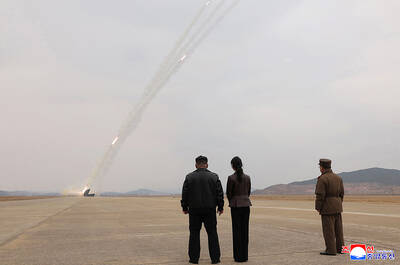
North Korea tested nuclear-capable rocket launchers, state media reported yesterday, a day after Seoul detected the launch of about 10 ballistic missiles. The test comes after South Korean and US forces launched their springtime military drills, due to run until Thursday. North Korean leader Kim Jong-un on Saturday oversaw the testing of the multiple rocket launcher system (MRLS), the Korean Central News Agency (KCNA) said. The test involved 12 600mm-caliber ultra-precision multiple rocket launchers and two artillery companies, it said. Kim said the drill gave Pyongyang’s enemies, within the 420km striking range, a sense of “uneasiness” and “a deep understanding

RECOGNITION: Former Fijian prime minister Mahendra Chaudhry said that Taiwan’s New Southbound Policy serves as a stabilizing force in the Indo-Pacific region Taiwan can lead the unification of the Chinese people, Nobel Peace Prize laureate and former Polish president Lech Walesa said in Taipei yesterday, adding that as the world order is changing, peaceful discussion would find good solutions, and that the use of force and coercion would always fail. Walesa made the remarks during his keynote address at a luncheon of the Yushan Forum in Taipei, titled “Indo-Pacific Partnership Prospects: Taiwan’s Values, Technology and Resilience,” organized by the Taiwan-Asia Exchange Foundation with the Ministry of Foreign Affairs. Walesa said that he had been at the forefront of a big peaceful revolution and “if

North Korea yesterday fired about 10 ballistic missiles to the sea toward Japan, the South Korean Joint Chiefs of Staff (JCS) said, days after Pyongyang warned of “terrible consequences” over ongoing South Korea-US military drills. Pyongyang recently dashed hopes of a diplomatic thaw with Seoul, Washington’s security ally, describing its latest peace efforts as a “clumsy, deceptive farce.” Seoul’s military detected “around 10 ballistic missiles launched from the Sunan area in North Korea toward the East Sea [Sea of Japan] at around 1:20pm,” JCS said in a statement, referring to South Korea’s name for the body of water. The missiles

‘UNWAVERING FRIENDSHIP’: A representative of a Japanese group that co-organized a memorial, said he hopes Japanese never forget Taiwan’s kindness President William Lai (賴清德) yesterday marked the 15th anniversary of the Tohoku earthquake and tsunami, urging continued cooperation between Taiwan and Japan on disaster prevention and humanitarian assistance. Lai wrote on social media that Taiwan and Japan have always helped each other in the aftermath of major disasters. The magnitude 9 earthquake struck northeastern Japan on March 11, 2011, triggering a massive tsunami that claimed more than 19,000 lives, according to data from Japanese authorities. Following the disaster, Taiwan donated more than US$240 million in aid, making it one of the largest contributors of financial assistance to Japan. In addition to cash donations and


 RSS
RSS