


From the Himalayan foothills, he runs a US$40 million-a-year health empire, owns a Scottish island and claims to cure cancer. Now, India’s star yoga guru plans to enter politics to help the poor and punish the corrupt.
Swami Ramdev is out to “cleanse” the world’s largest democracy of 1.2 billion people of greed and foreign influences, drawing on the support of a television audience of millions and his claim to have a follower in every Indian household.
It is too early to say whether Ramdev will prove a serious political force or a passing fad, but he could appeal to millions of Hindus whose traditional bent grates against a rapidly globalizing economy, and be a man other politicians may woo.
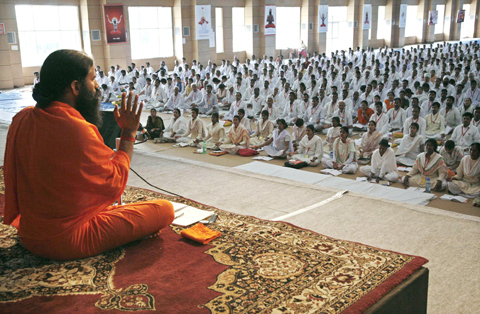
PHOTO: REUTERS
Dressed in his trademark orange robe, wooden sandals and lounging in a chair, Ramdev told reporters that his party would contest all 543 seats in the next election due by 2014.
If his TV audience is anything to go by, he will have a head start. At least 30 million watch Ramdev’s daily yoga teachings treating anything from diabetes to high blood pressure.
A Ramdev-led government would overhaul India’s political, legal and education systems, which he said were hangovers from colonial rule, and set up fast-track courts to pass sentences for capital crimes including corruption.
“People who are corrupt should face capital punishment. This is how it will stop, otherwise it won’t stop,” Ramdev said at his sprawling ashram in the northern town of Haridwar, one of Hinduism’s holiest sites on the banks of the Ganges River.
“The policies which were formed by the British were not to run the country ... they were formulated to loot the country,” he said.
Ramdev wants to withdraw the rupee and issue a new currency, with the aim of taking the old money out of criminals’ pockets. Foreign corporations will be boycotted.
Yoga will spread far and wide, especially to schools and hospitals if Ramdev wins power. He also has little time for shopping, TV soaps or cricket — another British import — though he said these were his personal preferences.
His ashram can host 6,000 people and is the nerve center for three trusts worth US$40 million in turnover last year, including a Scottish island now renamed “Peace Island.”
Ramdev, who does not disclose his age, has drawn sharp criticism, however, over issues such as his claims to cure cancer and his belief that homosexuality is a mental disease.
In an interview punctuated by Ramdev’s frequent laughter and the occasional burp, he said he wanted to “befriend” gay people who could come to him for treatment. He also said he was misquoted in another row over claims he has an AIDS cure.
“People like to create controversies for me,” he said.
Posters of Swami Ramdev are dotted around Haridwar, which has been celebrating the religious festival, Kumbh Mela, since January. About 50 million people are expected to attend.
At 5am on a Thursday, Swami Ramdev was already two hours into his 20-hour working day, fueled by a diet of milk, green vegetables and seasonal fruit.
In a tent guarded by a dozen security men, more than 500 people sat cross-legged in front of Ramdev ready to watch and copy his moves.
There was applause when he performed postures like a headstand or made his belly dance inside his ribcage, a trademark.
The morning’s teaching was also laced with political messages, especially on the recent killing of 76 police by Maoist rebels.
“Corrupt politicians are responsible for the Maoist problems,” said Ramdev, who rose from an illiterate farming family to rank 29th in a recent list of India’s most powerful people.
“Politicians should go and die if they cannot provide security,” he said. “If any politician got a bullet anywhere near them, they’d pee in their pants.”
Ramdev’s views on corruption may gain traction in a country where, according to Social Watch India, a quarter of lawmakers had criminal charges pending against them last year.
Ramdev said he would speed India’s economic rise by retrieving billions of dollars he believes are stashed away in foreign tax havens, which echoes a key manifesto item by the Hindu-nationalist Bharatiya Janata Party in the last election.
However, his critics say some of his treatment claims on cancer and swine flu are misleading and worry about what will happen if Ramdev’s influence were translated into a role in government.
“If he has influence in the political process, it will be very dangerous,” said Sanal Edamaruku, of the Indian Rationalist Association. “If he is in the political decision-making process, it can do enormous damage to the country’s progress.”
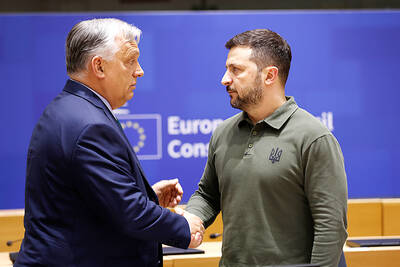
Hungarian authorities temporarily detained seven Ukrainian citizens and seized two armored cars carrying tens of millions of euros in cash across Hungary on suspicion of money laundering, officials said on Friday. The Ukrainians were released on Friday, following their detention on Thursday, but Hungarian officials held onto the cash, prompting Ukraine to accuse Hungary’s Russia-friendly government of illegally seizing the money. “We will not tolerate this state banditism,” Ukrainian Minister of Foreign Affairs Andrii Sybiha said. The seven detained Ukrainians were employees of the Ukrainian state-owned Oschadbank, who were traveling in the two armored cars that were carrying the money between Austria and
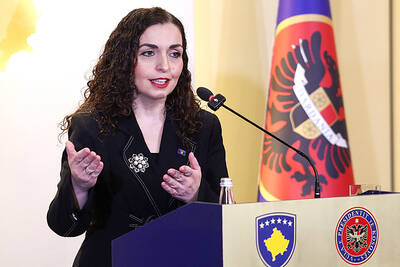
Kosovar President Vjosa Osmani on Friday after dissolving the Kosovar parliament said a snap election should be held as soon as possible to avoid another prolonged political crisis in the Balkan country at a time of global turmoil. Osmani said it is important for Kosovo to wrap up the upcoming election process and form functional institutions for political stability as the war rages in the Middle East. “Precisely because the geopolitical situation is that complex, it is important to finish this electoral process which is coming up,” she said. “It is very hard now to imagine what will happen next.” Kosovo, which declared

MORE BANS: Australia last year required sites to remove accounts held by under-16s, with a few countries pushing for similar action at an EU level and India considering its own ban Indonesia on Friday said it would ban social media access for children under 16, citing threats from online pornography, cyberbullying, online fraud and Internet addiction. “Accounts belonging to children under 16 on high-risk platforms will start to be deactivated, beginning with YouTube, TikTok, Facebook, Instagram, Threads, X, Bigo Live and Roblox,” Indonesian Minister of Communications and Digital Meutya Hafid said. “The government is stepping in so that parents no longer have to fight alone against the giants of the algorithm. Implementation will begin on March 28, 2026,” she said. The social media ban would be introduced in stages “until all platforms fulfill their
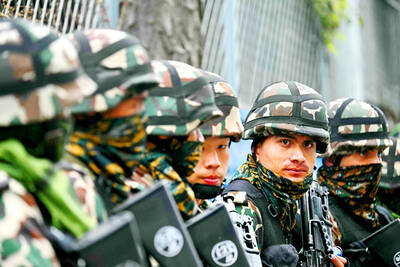
Counting was under way in Nepal yesterday, after a high-stakes parliamentary election to reshape the country’s leadership following protests last year that toppled the government. Key figures vying for power include former Nepalese prime minister K. P. Sharma Oli, rapper-turned-mayor Balendra Shah, who is bidding for the youth vote, and newly elected Nepali Congress party leader Gagan Thapa. In Kathmandu’s tea shops and city squares, people were glued to their phones, checking results as early trends flashed up — suggesting Shah’s centrist Rastriya Swatantra Party (RSP) was ahead. Nepalese Election Commission spokesman Prakash Nyupane said the counting was ongoing “in a peaceful manner”


 RSS
RSS