


A stampede broke out at a Hindu temple in northern India yesterday as thousands of people jostled with each other to get free clothes and utensils, leaving at least 63 people dead and dozens more injured, officials said.
The force of the stampede was so great, it knocked down a gate at the temple compound in Kunda, a small town 180km southeast of Lucknow, the capital of Uttar Pradesh state.
Up to 10,000 devotees had gathered at the temple around noon to receive free goods to mark the anniversary of the death of the wife of the religious leader, Kripalu Maharaj, said Brij Lal, a local police official
About 44 worshippers were injured in the crush of people at a Hindu Ram Janki temple, said Ashok Kumar, a senior government official.
By late afternoon police had cleared the compound and started the process of identifying the bodies, Kumar said.
“We have now counted all the bodies and they include 37 children and 26 women who had come to collect free gifts,” assistant superintendent of police S.P. Pathak said by telephone from Kunda.
However, “the [death] toll is likely to rise further as many women and children are injured. At least 20 are serious,” Lal said.
Local residents in Kunda village, where the temple is located, helped police carry the injured to nearby hospitals, police said. Hundreds of people gathered at the hospitals for news of their family members.
“She had just wandered in to see what was happening,” said Gudal, a 38-year-old farmer whose seven-year-old daughter, Ranjana, was killed.
Gudal, who uses only one name, wept as she spoke.
According to his Web site, Kripalu Maharaj runs a charitable trust which sets up schools, temples and hospitals and operates five large ashrams, including one in the US.
Stampedes at religious events in India are common as large numbers of excited worshippers pack into congested areas. Panic can spread quickly and, with few safety regulations in place, the result is often lethal.
The deadliest recent incident was in October 2008 when about 220 people died near a temple inside Jodhpur’s famous Mehrangarh Fort.

Hungarian authorities temporarily detained seven Ukrainian citizens and seized two armored cars carrying tens of millions of euros in cash across Hungary on suspicion of money laundering, officials said on Friday. The Ukrainians were released on Friday, following their detention on Thursday, but Hungarian officials held onto the cash, prompting Ukraine to accuse Hungary’s Russia-friendly government of illegally seizing the money. “We will not tolerate this state banditism,” Ukrainian Minister of Foreign Affairs Andrii Sybiha said. The seven detained Ukrainians were employees of the Ukrainian state-owned Oschadbank, who were traveling in the two armored cars that were carrying the money between Austria and

Kosovar President Vjosa Osmani on Friday after dissolving the Kosovar parliament said a snap election should be held as soon as possible to avoid another prolonged political crisis in the Balkan country at a time of global turmoil. Osmani said it is important for Kosovo to wrap up the upcoming election process and form functional institutions for political stability as the war rages in the Middle East. “Precisely because the geopolitical situation is that complex, it is important to finish this electoral process which is coming up,” she said. “It is very hard now to imagine what will happen next.” Kosovo, which declared

MORE BANS: Australia last year required sites to remove accounts held by under-16s, with a few countries pushing for similar action at an EU level and India considering its own ban Indonesia on Friday said it would ban social media access for children under 16, citing threats from online pornography, cyberbullying, online fraud and Internet addiction. “Accounts belonging to children under 16 on high-risk platforms will start to be deactivated, beginning with YouTube, TikTok, Facebook, Instagram, Threads, X, Bigo Live and Roblox,” Indonesian Minister of Communications and Digital Meutya Hafid said. “The government is stepping in so that parents no longer have to fight alone against the giants of the algorithm. Implementation will begin on March 28, 2026,” she said. The social media ban would be introduced in stages “until all platforms fulfill their
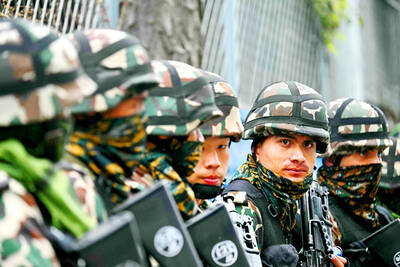
Counting was under way in Nepal yesterday, after a high-stakes parliamentary election to reshape the country’s leadership following protests last year that toppled the government. Key figures vying for power include former Nepalese prime minister K. P. Sharma Oli, rapper-turned-mayor Balendra Shah, who is bidding for the youth vote, and newly elected Nepali Congress party leader Gagan Thapa. In Kathmandu’s tea shops and city squares, people were glued to their phones, checking results as early trends flashed up — suggesting Shah’s centrist Rastriya Swatantra Party (RSP) was ahead. Nepalese Election Commission spokesman Prakash Nyupane said the counting was ongoing “in a peaceful manner”


 RSS
RSS