


On a grey Friday afternoon in Paris, Amina and her girlfriends are carrying fake designer handbags and wearing trainers sodden by the rain. Their heads are enveloped in the fur lining of their jacket hoods, their eyes rimmed with black kohl, and they are chatting vivaciously, swapping numbers on their shiny cell phones.
But there is one factor which distinguishes this group of young women from a standard cluster of twentysomethings. Amina, 21, is dressed in a black veil which covers her entire body and most of her face. And, as she speaks, her eyes flash with pride and indignation.
“I choose to wear this. Not every day, just now and again. But when I do wear it, it is entirely of my own volition. No one is forcing me,” she says, standing with her friends on a busy street corner in the heavily Muslim northern district of Barbes. “If they make us take it off they’ll be taking a part of us. I’d rather die than let them do it.”
Amina, who is studying at the university of Paris, is in the eye of a storm which in recent months has swept through France and left resentment in its wake.
Citing concerns about laicite — secularism — and equality of the sexes, members of parliament voted last week to push through legislation that would forbid women from wearing the full Islamic veil in official spaces such as hospitals, post offices and buses. Figures from all political parties, feminist groups and even an imam have condemned a piece of clothing they describe as a “walking prison.”
The proposals — which have been denounced as “stigmatizing” by some and as too lenient by others — were the result of a parliamentary inquiry that has raised fresh questions about what it means to be a Muslim in France. If its path through parliament is smooth, the partial ban could come into effect by the end of the year.
For Amina and her friends, who as young Frenchwomen are typical of the estimated 1,900 people in the country that a government report says are believed to wear the niqab, the idea of a ban is a “shocking” attempt by the state to interfere with an act they insist is their own religious choice — ironically, they say, out of a concern for laicite.
“France is supposed to be a free country. Nowadays women have the right to take their clothes off but not put them on,” Kheira says.
She is showing her face, but says she has her niqab wrapped up in her handbag.
Since the idea of a ban was first mooted last summer, the women say they have noticed a rise in hostility from the public which has seen them “verbally insulted” and stared at in the street. French traditions of the separation of church and state, which in 2004 saw headscarves and “conspicuous” religious symbols banned from schools, mean that as overt a religious statement as the niqab makes many people uneasy.
Last week French President Nicolas Sarkozy, keen to dispel the belief that his policies are doing more harm than good to intra-community relations, insisted he would let no French Muslim citizen be “stigmatized.” But that is exactly what many feel he has already done.
“They are demonizing Islam,” Kheira says .
“It started with the headscarf. Then it was the [discussion about] minarets. Now it’s the niqab.” Samia says.
The issue is not so straightforward, however, for the rest of France’s Muslim population, which at between 5 and 6 million is the largest in western Europe. For many in Barbes — home to a poor but vibrant Maghrebi community — the niqab is a rare sight and one which alienates some Muslims as much as it does some others.
“Personally I think there should be a ban,” says one man, a local bartender of Moroccan origin. “It annoys me to see a woman all covered up.”
Such views are not uncommon among a Muslim mainstream which feels there is a gulf between their religious practices and those of a tiny minority of women generally thought to be influenced by the strict brand of Salafi Islam. And, while many others are indifferent to the niqab, they object to being held hostage by that minority; some fear the niqab has given the authorities an excuse to target the entire Muslim population.
“It angers me because it’s my community they’re talking about. It’s giving the wrong idea of what it is to be Muslim,” explains Kemal Idris, 50, an Algerian working in a halal butchers’ near the local, oversubscribed mosque.
But while he sympathizes with concern for female freedom and laicite, he believes there are many more “serious problems” which need tackling first.
“How many burqas are there in France? 100? 200? No one knows. I’ve lived in this area for 25 years and I don’t think I’ve ever seen one. That is not the problem,” he says.
Ever since the autumn, when French Immigration Minister, Eric Besson, launched a nationwide debate into “national identity” in a purported attempt to bring unity to a fractured country, critics have accused the government of pursuing a provocative line which risks exacerbating, rather than healing, social tensions. Very often, Muslim “integration” is the topic up for discussion.
But many people believe that, if France is to make good on its promises to be the upholder of freedom and human rights, it would do better to fix the big issues facing Muslims — discrimination, urban planning and unemployment — than to engage in a theoretical debate about their place in the nation.
As for the niqab, the implementation of a ban could act as a provocation.
“The more we’re stopped the more we’ll do it. Out of solidarity,” Samia says. “It’s a battle.”
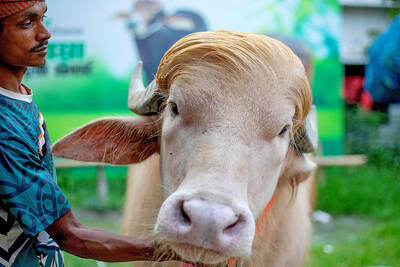
Crowds in Bangladesh are flocking to snap photographs with an unlikely social media star — an albino buffalo with flowing blond hair nicknamed “Donald Trump” that is due to be sacrificed within days. Owner Zia Uddin Mridha, 38, said his brother named the 700kg bull over its flowing helmet of hair resembling the signature look of the US president. “My younger brother picked this name because of the buffalo’s extraordinary hair,” he said at his farm in Narayanganj, just outside the capital, Dhaka. Mridha said that a constant stream of curious visitors — social media fans, onlookers and children — have come throughout
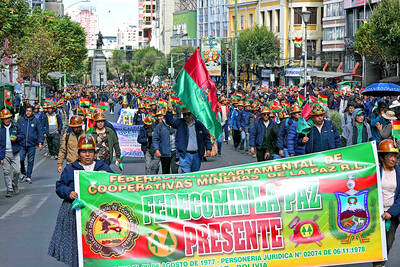
The Bolivian government on Friday struck a deal with protesting miners, but was still grappling with blockades and demonstrations by other workers across La Paz. Other groups are still blocking access roads into the city, which is also the seat of the government. Police on Thursday prevented the miners from entering the main square by using tear gas, while the demonstrators hurled stones and explosives with slingshots. Protests against the policies of Bolivian President Rodrigo Paz have convulsed the Andean nation since early this month, and roadblocks were choking routes into La Paz throughout Friday, the national road authority said. Miners demanded that Paz
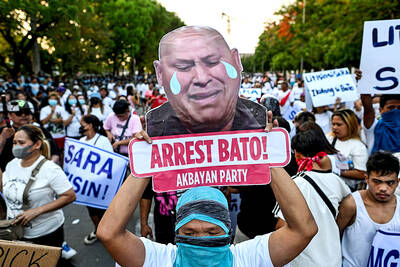
The Philippines said it has asked the country’s Supreme Court to allow it to arrest former Philippine president Rodrigo Duterte’s chief drug war enforcer to stand trial in an international tribunal. The International Criminal Court (ICC) last week unsealed an arrest warrant against Philippine Senator Ronald dela Rosa, accusing him along with Duterte and other “coperpetrators” of the “crime against humanity of murder.” Dela Rosa briefly sought refuge in the Philippine Senate last week while asking the Philippine Supreme Court to stop an ongoing attempt by government agents to arrest him. “By his own conduct, he has placed himself outside the protection of
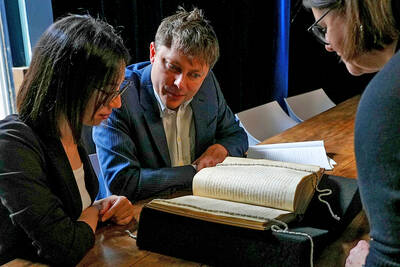
The researchers in Ireland looked at their computer screen, marveling at a medieval book tracked down in a Roman library. They flipped through its digitized pages and found their sought-after treasure: the oldest surviving English poem. “We were extremely surprised. We were speechless. We couldn’t believe our eyes when we first saw that,” said Elisabetta Magnanti, a visiting research fellow at Trinity College Dublin’s school of English. The poem was also within the main body of Latin text, she said, calling it “extraordinary.” Composed in Old English by a Northumbrian agricultural worker in the 7th century, Caedmon’s Hymn appears within some copies of


 RSS
RSS