

Venezuelan President Hugo Chavez announced a 25 percent increase in Venezuela’s minimum wage on Friday to try to blunt the effects of soaring inflation, and defended his handling of an energy crisis and other domestic problems.
Chavez challenged opponents’ predictions that his popularity would plummet because of measures such as last week’s currency devaluation and rolling blackouts imposed by the government.
“They say the country is collapsing ... that Chavez is going to fall,” he said in his annual state-of-the-nation address to the National Assembly. “They are going to be disappointed.”
Chavez’s opponents are looking to capitalize on a range of vulnerabilities as they try to regain control of the National Assembly in September elections: energy shortages, 25 percent inflation, a banking scandal involving businessmen with ties to the government, rampant crime and heaps of trash lining potholed city streets.
“They say everything is Chavez’s fault. But with so much repetition, which is what they do, some people end up believing them,” he said. “There’s a government here that knows what it’s doing.”
Chavez isn’t easily thrown off balance by adversity, and “El Comandante” seemed very much at ease as he greeted hundreds of spirited supporters outside the assembly upon his arrival.
He briefly strummed on a harp, joining a musical group playing joropo, folk music from the sun-baked central plains where he was born and raised.
Chavez said the minimum wage will increase 10 percent in March and 15 percent in September, bringing it to nearly 1,200 bolivars (US$521) at a new preferential exchange rate set last week for priority goods such as food. Inflation is widely expected to surge higher this year after last week’s devaluation.
Chavez’s government also began power outages of up to four hours a day throughout the country this week.
But a day after the measures took effect, Chavez suspended the outages in the capital of Caracas, saying the rationing plan was riddled with mistakes.
Critics say Chavez backtracked in response to widespread anger among the city’s estimated 6 million residents. Venezuelans have also been coping with water rationing and the government turned to power outages to prevent an electricity collapse. Drought has drained water to near-critical levels behind Guri Dam, which supplies most of Venezuela’s electricity.
“We’re used to living with problems in Venezuela, but now they are accumulating and reaching intolerable levels and everything indicates that they are going to get worse,” opposition politician Ramon Muchacho said in a telephone interview after Chavez’s speech.
“Even though I recognize the president as an excellent campaigner,” Muchacho said, “I’m sure the opposition can capitalize on this and regain political ground that it’s lost.”
Pollster Luis Vicente Leon said the blackouts and devaluation were likely to have a negative impact on Chavez’s popularity.
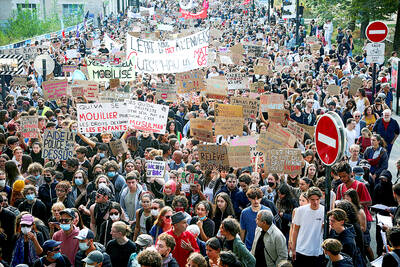
VIOLENT STANDOFFS: The government said 215 students have been injured since the start of the movement last month, including a teenager who lost a hand on Monday Thousands of demonstrators yesterday massed under heavy police surveillance in Paris and cities across France, as unions and teachers joined high-school students who for days have been demanding better conditions in protests punctuated by violent clashes. Students have blocked the entrances to hundreds of high schools for 15-to-17-year-olds since late last month, complaining of missing teachers, overloaded schedules, dilapidated classrooms and buildings that cannot cope with rising temperatures. In the Paris suburb of Creteil, where the protests started last month, students piled barriers outside the Saint-Exupery high school. “We are here to make our voice heard, all too often forgotten,” student Abderrahmane Abdelkader

As shark attack survivor Mel Ismail fought the predator that severed his leg, he noticed something odd. “I saw its eye ... a big black eye,” Ismail said. “But it was winking back at me — I was trying to get my fingers in its eye and just pushing its eye as I was being dragged.” When the shark swam off, he managed to struggle back to shore, the surfer and professional firefighter said in an Australian Broadcasting Corp interview broadcast on Thursday. He was surfing at Glenfield Beach near Geraldton on Australia’s west coast when he was attacked on Sept. 14. He
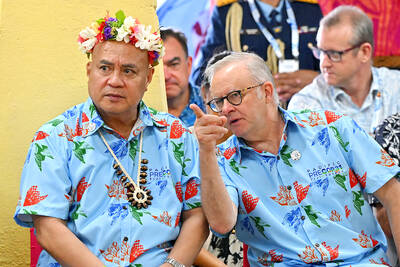
A Tuvalu government adviser yesterday said it felt like Australia had “taken over” the tiny country’s sovereignty during a visit by leaders to the Pacific island. The official — a senior government adviser who asked to remain anonymous because they were not authorized to speak to the media — said they were disappointed in Australia’s handling of the visit. The comments came during a visit by Australian Prime Minister Anthony Albanese and other leaders to Tuvalu, which has become a symbol of the existential threat posed by rising seas and is a key partner in Canberra’s Pacific strategy. “Just because we signed the
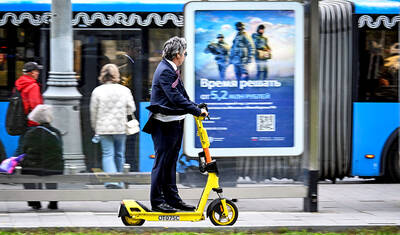
Halfway around the world from Russia, in a Caribbean tourism hot spot, men young and old are being lured by Moscow with tantalizing job offers, only to find themselves en route to the front lines in Ukraine. Moscow and Kyiv have recruited thousands of foreign nationals into their armies since Russia launched its invasion of Ukraine in 2022. Moscow is accused, in some cases, of using fake job ads to hoodwink men from deprived backgrounds in Africa, Asia and Latin America into traveling to Russia and then forcing them to fight on arrival. From countries such as India, Kenya, Equatorial Guinea, Colombia and


 RSS
RSS