


Polls opened yesterday in Romania’s presidential election, as the country struggles with a severe recession and the political turmoil following the government’s fall in the middle of last month.
This is the first election of a head of state since Romania entered the EU in January 2007.
More than 18 million people out of the population of 21.5 million are listed to vote in more than 21,400 polling stations around the country. Three hundred have also been opened abroad, especially in Italy and Spain, where there are strong communities of Romanian immigrants.
The polls were due to close at 7pm GMT.
Twelve candidates are running for the presidential office, but the center-right Romanian President Traian Basescu and his Social Democrat rival Mircea Geoana are most likely to face each other in the run-off, due on Dec. 6, polls showed.
Basescu, a former sea captain aged 58, in office since 2004, and Geoana, 51, an ambassador to the US in the late 1990s and foreign affairs minister between 2000 and 2004, are both likely to garner between 30 percent and 33 percent of the votes in the first round.
Basescu insists on “modernizing the state” and “eliminating the privileges of certain categories” in the coming years, while his rival is proposing a “vigorous anti crisis plan.”
Romania’s economy is expected to shrink by 8 percent this year.
A third installment of a 20 billion euro (US$29.7 billion) aid package by the IMF, the EU and the World Bank has been postponed until a new government is formed to replace the one led by former Romanian prime minister Emil Boc, which fell last month.
Along with the presidential vote, Romania is also holding a national referendum to decide if it should reduce the number of lawmakers from the current 471 to 300, in a unicameral chamber.
Several NGOs contested the organization of this referendum called by the incumbent president the same day as the presidential election, saying it was affecting the equality of chances between candidates.
As many Romanians claim disillusionment with their politicians, turnout could be less then 50 percent.
Since the fall of communist dictator Nicolae Ceausescu 20 years ago, participation never ceased to drop in Romania, from 86 percent in 1990 to 58.93 percent in the last presidential election in 2004.
In Romania, a lot of people feel they are forced to vote “for the less bad candidate” at every election, historian Neagu Djevara said in an interview with the daily newspaper Evenimentul Zilei.

SPEAKING OUT: After Siranudh Scott’s allegations surfaced, celebrities and public figures took to social media to share their own experiences of sexual misconduct and abuse A high-profile alleged sexual abuse case within a wealthy Thai beer brewing family has prompted a wave of painful accounts from survivors of unconnected abuse in the conservative nation. Siranudh Scott, a member of the billionaire Thai family that founded the ubiquitous Singha beer brand, posted an emotional video this month accusing his elder brother Sunit of repeatedly abusing him when he was a teenager. Sunit, who is in his 30s, later denied the allegations in a video posted online, but Singha parent Boonrawd dismissed him from his executive role with the company on Tuesday last week. “I felt I needed to speak

A Hong Kong astronaut is to join a Chinese space mission for the first time as part of a three-person crew launching today, as Beijing edges closer to its goal of landing people on the moon. The Tiangong space station — crewed by teams of three astronauts that are typically rotated every six months — is the crown jewel of China’s space program, boosted by billions in state investment in a bid to catch up with the US and Russia. The Shenzhou-23 mission is to blast off at 11:08pm from the Jiuquan Satellite Launch Center in northwestern China, carrying three astronauts to
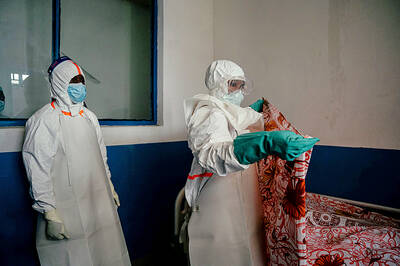
UPGRADED ALERT: The risk inside DR Congo is now considered ‘very high,’ while neighboring countries face a ‘high’ threat as the outbreak continues, the WHO said Ebola is spreading faster than responders can track it in eastern Congo, where health workers managed to follow up with barely one in five identified contacts in a single day. Authorities in the Democratic Republic of the Congo (DR Congo) reported 83 confirmed infections, 746 suspected cases and 1,603 identified contacts as of Thursday, but health workers were able to follow up on only 342 contacts that day — about 21 percent of the total under monitoring — data released by the DR Congo Ministry of Public Health on Friday showed. The figures suggest the response is falling behind the outbreak itself,

SEEKING ORDER: Rodrigo Paz said that ‘anyone who wants to destroy the nation will have to deal with this president and the full force of the constitution’ Bolivian President Rodrigo Paz on Wednesday said that the nation was at a “breaking point” after nearly a month of protests that have caused shortages of food, fuel and medicine. Paz, who took office six months ago amid the worst economic crisis there in four decades, is battling a groundswell of fury over his policies. The political capital, La Paz, has been besieged by low-income workers and members of the indigenous majority calling for his resignation. “The country needs order and is reaching breaking point,” the 58-year-old said at a public event in La Paz, renewing his appeal for dialogue. On Tuesday, the Bolivian


 RSS
RSS