


US President Barack Obama will attend a memorial service in Fort Hood tomorrow to honor victims of the shooting rampage in which 13 people died, the White House said.
Investigators were meanwhile working around the clock to uncover what triggered the shooting, which also wounded 30 people.
Major Nidal Malik Hasan, suspected in the killings that also wounded 30 people.

PHOTO: REUTERS
“All evidence at this point indicates the suspect allegedly acted alone,” Chris Grey, spokesman for the US Army criminal investigation division (CID), told reporters on Saturday, adding that no motive had yet been established.
Criminal investigators were poring over evidence to determine if the alleged shooter — Army doctor Major Nidal Malik Hasan — was motivated by Islamist ideology or had snapped under the pressure of his job counseling soldiers traumatized by combat.
An initial search of Hasan’s computer revealed no direct exchanges with known extremists, but US Army and FBI officials had yet to rule out possible links to terrorist groups, US media reported.
In retrospect, the signs of Hasan’s growing anger over the US wars in Iraq and Afghanistan seem unmistakable. But even people who worried his increasingly strident views were clouding his ability to serve the US military could not predict the rampage he stands accused of.
In the months leading to Thursday’s shooting spree, Hasan raised eyebrows with comments that the war on terror was “a war on Islam” and wrestled with what to tell fellow Muslim solders who had their doubts about fighting in Islamic countries.
“The system is not doing what it’s supposed to do,” said Val Finnell, who complained to administrators at a military university about what he considered Hasan’s “anti-American” rants. “He at least should have been confronted about these beliefs, told to cease and desist, and to shape up or ship out.”
Finnell studied with Hasan in 2007 and last year in the master’s program in public health at the military’s Uniformed Services University of the Health Sciences in Bethesda, Maryland, where Hasan persistently complained about perceived anti-Muslim sentiment in the military and injected his politics into courses where they had no place.
“In retrospect, I’m not surprised he did it,” Finnell said of the shootings. “I had real questions about what his priorities were, what his beliefs were.”
Hasan remains in intensive care but breathing on his own late on Saturday at an Army hospital in San Antonio, Texas. Officials refused to say if he was talking to investigators.
At least 17 victims remain hospitalized with gunshot wounds, and nine were in intensive care.
Military investigators continue to refer to Hasan as the only suspect in the shootings but won’t say when charges would be filed. He likely would face military justice rather than federal criminal charges if investigators determine the violence was the work of just one person.
Hasan’s family described a man incapable of the attack, calling him a devoted doctor and devout Muslim who showed no signs that he might lash out.
Still, a picture has emerged of a man who was forcefully opposed to the wars in Iraq and Afghanistan, was trying to elude his pending deployment to Afghanistan and had struggled professionally in his work as an Army psychiatrist.
“I told him, ‘There’s something wrong with you,’” Osman Danquah, co-founder of the Islamic Community of Greater Killeen, said on Saturday. “I didn’t get the feeling he was talking for himself, but something just didn’t seem right.”
Danquah assumed the military’s chain of command knew about Hasan’s doubts.
Others, however, recalled a pleasant neighbor, while a superior officer at Darnall Army Medical Center at Fort Hood, Colorado, Kimberly Kesling, has said Hasan was quiet with a strong work ethic who provided excellent care for his patients.
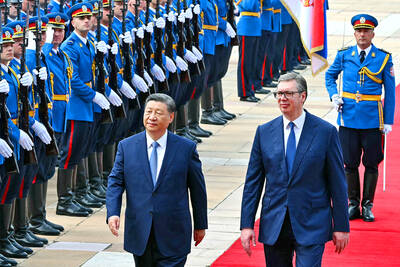
MONEY MATTERS: Xi was to highlight projects such as a new high-speed railway between Belgrade and Budapest, as Serbia is entirely open to Chinese trade and investment Serbian President Aleksandar Vucic yesterday said that “Taiwan is China” as he made a speech welcoming Chinese President Xi Jinping (習近平) to Belgrade, state broadcaster Radio Television of Serbia (RTS) said. “We have a clear and simple position regarding Chinese territorial integrity,” he told a crowd outside the government offices while Xi applauded him. “Yes, Taiwan is China.” Xi landed in Belgrade on Tuesday night on the second leg of his European tour, and was greeted by Vucic and most government ministers. Xi had just completed a two-day trip to France, where he held talks with French President Emmanuel Macron as the

With the midday sun blazing, an experimental orange and white F-16 fighter jet launched with a familiar roar that is a hallmark of US airpower, but the aerial combat that followed was unlike any other: This F-16 was controlled by artificial intelligence (AI), not a human pilot, and riding in the front seat was US Secretary of the Air Force Frank Kendall. AI marks one of the biggest advances in military aviation since the introduction of stealth in the early 1990s, and the US Air Force has aggressively leaned in. Even though the technology is not fully developed, the service is planning
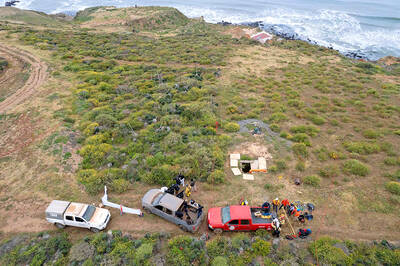
INTERNATIONAL PROBE: Australian and US authorities were helping coordinate the investigation of the case, which follows the 2015 murder of Australian surfers in Mexico Three bodies were found in Mexico’s Baja California state, the FBI said on Friday, days after two Australians and an American went missing during a surfing trip in an area hit by cartel violence. Authorities used a pulley system to hoist what appeared to be lifeless bodies covered in mud from a shaft on a cliff high above the Pacific. “We confirm there were three individuals found deceased in Santo Tomas, Baja California,” a statement from the FBI’s office in San Diego, California, said without providing the identities of the victims. Australian brothers Jake and Callum Robinson and their American friend Jack Carter
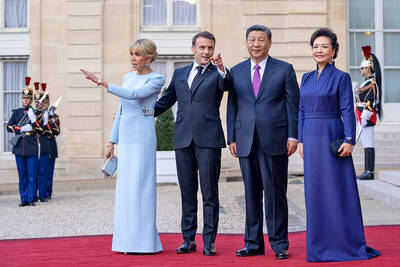
CUSTOMS DUTIES: France’s cognac industry was closely watching the talks, fearing that an anti-dumping investigation opened by China is retaliation for trade tensions French President Emmanuel Macron yesterday hosted Chinese President Xi Jinping (習近平) at one of his beloved childhood haunts in the Pyrenees, seeking to press a message to Beijing not to support Russia’s war against Ukraine and to accept fairer trade. The first day of Xi’s state visit to France, his first to Europe since 2019, saw respectful, but sometimes robust exchanges between the two men during a succession of talks on Monday. Macron, joined initially by EU Commission President Ursula von der Leyen, urged Xi not to allow the export of any technology that could be used by Russia in its invasion


 RSS
RSS