


Tibetan spiritual leader the Dalai Lama said yesterday he was surprised at China’s protest against his planned visit to an area of India claimed by Beijing, hinting he backed India on the border issue.
The Dalai Lama also criticized China’s one-party rule and its state-controlled media, while praising India’s “successful” democracy.
The Buddhist monk, who arrived in Tokyo on Friday for a week-long stay in Japan ahead of a Nov. 8 visit to Arunachal Pradesh state in the northeast of India where China and India fought a border war in 1962.
“I was surprised” at China’s criticism of the planned visit, the Dalai Lama told reporters when asked about the motive behind his trip.
“Because in [19]62, the People’s Liberation Army already reached that area, already occupied ... then India sort of pushed them back. The Chinese government unilaterally [made] ceasefire, withdrawal,” he said. “So what’s the problem?”
The Dalai Lama added that Beijing was overpoliticizing his travels, saying his decisions on where to go were spiritual in nature, not political.
He said the Chinese government saw him as a “troublemaker” and had read too much political meaning into his frequent travels abroad.
“The Chinese government considers me a troublemaker, so it is my duty to create more trouble,” he quipped. “The Chinese government politicizes too much wherever I go. Where I go is not political.”
The Dalai Lama, who fled to India in 1959 after China crushed an anti-Chinese uprising in Tibet, is viewed as a “splittist” by Beijing, although he says he wants autonomy rather than full independence for his Himalayan homeland.
China has said it is “firmly opposed” to the Dalai Lama’s trip to Arunachal Pradesh.
“One reason why India is successful in democracy is ... that [for] more than 2000 years India [has had] this strong tradition to respect different views,” the Dalai Lama said, stressing the importance of respecting different religions and the views of non-believers.
In September he visited Taiwan, his third trip there, to bless the survivors of Typhoon Morakot, which left at least 700 people dead after it hit the country on Aug 8. He visited disaster areas in southern Taiwan, comforted survivors and held a prayer meeting for typhoon victims attended by 15,000 people, according to his official Web site.
He also criticized China’s one-party state and lack of media freedom.
“People in China [have] no free information, too much sensation. And their own newspaper, media — all their information is one-sided propaganda,” he said.
The Dalai Lama called on the foreign media to visit China to “find the reality” in the western regions of Tibet and Xinjiang, home to the Tibetan and Uighur ethnic minorities respectively.
Deadly unrest broke out in Tibet in March last year and July this year in Xinjiang as part of long-standing friction between China’s majority Han population and ethnic minorities.

Four contenders are squaring up to succeed Antonio Guterres as secretary-general of the UN, which faces unprecedented global instability, wars and its own crushing budget crisis. Chile’s Michelle Bachelet, Argentina’s Rafael Grossi, Costa Rica’s Rebeca Grynspan and Senegal’s Macky Sall are each to face grillings by 193 member states and non-governmental organizations for three hours today and tomorrow. It is only the second time the UN has held a public question-and-answer, a format created in 2016 to boost transparency. Ultimately the five permanent members of the UN’s top body, the Security Council, hold the power, wielding vetoes over who leads the
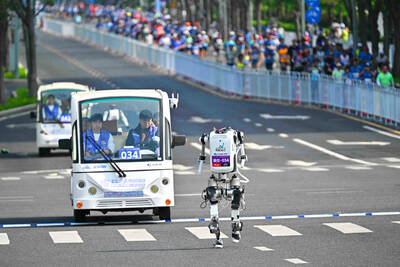
A humanoid robot that won a half-marathon race for robots in Beijing on Sunday ran faster than the human world record in a show of China’s technological leaps. The winner from Honor, a Chinese smartphone maker, completed the 21km race in 50 minutes and 26 seconds, said a WeChat post by the Beijing Economic-Technological Development Area, also known as Beijing E-Town, where the race began. That was faster than the human world record holder, Ugandan Jacob Kiplimo, who finished the same distance in about 57 minutes in March at the Lisbon road race. The performance by the robot marked a significant step forward
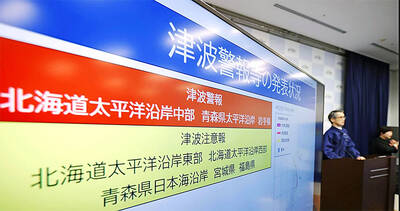
An earthquake registering a preliminary magnitude of 7.7 off northern Japan on Monday prompted a short-lived tsunami alert and the advisory of a higher risk of a possible mega-quake for coastal areas there. The Cabinet Office and the Japan Meteorological Agency said there was a 1% chance for a mega-quake, compared to a 0.1% chance during normal times, in the next week or so following the powerful quake near the Chishima and Japan trenches. Officials said the advisory was not a quake prediction but urged residents in 182 towns along the northeastern coasts to raise their preparedness while continuing their daily lives. Prime
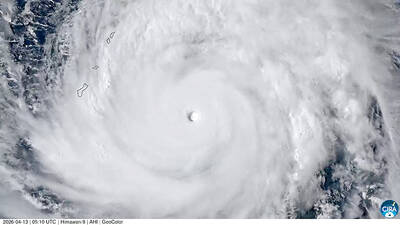
HAZARDOUS CONDITION: The typhoon’s sheer size, with winds extending 443km from its center, slowed down the ability of responders to help communities, an official said The US Coast Guard was searching for six people after losing contact with their disabled boat off the coast of Guam following Typhoon Sinlaku. The crew of the 44m dry cargo vessel, the US-registered Mariana, on Wednesday notified the coast guard that the boat had lost its starboard engine and needed assistance, Petty Officer 3rd Class Avery Tibbets said yesterday. The coast guard set up a one-hour communication schedule with the vessel, but lost contact on Thursday. A Coast Guard HC-130 Hercules aircraft was launched to search for the six people on board, but it had to return to Guam because of


 RSS
RSS