


Indonesia does not intend to resume sharing bird flu samples with other countries until there is a global mechanism for virus sharing in place, the newly appointed health minister said yesterday.
Indonesia, which has suffered the most confirmed deaths from the H5N1 bird flu virus, has been holding out for guarantees from richer nations and drug makers that poor countries will get access to affordable vaccines derived from their samples.
But the move has drawn global concern, since experts say it is vital to have access to samples of the constantly mutating virus.
“It depends on the international treaty result regarding the standard material transfer agreement, I will closely monitor this,” Indonesian Health Minister Endang Rahayu Sedyaningsih said.
The WHO’s more than 190 member states have been holding negotiations on virus sharing, but a sticking point has been how and when biological samples of viruses would be shared with the world’s pharmaceutical companies, who need them to make vaccines, an issue known as “material transfer.”
Jakarta wants a material transfer agreement for each sample of the virus sent to foreign labs, specifying it will be used only for diagnostic purposes and not for commercial gain.
The health minister also said there were no plans to reopen a US Naval laboratory operating in Indonesia, but biomedical research with the US would take place instead under a civilian-to-civilian program.
The US Naval Medical Research Unit No. 2, or NAMRU-2 for short, was central to Indonesia’s early efforts to track H5N1. It was one of the few labs globally capable of the genetic analysis needed to identify H5N1 at the beginning of the epidemic.
The lab had been in Indonesia since 1970 and is one of five in the world.
Its future became politicized after some Indonesian officials said its operations were not transparent.
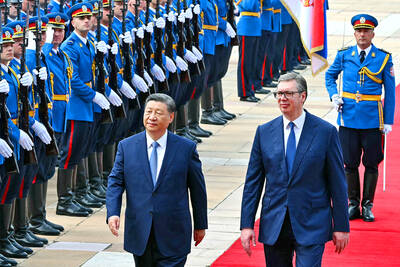
MONEY MATTERS: Xi was to highlight projects such as a new high-speed railway between Belgrade and Budapest, as Serbia is entirely open to Chinese trade and investment Serbian President Aleksandar Vucic yesterday said that “Taiwan is China” as he made a speech welcoming Chinese President Xi Jinping (習近平) to Belgrade, state broadcaster Radio Television of Serbia (RTS) said. “We have a clear and simple position regarding Chinese territorial integrity,” he told a crowd outside the government offices while Xi applauded him. “Yes, Taiwan is China.” Xi landed in Belgrade on Tuesday night on the second leg of his European tour, and was greeted by Vucic and most government ministers. Xi had just completed a two-day trip to France, where he held talks with French President Emmanuel Macron as the

With the midday sun blazing, an experimental orange and white F-16 fighter jet launched with a familiar roar that is a hallmark of US airpower, but the aerial combat that followed was unlike any other: This F-16 was controlled by artificial intelligence (AI), not a human pilot, and riding in the front seat was US Secretary of the Air Force Frank Kendall. AI marks one of the biggest advances in military aviation since the introduction of stealth in the early 1990s, and the US Air Force has aggressively leaned in. Even though the technology is not fully developed, the service is planning
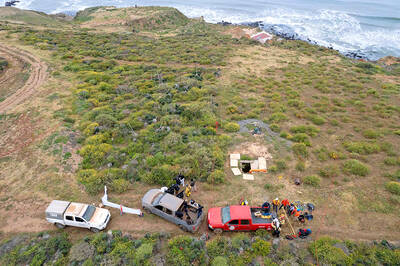
INTERNATIONAL PROBE: Australian and US authorities were helping coordinate the investigation of the case, which follows the 2015 murder of Australian surfers in Mexico Three bodies were found in Mexico’s Baja California state, the FBI said on Friday, days after two Australians and an American went missing during a surfing trip in an area hit by cartel violence. Authorities used a pulley system to hoist what appeared to be lifeless bodies covered in mud from a shaft on a cliff high above the Pacific. “We confirm there were three individuals found deceased in Santo Tomas, Baja California,” a statement from the FBI’s office in San Diego, California, said without providing the identities of the victims. Australian brothers Jake and Callum Robinson and their American friend Jack Carter
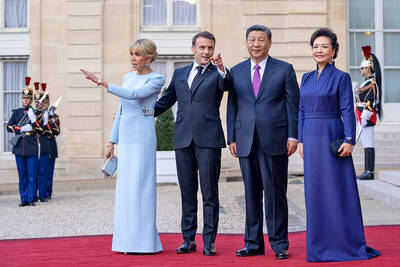
CUSTOMS DUTIES: France’s cognac industry was closely watching the talks, fearing that an anti-dumping investigation opened by China is retaliation for trade tensions French President Emmanuel Macron yesterday hosted Chinese President Xi Jinping (習近平) at one of his beloved childhood haunts in the Pyrenees, seeking to press a message to Beijing not to support Russia’s war against Ukraine and to accept fairer trade. The first day of Xi’s state visit to France, his first to Europe since 2019, saw respectful, but sometimes robust exchanges between the two men during a succession of talks on Monday. Macron, joined initially by EU Commission President Ursula von der Leyen, urged Xi not to allow the export of any technology that could be used by Russia in its invasion


 RSS
RSS