


An “exceptional” collection of dinosaur footprints that could be the biggest ever recorded has been found by two amateur enthusiasts on an expedition near France’s Jura mountains, paleontologists said on Tuesday.
Prints up to 2m in diameter and recurring over a large area have been uncovered near the village of Plagne in eastern France, 48km west of Geneva, the National Center of Scientific Research said.
The center said the significance of the prints could not be overestimated.
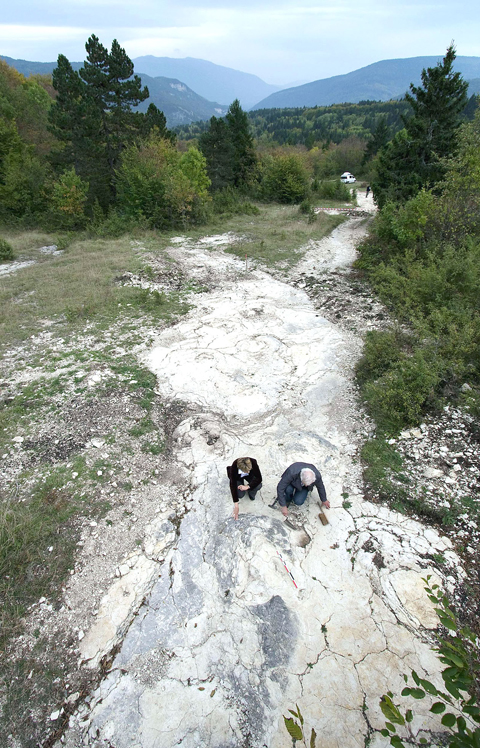
PHOTO: REUTERS
“According to the researchers’ initial work, these tracks are the biggest ever seen,” it said.
Pierre Hantzpergue, a paleontologist at the University of Lyon, who verified the prints with a colleague at the research center, said the perfectly preserved tracks could make Plagne one of the most significant dinosaur locations in the world.
“What is remarkable about this site ... is firstly the sheer size of the footprints. They are really enormous. This is new. Some very big footprints have been found in the US, but I don’t think they are as big as these,” he said.
The site’s other — equally important — aspect was the geographical spread. The research center said they were formed “over dozens if not hundreds of meters.”
“These are very large distances,” Hantzpergue said. “We’ve seen tracks of maybe 50 meters in France, around 100 meters in Switzerland, and the world record is in Portugal ... with about 150 meters. Now, we still have many hectares to search, but we will undoubtedly have more than 150 meters at Plagne — the biggest that is known in the world.”
The prints are believed to have been left by sauropods, herbivorous giants that roamed the region about 150 million years ago. They appear to have been preserved by a thick layer of limestone sediment dating from the late Jurassic period, the geological era named after the Jura mountains, which lie to the north of the tracks. The footprints are believed to have emerged after top soil eroded.
Despite the region’s reputation for paleontological discoveries, this latest and probably most spectacular find was left to amateurs from the local town of Oyonnax, near Geneva, to stumble upon.
Marie-Helene Marcaud, a teacher, and Patrice Landry, a geologist, uncovered the tracks on April 5 during one of their regular expeditions with the Naturalists’ Society of Oyonnax. Amazed by their find, they contacted Hantzpergue and Jean-Michel Mazin at the National Center of Scientific Research to confirm their authenticity.
A string of discoveries in the ancient landscape of the Franco-Swiss border has allowed scientists to piece together the history of biodiversity over the past 200 million years.
In 2004 thousands of footprints, of dinosaurs and other creatures including marine crocodiles and mammoths, were revealed on the Swiss side of the border when a motorway project began. On the French side, sauropod tracks were found at Coisia in 2004, and on the floor of the Loulle quarry in 2006.

PARLIAMENT CHAOS: Police forcibly removed Brazilian Deputy Glauber Braga after he called the legislation part of a ‘coup offensive’ and occupied the speaker’s chair Brazil’s lower house of Congress early yesterday approved a bill that could slash former Brazilian president Jair Bolsonaro’s prison sentence for plotting a coup, after efforts by a lawmaker to disrupt the proceedings sparked chaos in parliament. Bolsonaro has been serving a 27-year term since last month after his conviction for a scheme to stop Brazilian President Luiz Inacio Lula da Silva from taking office after the 2022 election. Lawmakers had been discussing a bill that would significantly reduce sentences for several crimes, including attempting a coup d’etat — opening up the prospect that Bolsonaro, 70, could have his sentence cut to

China yesterday held a low-key memorial ceremony for the 1937 Nanjing Massacre, with Chinese President Xi Jinping (習近平) not attending, despite a diplomatic crisis between Beijing and Tokyo over Taiwan. Beijing has raged at Tokyo since Japanese Prime Minister Sanae Takaichi last month said that a hypothetical Chinese attack on Taiwan could trigger a military response from Japan. China and Japan have long sparred over their painful history. China consistently reminds its people of the 1937 Nanjing Massacre, in which it says Japanese troops killed 300,000 people in what was then its capital. A post-World War II Allied tribunal put the death toll

‘UNWAVERING ALLIANCE’: The US Department of State said that China’s actions during military drills with Russia were not conducive to regional peace and stability The US on Tuesday criticized China over alleged radar deployments against Japanese military aircraft during a training exercise last week, while Tokyo and Seoul yesterday scrambled jets after Chinese and Russian military aircraft conducted joint patrols near the two countries. The incidents came after Japanese Prime Minister Sanae Takaichi triggered a dispute with Beijing last month with her remarks on how Tokyo might react to a hypothetical Chinese attack on Taiwan. “China’s actions are not conducive to regional peace and stability,” a US Department of State spokesperson said late on Tuesday, referring to the radar incident. “The US-Japan alliance is stronger and more

FALLEN: The nine soldiers who were killed while carrying out combat and engineering tasks in Russia were given the title of Hero of the Democratic People’s Republic of Korea North Korean leader Kim Jong-un attended a welcoming ceremony for an army engineering unit that had returned home after carrying out duties in Russia, North Korean state media KCNA reported on Saturday. In a speech carried by KCNA, Kim praised officers and soldiers of the 528th Regiment of Engineers of the Korean People’s Army (KPA) for “heroic” conduct and “mass heroism” in fulfilling orders issued by the ruling Workers’ Party of Korea during a 120-day overseas deployment. Video footage released by North Korea showed uniformed soldiers disembarking from an aircraft, Kim hugging a soldier seated in a wheelchair, and soldiers and officials


 RSS
RSS