

An earthquake survivor trapped in a collapsed hotel in western Indonesia sent a text message saying he and some others were alive, triggering a frantic rescue operation, but hopes faded yesterday as sniffer dogs failed to detect life.
Padang’s police chief said voices and claps were heard from survivors buried in the Ambacang Hotel since the 7.6-magnitude quake struck on Wednesday, killing at least 715 people. He said one survivor — who had been staying in Room 338 — sent a text message to relatives Friday, saying he and some others were still alive.
“We estimate there are still eight people trapped alive under Ambacang Hotel,” Colonel Boy Rafli Amar told reporters. “We are still trying hard to evacuate them.”
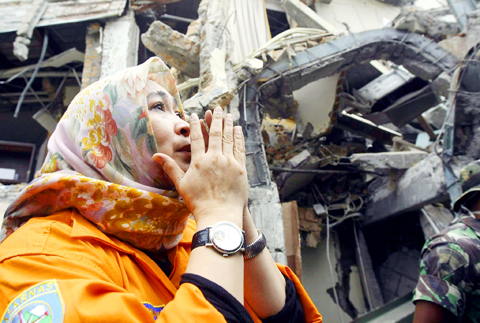
PHOTO: EPA
After more than six hours of searching, Amar said: “So far, rescuers have found nothing.”
As he spoke, rescuers used backhoes and drills to try and break a passage through thick slabs of concrete of the six-story hotel.
Hidehiro Murase, the head of a Japanese search dog team, said its search had been fruitless.
“We did an extensive search this morning, but there were no signs of life. Our dogs are trained to smell for living people, not the dead, and they didn’t sense anything,” he said.
Six Swiss rescuers entered the rubble through a hole but came out minutes later.
“I haven’t seen any sign of bodies yet, but the stench filling the air is very strong,” said one of them, Villa Stefano, wiping sweat and dust from his face.
The quake devastated more than 100km along the western coast of Sumatra island, prompting a huge international aid operation in a country that sits on a major geological fault zone and has dozens of quakes every year.
The UN estimated the death toll could rise to 1,100.
More than 20,000 houses and buildings were destroyed and 2,400 people hospitalized across seven district, said Priyadi Kardono, a spokesman for the national disaster agency.
Block after block of toppled hotels, hospitals, office buildings and schools had yet to be searched in Padang, a port city of 900,000. Dozens of unclaimed corpses were laid out in the scorching sun at Dr M. Djamil General Hospital, Padang’s biggest, which was damaged in the quake.
Eric van Druten, a 31-year-old Australian surfer, said several of his friends were staying at the Ambacang and another hotel. He said he ran toward the swimming pool when the earthquake began to shake the building.
“But the wall collapsed, so we had to get out. There is still a heap of people in the pool,” he said.
In remoter areas outside Padang the full scale of the disaster was only starting to become clear, with villages wiped out and survivors drinking coconut water after their drinking sources were contaminated.
“In my village, 75 people were buried. There are about 300 people missing from this whole area. We need tents and excavators to get the bodies but the roads are cut off,” said Ogi Martapela, 28, who said his older brother died in the landslide.
Another resident said it was too late for aid.
“Don’t bother trying to bring aid up there,” said Afiwardi, who pointed past a landslide that cut off a road. “Everyone is dead.”
The aid effort appeared to be cranking up yesterday, but it has yet to reach many areas.
“We have not received a thing. We need food, clothes, blankets, milk. It seems like the government has forgotten about us,” said Siti Armaini, sitting outside her collapsed home in Pariaman, about 40km north of Padang and nearer to the quake’s epicenter.
The mayor of the badly hit district of Padang Pariaman said by telephone that heavy digging machinery was starting to reach some areas hit by landslides, but that survivors desperately needed tents and blankets after losing their homes.
“We are devastated. Eighty percent of houses have caved in, roads are split and cracked,”Mayor Muslim Kasim said.
Testos, an Indonesian Red Cross worker at an aid station in central Padang, said they now had around half what was needed.
“We also need drinking water and clothes because many peoples clothes were burnt in fires,” he said. “We also need medicines to stop infection.”
Fuel was being rationed amid a power outage, water and food were in short supply and villagers dug out the dead with their bare hands.
As the scale of the destruction became clearer, Indonesian Vice President Jusuf Kalla told reporters in the capital, Jakarta, that the recovery operation would cost at least US$400 million.
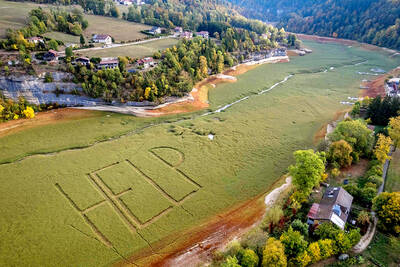
The picturesque Lac des Brenets between France and Switzerland has dried up after a record-breaking hot summer, leaving locals crying out for help to save the lake. Indeed, the words “HELP” and “SOS” have been scratched out in the weeds now flourishing on the exposed lake bed. The drought has ruined pleasure boat tourism, while some question whether the lake will ever return to enduring full health. “It’s absolutely heartbreaking,” said historian David Favre, who lives in Les Brenets. “As children, we used to spend all our summers swimming at the beach, having fun by the water, diving, jumping in and sometimes even
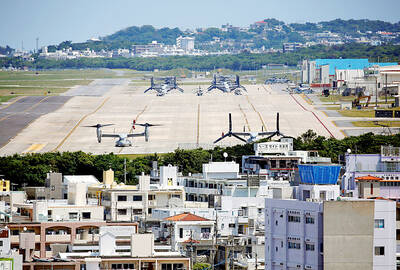
STRAIN ON TIES: The police arrested a 20-year-old man who matched the description of a suspect caught on CCTV leaving a hotel in Naha with the victim’s belongings A US Marine stationed on Japan’s southern island of Okinawa was arrested on suspicion of the murder of a Japanese woman, police said yesterday. The suspect “killed the 39-year-old woman at a hotel in Naha and stole her wallet on Saturday,” a local police spokesman said. US Ambassador George Glass posted on social media that he had spoken with Japan’s foreign ministry and Okinawa’s governor to offer “our sincere condolences and pledging full cooperation as the investigation continues.” Japanese Prime Minister Sanae Takaichi called the crime “exceptionally brutal and vicious” on X. The government has urged the US “to provide maximum cooperation

A US lawmaker has called on Starbucks to close its first stores in Xinjiang, China, calling it a “morally bankrupt decision” to do business in a region where Uighurs face repression. China denies widespread accusations about abuses of the Uighurs, a mainly Muslim people, saying its policies there were aimed at combating terrorism, separatism and religious extremism. Starbucks opened its first two stores this week in Xinjiang’s capital, Urumqi, including one at the city centre’s grand bazaar and a second at its international airport. John Moolenaar, chairman of the Select Committee on China of the House of Representatives, called on Starbucks to “immediately

WARNING: Some analysts have expressed concern over what kind of investors the citizenship scheme would attract, saying it could bring in people of dubious origin Argentine President Javier Milei’s government on Friday said the country would offer citizenship to foreigners who invest at least US$350,000 in the country. Latin America’s third-largest economy lagged far behind Brazil and Mexico in the foreign direct investment stakes last year, according to the Organisation for Economic Co-operation and Development (OECD). Milei, a free-market radical, has slashed public spending, deregulated the economy and dismantled trade barriers in a bid to make Argentina more competitive and boost the Treasury’s dwindling dollar reserves. However, investors are still waiting for Argentina’s roller-coaster economy to “prove that what it’s doing will actually be sustainable over time,” economist


 RSS
RSS