


Major allegations of fraud in Afghanistan’s presidential election have topped 550, more than doubling the last figure reported by the commission investigating accusations, officials said yesterday.
The spike in allegations is a strong indicator of how pervasive ballot box stuffing and voter intimidation may have been during the country’s Aug. 20 vote, and could threaten the legitimacy of the election.
Partial, preliminary results have been released in small batches over the last few days, but results will not be made official until major fraud allegations are investigated.
Results so far show Afghan President Hamid Karzai leading with 46.2 percent of the votes and top challenger Abdullah Abdullah with 31.4 percent. The count is based on votes from 35 percent of the country’s polling stations. Karzai will need to reach 50 percent to avoid a two-person run-off.
The independent Electoral Complaints Commission has received more than 2,000 allegations of fraud and intimidation on voting day or during the counting of ballots, said Nellika Little, a spokeswoman for the group.
Of those, 567 have been deemed serious enough to affect the poll’s outcome if proved true, Little said. On Friday, the commission had reported 270 major allegations. It still is evaluating complaints, so the figure could rise further.
The investigations of fraud could greatly delay final results, which are already not expected until the middle of next month at the earliest.
The delay could create a power vacuum in Afghanistan or foment violence by supporters of Abdullah if they feel they have been cheated.
The fraud allegations have raised concerns about whether Afghans will accept the certified results when they are finally released.
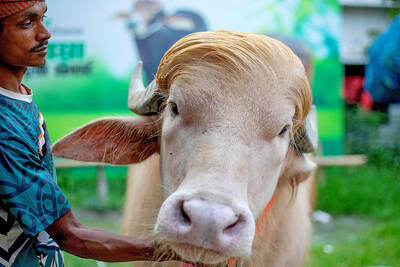
Crowds in Bangladesh are flocking to snap photographs with an unlikely social media star — an albino buffalo with flowing blond hair nicknamed “Donald Trump” that is due to be sacrificed within days. Owner Zia Uddin Mridha, 38, said his brother named the 700kg bull over its flowing helmet of hair resembling the signature look of the US president. “My younger brother picked this name because of the buffalo’s extraordinary hair,” he said at his farm in Narayanganj, just outside the capital, Dhaka. Mridha said that a constant stream of curious visitors — social media fans, onlookers and children — have come throughout

It began as a satirical online project. Now millions of young people in India are flocking to it as an outlet for their frustration. A parody political party called the Cockroach Janta Party, with the insect as its symbol, has exploded across India’s social media by turning absurdist humor into protest. Memes and short videos mocking corruption, joblessness and political dysfunction have flooded social media sites, where millions of users are embracing the cockroach — known for its ability to survive harsh conditions — as a tongue-in-cheek symbol of endurance. The online movement’s rise has been unusually rapid. The Cockroach Janta Party (CJP)
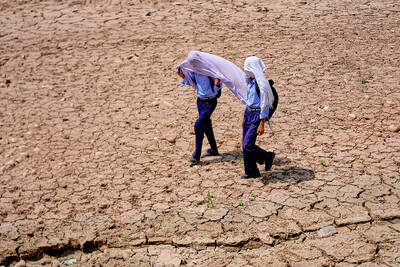
HOTTER: While Indians are accustomed to summer heat, climate change has caused northwestern India to warm faster than other parts of the country, an academic said Roads and markets have emptied during afternoons and some farmers have switched to nighttime work to avoid scorching temperatures as a heat wave grips large parts of India. The India Meteorological Department forecast maximum temperatures for yesterday of about 45°C in the capital, New Delhi, where authorities have opened temporary “cooling zones” to help people cope. The weather department warned that conditions would likely persist across several northern regions in the coming days, with temperatures staying well above seasonal averages. Authorities urged people to stay indoors during the hottest hours and take precautions against heat-related illnesses. India declares a heat wave whenever maximum temperatures
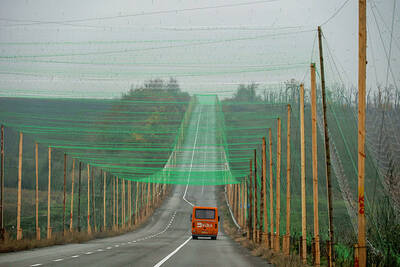
BIGGER ROLE: Beijing has said it maintains an impartial stance on the war in Ukraine, but by training Russian troops, China is far more involved than previously known China’s armed forces secretly trained about 200 Russian military personnel in China late last year, and some have since returned to fight in Ukraine, according to three European intelligence agencies and documents seen by Reuters. While China and Russia have held a number of joint military exercises since Moscow’s full-scale invasion of Ukraine in 2022, Beijing has repeatedly said that it is neutral in the conflict and presents itself as a peace mediator. The covert training sessions, which predominantly focused on the use of drones, were outlined in a dual-language Russian-Chinese agreement signed by senior Russian and Chinese officers in Beijing on


 RSS
RSS