


UN Secretary-General Ban Ki-moon faced a barrage of criticism on Friday for apparently praising the Burmese junta without winning any concessions over human rights or a move toward democracy.
Ban was under pressure to produce concrete results from his two-day mission to Burma, which was criticized as providing an endorsement to the Burmese leadership just as it is staging a trial of opposition leader Aung San Suu Kyi.
The high-stakes visit to Burma comes at a critical time for Ban, whose low-key approach to his job has been criticized as ineffectual.
He came under further fire on arrival in Naypyidaw, the regime’s headquarters, when he told the head of the junta, General Than Shwe: “I appreciate your commitment to moving your country forward.”
“That is absolute nonsense,” said Brad Adams, a Burma specialist at Human Rights Watch. “It’s just what we implored him not to say, to make these diplomatic gaffes. Than Shwe has steadily moved his country backwards.”
British officials were also furious at the remarks. They had urged Ban not to visit Burma and risk handing the junta a propaganda prize without ensuring he would gain concessions in the form of the release of political prisoners and steps toward genuine democracy.
“Only agreement to release all political prisoners [and] start a genuine dialogue with the opposition and ethnic groups will give any credibility to the elections in 2010,” British Prime Minister Gordon Brown said in an article in the US online magazine the Huffington Post.
According to his office at No. 10 Dowing Street, London, Brown calls Ban at least twice a week to discuss Burma.
“I hope that Ban Ki-moon can convince the generals to take the first steps,” Brown said. “A serious offer is on the table: The international community will work with Burma if the generals are prepared to embark on a genuine transition to democracy. But if the Burmese regime refuses to engage, the international community must be prepared to respond robustly.”
However, Than Shwe said little at his meeting with Ban and did not grant the secretary-general’s request to meet Aung San Suu Kyi in prison. Ban expressed hope that a meeting could still be permitted.
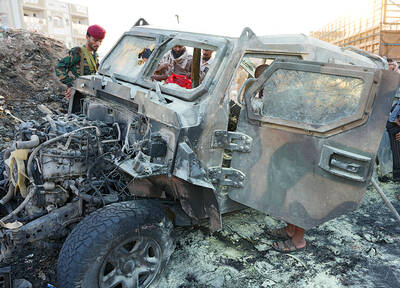
‘TERRORIST ATTACK’: The convoy of Brigadier General Hamdi Shukri resulted in the ‘martyrdom of five of our armed forces,’ the Presidential Leadership Council said A blast targeting the convoy of a Saudi Arabian-backed armed group killed five in Yemen’s southern city of Aden and injured the commander of the government-allied unit, officials said on Wednesday. “The treacherous terrorist attack targeting the convoy of Brigadier General Hamdi Shukri, commander of the Second Giants Brigade, resulted in the martyrdom of five of our armed forces heroes and the injury of three others,” Yemen’s Saudi Arabia-backed Presidential Leadership Council said in a statement published by Yemeni news agency Saba. A security source told reporters that a car bomb on the side of the road in the Ja’awla area in
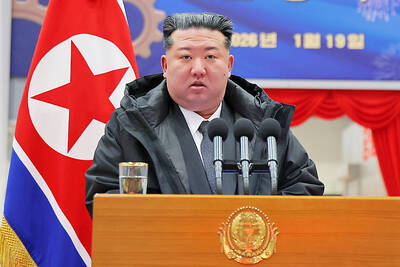
‘SHOCK TACTIC’: The dismissal of Yang mirrors past cases such as Jang Song-thaek, Kim’s uncle, who was executed after being accused of plotting to overthrow his nephew North Korean leader Kim Jong-un has fired his vice premier, compared him to a goat and railed against “incompetent” officials, state media reported yesterday, in a rare and very public broadside against apparatchiks at the opening of a critical factory. Vice Premier Yang Sung-ho was sacked “on the spot,” the state-run Korean Central News Agency said, in a speech in which Kim attacked “irresponsible, rude and incompetent leading officials.” “Please, comrade vice premier, resign by yourself when you can do it on your own before it is too late,” Kim reportedly said. “He is ineligible for an important duty. Put simply, it was
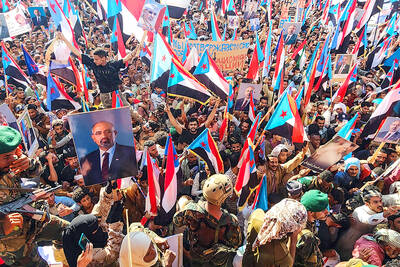
Yemen’s separatist leader has vowed to keep working for an independent state in the country’s south, in his first social media post since he disappeared earlier this month after his group briefly seized swathes of territory. Aidarous al-Zubaidi’s United Arab Emirates (UAE)-backed Southern Transitional Council (STC) forces last month captured two Yemeni provinces in an offensive that was rolled back by Saudi strikes and Riyadh’s allied forces on the ground. Al-Zubaidi then disappeared after he failed to board a flight to Riyadh for talks earlier this month, with Saudi Arabia accusing him of fleeing to Abu Dhabi, while supporters insisted he was
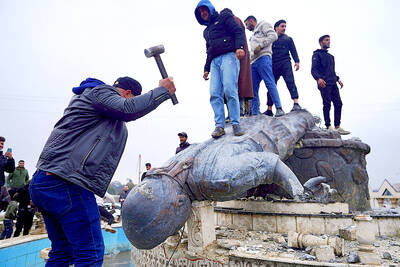
Syrian President Ahmed al-Sharaa on Sunday announced a deal with the chief of Kurdish-led forces that includes a ceasefire, after government troops advanced across Kurdish-held areas of the country’s north and east. Syrian Kurdish leader Mazloum Abdi said he had agreed to the deal to avoid a broader war. He made the decision after deadly clashes in the Syrian city of Raqa on Sunday between Kurdish-led forces and local fighters loyal to Damascus, and fighting this month between the Kurds and government forces. The agreement would also see the Kurdish administration and forces integrate into the state after months of stalled negotiations on


 RSS
RSS