


Coral reefs will disappear from the Coral Triangle by the end of this century unless effective action is taken on climate change, a study released yesterday said.
The Coral Triangle, considered the world’s richest marine environment, spans the coasts, reefs and seas of Indonesia, the Philippines, Malaysia, Papua New Guinea, the Solomon Islands and East Timor.
The study, commissioned by the World Wildlife Fund for Nature (WWF), said the destruction of the Coral Triangle would reduce the ability of coastal environments to feed people by 80 percent and result in the livelihoods of around 100 million people being lost or badly affected.
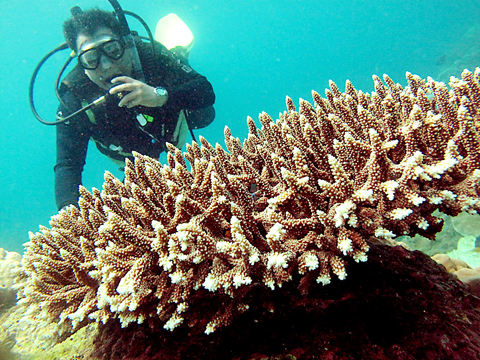
PHOTO: EPA
Such a scenario would be prevented if global action on climate change is taken and the problems of over-fishing and pollution in the region are tackled, the study presented at the World Ocean Conference in Indonesia said.
“In one world scenario, we continue along our current climate trajectory and do little to protect coastal environments from the onslaught of local threats,” Ove Hoegh-Guldberg, who led the study, was quoted as saying in a statement released by the WWF.
In this scenario, people see the biological treasures of the Coral Triangle destroyed over the course of the century by rapid increases in ocean temperature, acidity and sea level, Hoegh-Guldberg said.
“Poverty increases, food security plummets, economies suffer and coastal people migrate increasingly to urban areas,” he said.
The WWF said the Coral Triangle includes 30 percent of the world’s coral reefs, 76 percent of its reef building coral species and more than 35 percent of its coral reef fish species, as well as vital spawning grounds for other economically important fish such as tuna. It sustains the lives of more than 100 million people.
Building a strong Coral Triangle in which economic growth, food security and natural environments are maintained could prevent the worst-case scenario, the report said.
Significant reductions in greenhouse gas emissions must be backed up by international investment in strengthening the region’s natural environments, it said.
More than 5,000 climatologists, ocean experts, government representatives and environmentalists from 80 nations were discussing the effects of climate change on the world’s oceans at the conference.
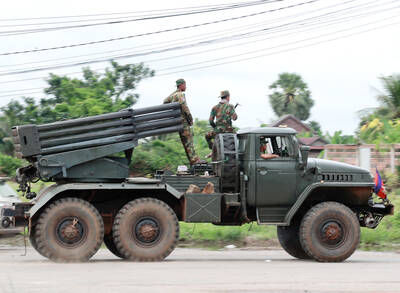
POLITICAL PATRIARCHS: Recent clashes between Thailand and Cambodia are driven by an escalating feud between rival political families, analysts say The dispute over Thailand and Cambodia’s contested border, which dates back more than a century to disagreements over colonial-era maps, has broken into conflict before. However, the most recent clashes, which erupted on Thursday, have been fueled by another factor: a bitter feud between two powerful political patriarchs. Cambodian Senate President and former prime minister Hun Sen, 72, and former Thai prime minister Thaksin Shinawatra, 76, were once such close friends that they reportedly called one another brothers. Hun Sen has, over the years, supported Thaksin’s family during their long-running power struggle with Thailand’s military. Thaksin and his sister Yingluck stayed
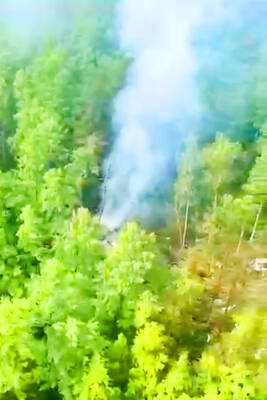
FOREST SITE: A rescue helicopter spotted the burning fuselage of the plane in a forested area, with rescue personnel saying they saw no evidence of survivors A passenger plane carrying nearly 50 people crashed yesterday in a remote spot in Russia’s far eastern region of Amur, with no immediate signs of survivors, authorities said. The aircraft, a twin-propeller Antonov-24 operated by Angara Airlines, was headed to the town of Tynda from the city of Blagoveshchensk when it disappeared from radar at about 1pm. A rescue helicopter later spotted the burning fuselage of the plane on a forested mountain slope about 16km from Tynda. Videos published by Russian investigators showed what appeared to be columns of smoke billowing from the wreckage of the plane in a dense, forested area. Rescuers in
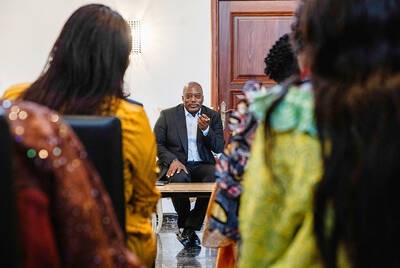
‘ARBITRARY’ CASE: Former DR Congo president Joseph Kabila has maintained his innocence and called the country’s courts an instrument of oppression Former Democratic Republic of the Congo (DR Congo) president Joseph Kabila went on trial in absentia on Friday on charges including treason over alleged support for Rwanda-backed militants, an AFP reporter at the court said. Kabila, who has lived outside the DR Congo for two years, stands accused at a military court of plotting to overthrow the government of Congolese President Felix Tshisekedi — a charge that could yield a death sentence. He also faces charges including homicide, torture and rape linked to the anti-government force M23, the charge sheet said. Other charges include “taking part in an insurrection movement,” “crime against the
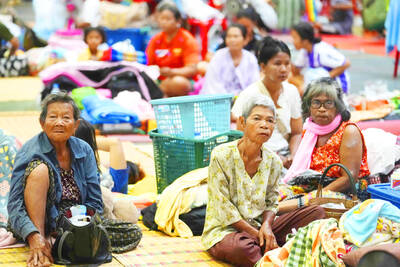
POINTING FINGERS: The two countries have accused each other of firing first, with Bangkok accusing Phnom Penh of targeting civilian infrastructure, including a hospital Thai acting Prime Minister Phumtham Wechayachai yesterday warned that cross-border clashes with Cambodia that have uprooted more than 130,000 people “could develop into war,” as the countries traded deadly strikes for a second day. A long-running border dispute erupted into intense fighting with jets, artillery, tanks and ground troops on Thursday, and the UN Security Council was set to hold an emergency meeting on the crisis yesterday. A steady thump of artillery strikes could be heard from the Cambodian side of the border, where the province of Oddar Meanchey reported that one civilian — a 70-year-old man — had been killed and


 RSS
RSS